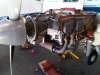
Failure

100% agree here. If I had the slightest doubt that a PPL student couldn't answer basic system questions backwards and forwards and upside down, he wouldn't be getting signed off for a PPL check ride. On a CFI ride? I at a loss for words here.

I have a feeling there's a lot more to this story than simply missing one data point, and I have to question the quality of the rest of your answers, if you couldn't answer something as basic as this.

That said, a CFI check ride isn't about regurgitating basic knowledge, it's about proving to a Fed or DPE that you not only know this stuff, but can teach it.

Is this the end of your career? Absolutely not. Go home, take some time off, collect yourself, and before you go for your next try, find a competent CFI buddy and have him grill the SH$T out of you BEFORE you go for the real thing.
That. Hell, if you want to come to ABQ and are willing to buy me lunch, I'd be happy to play FAA inspector :D
 
The F models have 6s as well. SMOOOTH! :cool:

I wouldn't worry about checkride busts OP. The reality is that it doesn't matter. You'll come across some throughout your career that think it does.

What was drilled and drilled over and over into my brain when getting my CFI was that if a student fails a checkride it's YOUR fault, not the students. YOUR CFI is failing you for not ensuring you're prepared for the checkride. He's pulling the "hail-marry" on you and it's unprofessional, but perhaps they feel you're preparing enough on your own and is trying to open your eyes, but they shouldn't be sending you in for a second failure. For whatever reason, this changes when you go to get a job. It suddenly matters. A little reminder about what I've said above usually clears that up. I only have one failure and that was the flight portion of an intermediate instrument stage check. Never been an issue.

I agree with the student failure being the CFI's fault, but I think that rule stops at the Commercial level. A CFI student is a bit of a "horse of a different color" and I think at that stage you become much more responsible for your own fate.
 
Was he asking about the particular 172 you fly or just 172s in general? I dont see why he would ask that for the CFI unless there were other things he was concerned about.
It sounds like he pulled some sort of Sigmon Freudian mind trick to confirm his suspicions that you might not be ready. Dont sweat it and move on. Third times a charm.
 
I can see that as well, but I still say, and should clarify a bit, that a checkride in which an endorsement is required, the failure rests on the CFI that's doing the endorsement. ATP, type rides, and company check rides are all on the individual.

It can easily become an human factors issue. Which may or may not be the case with the OP. Some check airmen are just "those guys", but an easy way to prepare a student for that is to have another CFI buddy do a mock checkride and be "that guy" to your student.
 
To the OP: How much time did you spend practicing teaching to your instructor? To your aviation friends? To your non-aviation friends?

A person can study, watch videos, make lesson plans, and draw diagrams until they're blue in the face, but if they don't practice *presenting* all their knowledge, they'll have a hard time teaching. Teaching isn't a self-taught activity. You must have feedback from another person.

Honestly, not that much. I mostly "taught myself" my explaining out loud various subjects.

Single shaft that drives the mags?​
Yup. The infamous dual death mag.

I'm not a dumbass after all.:smoke:
 
Honestly, not that much. I mostly "taught myself" my explaining out loud various subjects

I'll agree with jrh here. The absolute best way to learn to teach is to put it into practice with other people. The HUGE benefit here being that you discover how hard it is to actually teach even the simplest concepts. I've discovered this via the years of dance instruction I've given. Sure, it's easy enough to "teach" it to yourself... you already know it, you know what's coming, there is no element of confusion. Do the same thing to people that don't know anything about the topic, and you'll quickly find out how hard it is to explain things.

The big bonus here is that in order to teach these concepts to people, you actually have to become WAY more knowledgeable about the topic at hand to become a top-notch instructor. You need to learn the nitty-gritty details, so that when you present the material, you have far more actual knowledge from which to draw upon to present with. It doesn't mean that you actually USE or TEACH that nitty gritty yet... but you can use it to your advantage in how you present. So now, not only do you become a better teacher... in this particular case, you become a better pilot. This happened with my dancing... once I started teaching, I quickly discovered that I didn't know HALF of what I thought I knew. I had to break things down to very individual movements, notice what was happening with my momentum and how my leading affected my dance partner. Armed with that, my dancing went to a completely new level, I gained a MUCH better appreciate for the dance itself, and my instructing became far more intelligible, clear, and effective.

Can't wait to eventually become a CFI. I'm really looking forward to sharing this passion.
 
Honestly, not that much. I mostly "taught myself" my explaining out loud various subjects.

For what it's worth, when I trained CFIs, I spent about 30 hours doing ground instruction with them. Most of the time was spent having them teach me something, then I'd critique their teaching. I'd point out how to smooth over their explanations, play the role of dumb student and show how their explanations could be confusing or inaccurate, etc.

Granted, I only trained a few CFIs (3 or 4, I think) but none of them had trouble with their orals, even with the feds.

I'm hesitant to throw your instructor under the bus because I don't know his background or how he went about training you, but I don't understand how he could sign off a "self-taught" CFI. Personally, I would never put my name to it. Has he trained CFIs before? Or at least gone to a more structured sort of program for his own CFI training, so he has something to model your training after?

The point I'm getting to, is you might want to consider switching instructors as well. Do both a mock oral and mock flight with them to verify you're ready for your retest.

The last thing you want, after all this work, is to make it through the oral, only to bust again during the flight portion, because your CFI didn't adequately prepare you. I'm not saying you're doomed to this, but it's a possibility to consider.
 
The point I'm getting to, is you might want to consider switching instructors as well. Do both a mock oral and mock flight with them to verify you're ready for your retest.

Considered it.
 
For what it's worth, when I trained CFIs, I spent about 30 hours doing ground instruction with them. Most of the time was spent having them teach me something, then I'd critique their teaching. I'd point out how to smooth over their explanations, play the role of dumb student and show how their explanations could be confusing or inaccurate, etc.

Granted, I only trained a few CFIs (3 or 4, I think) but none of them had trouble with their orals, even with the feds.

I'm hesitant to throw your instructor under the bus because I don't know his background or how he went about training you, but I don't understand how he could sign off a "self-taught" CFI. Personally, I would never put my name to it. Has he trained CFIs before? Or at least gone to a more structured sort of program for his own CFI training, so he has something to model your training after?

The point I'm getting to, is you might want to consider switching instructors as well. Do both a mock oral and mock flight with them to verify you're ready for your retest.

The last thing you want, after all this work, is to make it through the oral, only to bust again during the flight portion, because your CFI didn't adequately prepare you. I'm not saying you're doomed to this, but it's a possibility to consider.


Likewise. The majority of CFI training that I've done was all ground, with the majority of that them teaching me, not the other way around. Further, it doesn't matter if it's a PPL or an MEI, if I'm not 110% sure you're going to pass, I'm not signing you off. I would NEVER sign off a "self taught" student, ESPECIALLY at the CFI level.

None of us here know what your CFI has or has not done for you, but clearly, something isn't working, so as the famous saying goes "doing the same thing over and over, expecting a different result, is the definition of insanity."
 
I kind of agree with you. I should have looked at it and reviewed it. But I also fly 6 types of aircraft.

That's not a good excuse. Really, how different is the GA fleet? And you know what you're taking your checkride in...

What model 172? Some have 4cyl/8 plugs others have 6cyl/12 plugs? Could be powered by a Continental or Lycoming. You could have 160hp 172 powered by an O-320 or IO-360....

It sounds like engines and stuff along those lines might be your weakness. What really helps is to focus on the similarities of the different aircraft you fly. Go look at the engine with the cowl off, buy the mechanic six pack and have him explain some stuff to you.
 
I can explain it, but I can't draw it. ( If that makes any sense)


Well how would you teach it to a student?? 75% of learning is visual, 13% is hearing. If they are only going retain the 13% of your explanation (if they haven't fallen asleep), then I think they will not fully grasp what you are trying to teach. This is when visuals and A&Ps become your best friend!! I don't think enough students get to actually see what is under the cowling.
 

Attachments

  • IMG00197-20100108-1141-1.jpg
    IMG00197-20100108-1141-1.jpg
    315.9 KB · Views: 87
I kind of agree with you. I should have looked at it and reviewed it. But I also fly 6 types of aircraft.

No excuse. Know the aircraft that you're going to be using for a checkride. It's not like there was a possibility of 25 different aircraft, and on the day you show up, is the day you find out which one it is and you'd better know it right then and there. Cease Quibbling.

He said that he sees that I have studied and put a lot of time into it ( I brought 10 books in and 130 pages of lesson plans that I made) but I need to be able to teach and explain things better. And I agree except that he assumes I answer the question wrong if I use diagrams, notes, or books to better explain a subject.

With engine systems there is no way to know everything and be able to explain in detail to a new student without using diagrams or notes.

Like has been alluded to, yes, it's a teaching test. But you have to know the knowledge in order to teach it. And you can't rely solely on notes or cheats to do it. Some things you just have to know.

Wrong choice of words. I guess what I should say is they better understand this checkride is about teaching, and they may let me use my notes/lesson plans/diagrams when explaining complex subjects.

How are you going to explain Airspace to a student? Are you going to just tell him or her about it or use various tools, videos and models to explain it? The DPE didn't like that idea...the FAA should. That is what I meant to say.

Again, some things you have to just know. Not everything is a "classroom". If you have to explain something about airspace while in the air and in the cockpit for some reason, you're not going to have your dry erase board and book of diagrams. Learn some freaking flexibility and how to make do with the cards you're dealt at any given moment. :bang: Not everything is black and white there junior.

Christ......kids of today want every damn thing handed to them on a silver freaking platter.

Seriously....not knowing how many cylinders a 172 engine has? It's not like you were being asked what the spark plug gap was for each cylinder, or being taken to a hangar where there was an O-360 in pieces and you were told to assemble it and get it running in 10 minutes. And it's not like the 172 has an R-4360 engine with 28 cylinders in 4 rows.

Being asked how many cylinders the engine has, is like being asked how many tires are on a 172. Seriously.

So knock off the candyass excuses, the incessant whining and quibbling, the passing of the buck for stuff that you should've known, look up the term "flexibility" in the dictionary and learn how to teach without needing every damn crutch known to man 24/7, hit the books and take it again. It's up to you and only you whether you screw it away again or not.

 
No excuse. Know the aircraft that you're going to be using for a checkride. It's not like there was a possibility of 25 different aircraft, and on the day you show up, is the day you find out which one it is and you'd better know it! Cease Quibbling.


Like has been alluded to, yes, it's a teaching test. But you have to know the knowledge in order to teach it. And you can't rely solely on notes or cheats to do it. Some things you just have to know.


Again, some things you have to just know. Not everything is a "classroom". If you have to explain something about airspace while in the air and in the cockpit for some reason, you're not going to have your dry erase board and book of diagrams. Learn some freaking flexibility and how to make do with the cards you're dealt at any given moment. :bang: Not everything is black and white there junior.

Christ......kids of today want every damn thing handed to them on a silver freaking platter.

Seriously....not knowing how many cylinders a 172 engine has? It's not like you were being asked what the spark plug gap was for each cylinder, or being taken to a hangar where there was an O-360 in pieces and you were told to assemble it and get it running in 10 minutes. And it's not like the 172 has an R-4360 engine with 28 cylinders in 4 rows.

Being asked how many cylinders the engine has, is like being asked how many tires are on a 172. Seriously.

So knock off the candyass excuses, the incessant whining and quibbling, the passing of the buck for stuff that you should've known, look up the term "flexibility" in the dictionary and learn how to teach without needing every damn crutch known to man 24/7, hit the books and take it again. It's up to you and only you whether you screw it away again or not.

I'm getting flashbacks.....
Waiting for the look of disgust....there it is!
*Stand, come to attention and salute*
"Terrible flight Lieutenant. Terrible. But the good news is that you'll make a great missileer. Get out of here."
"Yes sir"
Time to go cry in my popcorn...
 
Seriously....not knowing how many cylinders a 172 engine has? It's not like you were being asked what the spark plug gap was for each cylinder, or being taken to a hangar where there was an O-360 in pieces and you were told to assemble it and get it running in 10 minutes. And it's not like the 172 has an R-4360 engine with 28 cylinders in 4 rows.

Being asked how many cylinders the engine has, is like being asked how many tires are on a 172. Seriously.

So knock off the candyass excuses, the incessant whining and quibbling, the passing of the buck for stuff that you should've known, look up the term "flexibility" in the dictionary and learn how to teach without needing every damn crutch known to man 24/7, hit the books and take it again. It's up to you and only you whether you screw it away again or not.

This caused me to spit my coffee out onto my lap...thanks. :biggrin:

To the OP - Two failures of the CFI ride can probably be explained in an interview as people have already said, but make sure you do as much as possible to make sure this 3rd one goes smooy no matter who you take it with.
 
I'm talking like a basic combustion cycle — suck squeeze bang blow... and then elucidating what parts of the engine basically handle each part of the cycle to move the crankshaft.
......

Answer with the least amount of words. If they ask what does 'X' help determine, you say it determines 'Y'. Nothing more, nothing less. You start asnwering the original question with mroe than what the examiner wants and you may open up another set of questions that were not intended and get tripped up on.
 
Back
Top