UFO Encounters/Stories

A guy I know was/still is 100% convinced they are out there. He claims he was driving on 595 when he saw the mothership land in the median. Give him the chance and he would tell you all about it.

I don't know if this part is true or not but I heard he was telling someone this same story in a bar and managed to let them know he was a pilot too. The guy he was talking to ended up being someone with the FAA and he went after his medical. Like I said I don't know if that part is true or not. He was a good pilot too.
 
I dont necessarily consider "UFO's" aliens or whatever. I think for the most part its secret projects and new aircraft that we just dont know about yet. If that makes me crazy, then so be it.

What about pilots who are Scientologists? They believe in extra terrestrial life... Tom Cruise and John Travolta anyone?
 
A guy I know was/still is 100% convinced they are out there. He claims he was driving on 595 when he saw the mothership land in the median. Give him the chance and he would tell you all about it.

I don't know if this part is true or not but I heard he was telling someone this same story in a bar and managed to let them know he was a pilot too. The guy he was talking to ended up being someone with the FAA and he went after his medical. Like I said I don't know if that part is true or not. He was a good pilot too.

Sorry dude, i didnt mean to. But according to rules and regs, anyone drinking in a bar, who is a pilot, discussing about flying saucers and the like have to be considered crazy. I didnt mean for him to be sent to jupiter, but it's part of our SOP.


Oops...
 
I would refer the above discussion to the "drake equation" (from wikipedia):

The Drake equation states that:
<dl><dd>
847914dec26cc45ac2957da0054683de.png
</dd></dl> where:
<dl><dd>N is the number of civilizations in our galaxy with which communication might be possible;</dd></dl> and
<dl><dd>R<sup>*</sup> is the average rate of star formation in our galaxy</dd><dd>f<sub>p</sub> is the fraction of those stars that have planets</dd><dd>n<sub>e</sub> is the average number of planets that can potentially support life per star that has planets</dd><dd>f<sub>ℓ</sub> is the fraction of the above that actually go on to develop life at some point</dd><dd>f<sub>i</sub> is the fraction of the above that actually go on to develop intelligent life</dd><dd>f<sub>c</sub> is the fraction of civilizations that develop a technology that releases detectable signs of their existence into space</dd><dd>L is the length of time such civilizations release detectable signals into space.</dd></dl>The following was used to speculate about number of planets inhabited in the milky way:

Considerable disagreement on the values of most of these parameters exists, but the values used by Drake and his colleagues in 1961 were:

  • R* = 10/year (10 stars formed per year, on the average over the life of the galaxy)
  • f<sub>p</sub> = 0.5 (half of all stars formed will have planets)
  • n<sub>e</sub> = 2 (stars with planets will have 2 planets capable of supporting life)
  • f<sub>l</sub> = 1 (100% of these planets will develop life)
  • f<sub>i</sub> = 0.01 (1% of which will be intelligent life)
  • f<sub>c</sub> = 0.01 (1% of which will be able to communicate)
  • L = 10,000 years (which will last 10,000 years)
Drake's values give N = 10 × 0.5 × 2 × 1 × 0.01 × 0.01 × 10,000 = 10

for more details: http://en.wikipedia.org/wiki/Drake_equation
 
I don't have a UFO story, but the strangest thing to happen to me was a primary object that wouldn't leave. I never saw it despite many turns, several altitude changes and eventual 360s just trying to see him.
TRACON was baffled too because it was always behind me, shadowing me whichever way I turned.

That was the radar return off of the particulate material in the chemtrail.
 
I saw a red streak fly infront of me the other day. But I am pretty sure it was just a plane from one of the flight schools:buck:
 
I would refer the above discussion to the "drake equation" (from wikipedia):

The Drake equation states that:
<dl><dd>
847914dec26cc45ac2957da0054683de.png
</dd></dl> where:
<dl><dd>N is the number of civilizations in our galaxy with which communication might be possible;</dd></dl> and
<dl><dd>R<sup>*</sup> is the average rate of star formation in our galaxy</dd><dd>f<sub>p</sub> is the fraction of those stars that have planets</dd><dd>n<sub>e</sub> is the average number of planets that can potentially support life per star that has planets</dd><dd>f<sub>ℓ</sub> is the fraction of the above that actually go on to develop life at some point</dd><dd>f<sub>i</sub> is the fraction of the above that actually go on to develop intelligent life</dd><dd>f<sub>c</sub> is the fraction of civilizations that develop a technology that releases detectable signs of their existence into space</dd><dd>L is the length of time such civilizations release detectable signals into space.</dd></dl>The following was used to speculate about number of planets inhabited in the milky way:

Considerable disagreement on the values of most of these parameters exists, but the values used by Drake and his colleagues in 1961 were:

  • R* = 10/year (10 stars formed per year, on the average over the life of the galaxy)
  • f<sub>p</sub> = 0.5 (half of all stars formed will have planets)
  • n<sub>e</sub> = 2 (stars with planets will have 2 planets capable of supporting life)
  • f<sub>l</sub> = 1 (100% of these planets will develop life)
  • f<sub>i</sub> = 0.01 (1% of which will be intelligent life)
  • f<sub>c</sub> = 0.01 (1% of which will be able to communicate)
  • L = 10,000 years (which will last 10,000 years)
Drake's values give N = 10 × 0.5 × 2 × 1 × 0.01 × 0.01 × 10,000 = 10

for more details: http://en.wikipedia.org/wiki/Drake_equation

It doesn't matter if N = 10. They still wouldn't be here, and we still couldn't communicate with them. Even if we knew where they were at.

They probably lie somewhere in the region shown below (the Galactic Habitability Zone):

That region, presuming its a perfectly flat washer shape (which its not, but to make the math easier) is pi*29000ly^2 - pi*23000ly^2 = (2,642,077,190ly^2) - (1,661,901,110ly^2) = (980,176,080ly^2) provided pi = 3.14159, and my calculations with google are working.

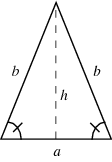
(980,176,080 Square Light Years) within which these civilizations can lie, just for an idea of the scope involved. If these civilizations are spread out equally around a circle with a radius half way through the habitability zone (or at about 26,000 light years from the center of the galaxy) then the calculation for the shortest distance between the a civilization to the left or right is is going to be the unequal side of an isosceles triangle.

IsoscelesTriangle_800.gif


b = 26,000ly, and the angle between h and b is 36degrees. So, a = 2(26,000 sin(36 degrees)) or
[SIZE=+1]30 564.8331LY
[/SIZE]


if I remember elementary geometry and did my google calculations right.

What does this mean? It means that on average, to contact one of the ten civilizations will take on average at least 30,564.833 Years for a one way signal to reach them. The time to send 3 round trip signals (or "Hey, how are you?" then "Good, and you?" and finally "Great, thanks for asking") will take about the same time there have been humans around. On those time scales even the species has ADHD. What this really means is that the chance of the civilization being there by the time we're able to get there, or even be able to send a signal is highly unlikely.

That's not to say that I'm right, or that SETI is a bad idea, but really, the odds are insanely against it. Though, if we get lucky and something is close (<100ly) or we aren't lucky enough to be close, but we're lucky enough to pick up a signal from something far away and extinct, the rewards are worth the cost.


[FONT=Arial, Helvetica, sans-serif]
galactic_habitable_zone.jpg
[/FONT]
 
The odds of life existing elsewhere turns out to be less than a lot of those predictions. There are a few reasons for this. Some are listed here: http://www.damninteresting.com/?p=942 but this did not cover a more interesting set of articles I read a few years ago. I can't find them right now, but they addressed the fact that having a single large moon keeps the Earth's core molten, and rotating that core, giving us the dynamo, so the magnetic fields, and, along with that, our protection against a lot of radiation. It does let some through, and it appears that life needs a small amount to allow the mutations necessary for evolution, but too much and it kills the life. Having that precise combination is a very low probability, and, when factored into the rest, makes the probability of other advanced life forms in our galaxy pretty low.
 
That was my point about the Drake equation: 10 planets out of 100000000000 stars estimated to be in just the milky way (or thereabouts) equals about 0.000000001%

That puts the likelihood of UFO's traipsing around OUR airspace as being rather small. Unless, of course, they are surveying our planet for the need to build an interstellar space bypass.
 
That was my point about the Drake equation: 10 planets out of 100000000000 stars estimated to be in just the milky way (or thereabouts) equals about 0.000000001%

That puts the likelihood of UFO's traipsing around OUR airspace as being rather small. Unless, of course, they are surveying our planet for the need to build an interstellar space bypass.

I realize that, but, unless I missed it, the Drake equation did not factor in the issue of the single large moon and its affect on the Van Allen belts, which directly influence the ability to survive on this planet. When you factor that in, the probability moves several magnitudes lower still.
 
I realize that, but, unless I missed it, the Drake equation did not factor in the issue of the single large moon and its affect on the Van Allen belts, which directly influence the ability to survive on this planet. When you factor that in, the probability moves several magnitudes lower still.


A single large moon is necessary to our type of life because it creates a core which creates radiation belts, but might not be necessary to all life, we don't know.
 
A single large moon is necessary to our type of life because it creates a core which creates radiation belts, but might not be necessary to all life, we don't know.

Well, not entirely true. Radiation is considered to be the most probable source for the mutations that are a required component for evolution, therefore, while you might be able to get life with less or more, the spectrum to get higher forms of life is fairly narrow. Is it possible for other models to occur? Yes, but the probability is VERY low, and, as the probability of having life at all is low, it reduces that probability by quite a bit.
 
I dont necessarily consider "UFO's" aliens or whatever. I think for the most part its secret projects and new aircraft that we just dont know about yet. If that makes me crazy, then so be it.

What about pilots who are Scientologists? They believe in extra terrestrial life... Tom Cruise and John Travolta anyone?

One common thing I notice about UFO reports, is that they tend to be near military bases, in many cases. I too believe that if these type of "crafts" exist, that they are being developed by our government and military, and are being kept top secret.

As per people having medicals yanked for discussing these types of things, and stuff they may have seen. Who gives someone, FAA, or not, the right to judge someone, based on something they may have seen. Does the FAA know for a fact that UFOs don't exist, thus they can, without question, automatically label someone as crazy, and yank their medical, because they claim to have seen one. If so, that is ridiculous. The word UFO means "unidentified flying object". Just because someone says they have seen a UFO, doesn't mean they believe in space aliens, and wear aluminum foil on their head.

As per the ORD incident. Supposedly many pilots, ground crew, and other witness at, and around the airport saw the UFO. The control tower was notified on a few occasions of the so called UFO. Now, suddenly the FAA, United Airlines, etc., all deny any reports of it. That is a bit strange, I must admit, because clearly they were all aware of the sightings.
 
Not all scientists agree . This was on the BBC News website recently:

http://news.bbc.co.uk/2/hi/science/nature/7870562.stm

I'm more inclined to think that there are probably a lot of Alien lifeforms out there. I find it hard to believe that we are particularly special (our star is pretty average). At the moment the exoplanets we are able to detect are all pretty close to their parent stars and orbit rapidly. Their proximity to their stars makes life all but impossible but just a few years ago it was just speculation that other stars had solar systems (although it made sense that they should). Now we know of over 300 exoplanets and have even managed to image one. I think that as our ability to detect exoplanets improved we will find candidates that could possibly harbor life in some shape or form.

I kind of doubt any little green (or grey) men are flying about our skies though.
 
Back
Top