I would refer the above discussion to the "drake equation" (from wikipedia):
The Drake equation states that:
<dl><dd>
</dd></dl> where:
<dl><dd>
N is the number of
civilizations in our galaxy with which communication might be possible;</dd></dl> and
<dl><dd>
R<sup>*</sup> is the average rate of
star formation in
our galaxy</dd><dd>
f<sub>
p</sub> is the fraction of those stars that have
planets</dd><dd>
n<sub>
e</sub> is the average number of planets that can potentially support
life per star that has planets</dd><dd>
f<sub>ℓ</sub> is the fraction of the above that actually go on to develop life at some point</dd><dd>
f<sub>
i</sub> is the fraction of the above that actually go on to develop
intelligent life</dd><dd>
f<sub>
c</sub> is the fraction of civilizations that develop a technology that releases detectable signs of their existence into space</dd><dd>
L is the length of time such civilizations release detectable signals into space.</dd></dl>The following was used to speculate about number of planets inhabited in the milky way:
Considerable disagreement on the values of most of these parameters exists, but the values used by Drake and his colleagues in 1961 were:
- R* = 10/year (10 stars formed per year, on the average over the life of the galaxy)
- f<sub>p</sub> = 0.5 (half of all stars formed will have planets)
- n<sub>e</sub> = 2 (stars with planets will have 2 planets capable of supporting life)
- f<sub>l</sub> = 1 (100% of these planets will develop life)
- f<sub>i</sub> = 0.01 (1% of which will be intelligent life)
- f<sub>c</sub> = 0.01 (1% of which will be able to communicate)
- L = 10,000 years (which will last 10,000 years)
Drake's values give
N = 10 × 0.5 × 2 × 1 × 0.01 × 0.01 × 10,000 = 10
for more details:
http://en.wikipedia.org/wiki/Drake_equation
It doesn't matter if N = 10. They still wouldn't be here, and we still couldn't communicate with them. Even if we knew where they were at.
They probably lie somewhere in the region shown below (the Galactic Habitability Zone):
That region, presuming its a perfectly flat washer shape (which its not, but to make the math easier) is pi*29000ly^2 - pi*23000ly^2 = (2,642,077,190ly^2) - (1,661,901,110ly^2) = (980,176,080ly^2) provided pi = 3.14159, and my calculations with google are working.
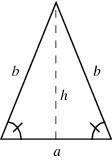
(980,176,080 Square Light Years) within which these civilizations can lie, just for an idea of the scope involved. If these civilizations are spread out equally around a circle with a radius half way through the habitability zone (or at about 26,000 light years from the center of the galaxy) then the calculation for the shortest distance between the a civilization to the left or right is is going to be the unequal side of an isosceles triangle.
b = 26,000ly, and the angle between h and b is 36degrees. So, a = 2(26,000 sin(36 degrees)) or
[SIZE=+1]30 564.8331LY
[/SIZE]
if I remember elementary geometry and did my google calculations right.
What does this mean? It means that on average, to contact one of the ten civilizations will take on average at least 30,564.833 Years for a one way signal to reach them. The time to send 3 round trip signals (or "Hey, how are you?" then "Good, and you?" and finally "Great, thanks for asking") will take about the same time there have been humans around. On those time scales even the species has ADHD. What this really means is that the chance of the civilization being there by the time we're able to get there, or even be able to send a signal is highly unlikely.
That's not to say that I'm right, or that SETI is a bad idea, but really, the odds are insanely against it. Though, if we get lucky and something is close (<100ly) or we aren't lucky enough to be close, but we're lucky enough to pick up a signal from something far away and extinct, the rewards are worth the cost.
[FONT=Arial, Helvetica, sans-serif]
[/FONT]