
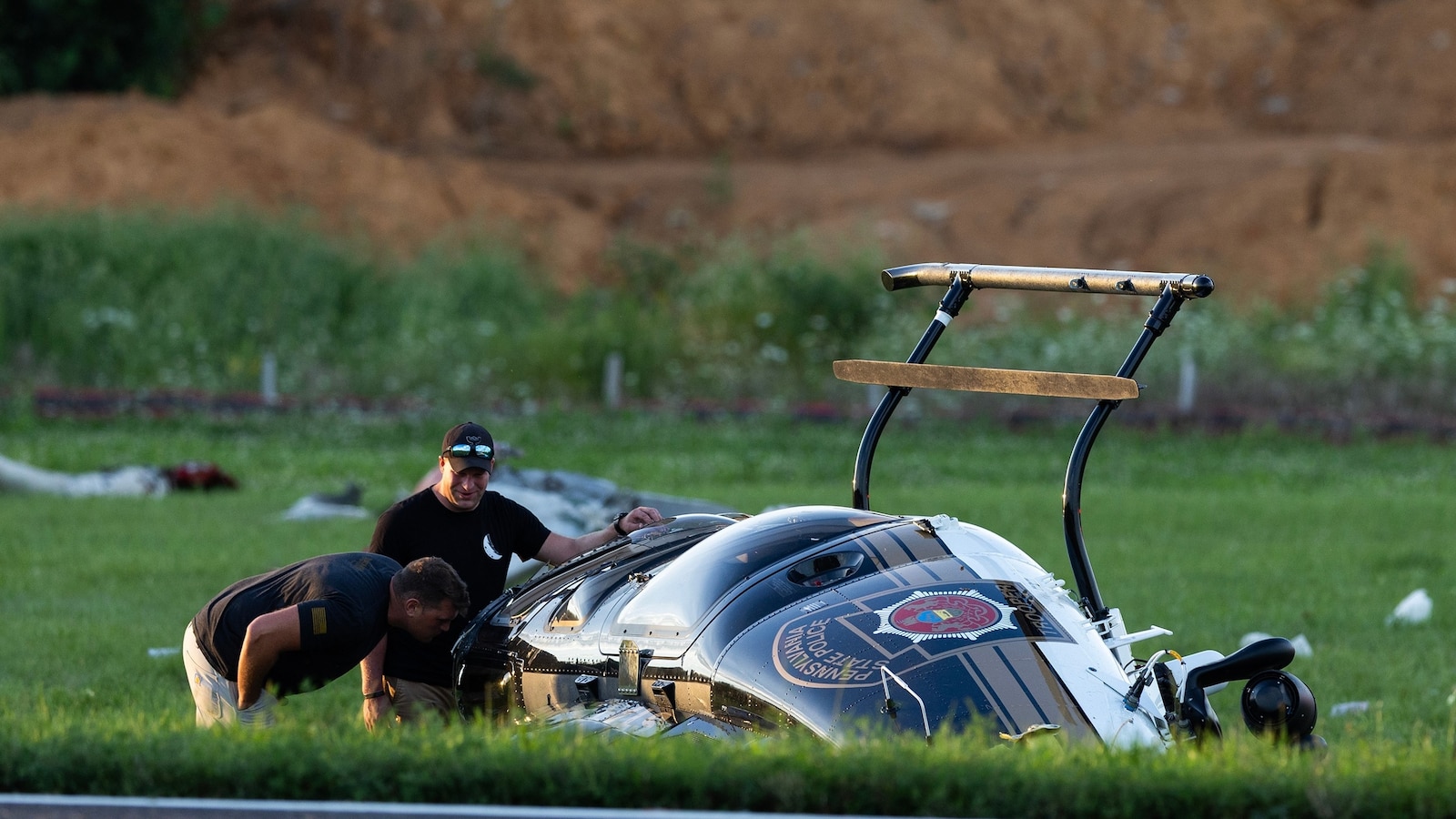
PA State Helo & Cessna 150 Midair

Murdoughnut

Well sized member
Based on comments given during the presser, helo was hovering in a grass area next to the runway when a C150 taking off veered from centerline and hit them from behind. At least one on the Cessna deceased, both helo crew members should recover, fortunately.

Lost all respect I would have otherwise had for Gov. Shapiro, who was all smiles and in a celebratory mode during this press conference, giving verbal high fives to the State Police and making political shout outs while entirely ignoring the fact that the Cessna pilot is deceased.


View: https://www.youtube.com/watch?v=Ymvven1bgZQ
 
I recognize I'm perpetuating online speculation here, but reading about this in other forums I learned something new: I did not realize helicopters produce substantial wake turbulence when hovering / taxiing like seen in the video above. Who knows if that was main cause or even contributing factor in this accident, but something I was blissfully unaware of and has apparently caused GA accidents in the past.
 
I recognize I'm perpetuating online speculation here, but reading about this in other forums I learned something new: I did not realize helicopters produce substantial wake turbulence when hovering / taxiing like seen in the video above. Who knows if that was main cause or even contributing factor in this accident, but something I was blissfully unaware of and has apparently caused GA accidents in the past.

Rotor wash is something to be very aware of just as jet wash is, both as a pilot of a helicopter as well as a pilot of another aircraft. Granted, the amount of it will vary whether a light helicopter or a heavy helicopter. A light helo such as the involved Bell, isn’t going to produce turbulence outflow significant enough to flip an airplane over, but it can blow stuff around such as dust/pebbles etc. By the same token, the induced flow of air coming into the top of a rotor system of a hovering helo means you don’t want to be passing close over the top of one either that is hovering or slow hover taxiing or air taxiing. None of this is to say that any of these factors are factors in this particular accident, it could simply be a case of failure to see and avoid the helo. That should he known in due time.
 
I recognize I'm perpetuating online speculation here, but reading about this in other forums I learned something new: I did not realize helicopters produce substantial wake turbulence when hovering / taxiing like seen in the video above. Who knows if that was main cause or even contributing factor in this accident, but something I was blissfully unaware of and has apparently caused GA accidents in the past.

Worse turbulence I've ever encountered as a pilot was from a Chinook that was ahead of me doing pattern work while I was landing at Dothan one night. It was violent.

Ever since then I've had a deep respect for helicopters and the wake they can produce.

With that said, I'm with Boris: the loss of control doesn't seem to be caused by rotor wash. At least to me it looks like something was going wrong long before it hit the helo.
 
Worse turbulence I've ever encountered as a pilot was from a Chinook that was ahead of me doing pattern work while I was landing at Dothan one night. It was violent.

Ever since then I've had a deep respect for helicopters and the wake they can produce.

With that said, I'm with Boris: the loss of control doesn't seem to be caused by rotor wash. At least to me it looks like something was going wrong long before it hit the helo.

i haven’t seen the video just yet, so i was discussing sidebar about rotor wash generalities. The above is partly why 14 CFR 91.129(f)(2) and 14 CFR 91.126(b)(2), specifying how helos need to avoid the flow of fixed wing traffic in traffic patterns.
 
i haven’t seen the video just yet, so i was discussing sidebar about rotor wash generalities. The above is partly why 14 CFR 91.129(f)(2) and 14 CFR 91.126(b)(2), specifying how helos need to avoid the flow of fixed wing traffic in traffic patterns.
I have observed helos around here crossing midfield perpendicular to the runway at 500 AGL when airplanes are departing / doing touch and gos. I get how that is trying to avoid the traffic pattern. But when the runway is 8000 ft. long, and the takeoff ground roll of a piston single is 1000 ft., it's a direct conflict, at least considering the wake.
 
Isn't the helicopter too close to the runway for another airplane to be operating on said runway?

Not necessarily. Helos can operate in the midfield grass/sod doing low-hover work, or lift to a low hover from same location in preparation for departure. it’s just obviously wise to announce the intentions of doing either. Only restriction is if the infield area is dirt, and doing such low hover work would create severe dust conditions. I’ll often do this if I’m doing hovering autorotation work from a 3 ft hover, or doing slope-landing work on the angled portions of an infield grass area, if there’s no other area on the field to do them. Personally, I try to be perpendicular to the runway/taxiway for visibility purposes of seeing traffic coming from either direction. But this is not always possible, if doing slope work and needing to be parallel to the runway/taxiway at that particular moment. The big thing is not to be doing any high hover work in these areas, as you become a potential hazard to aircraft making touch and go or low approach. Additionally, me personally, when aircraft traffic is about to pass by me if I’m working in an infield area doing low hover work, I try to be on the ground and at flat pitch on 5e main rotor blades, before an aircraft flies by or taxis by, so as to not hit them with rotor wash and/or not blow FOD or dust towards them.

In the video, the helo crew was lucky they were at the low hover height they were, what with the Cessna taking out its entire main rotor system and chopping the tailboom off, and the fuselage falling to the ground like a rock. Not sure why the Cessna appeared to have lost directional control before the impact with the helo.
 
I recognize I'm perpetuating online speculation here, but reading about this in other forums I learned something new: I did not realize helicopters produce substantial wake turbulence when hovering / taxiing like seen in the video above. Who knows if that was main cause or even contributing factor in this accident, but something I was blissfully unaware of and has apparently caused GA accidents in the past.

There’s an older video I used to make my students watch to illustrate this - I can’t get to it at the moment but it’s easy enough to find.

It’s a surveillance video from an airport. A Blackhawk makes a low approach, relatively slow, down a runway.

The following aircraft, a Cirrus, gets flipped over by the wake and crashes. The pilot in the Cirrus walks away but it’s harrowing AF to watch.
 
I’m so • tired of this YouTuber being everywhere and given his commentary as a FSX pilot. I wish we would stop giving him $ for engagement

Step one: Cut a hole in a box.

Wait, that’s for something else.

Step one: Stop clicking on their videos. Engagement (even out of disdain) = $$$ to them. Same goes for Dan Gryder, or any influencer.
 
I mean I typed "plane hits helicopter" into YouTube and that guy came up with the video I requested. I've never seen him before in my life but I think maybe your problem is with YouTube, because I'm not going to spend my time trying to avoid what I'm looking for because it will give clicks to some nerd.
 
Without commenting on this particular incident, over the years, I've learned that military and public operated aircraft (police, fire, rescue, etc) are on their own program. In theory we all operate within the same sphere, but understand that it's more like a Venn diagram, in which our common frames of reference represent only a slice of overlap.

They are going to run their missions the way they've been told to run them. If that happens to coincide with the rules everyone else is running, then cool, but if not, they're not really going to think twice about it. Remember for a lot of these folks, it's a job, and they are focused on that, and besides, they are following the bosses orders. The fraction that may do, or at least been exposed to, part 91 flying may have a wider aperture, but it's entirely ancillary.

As an example, back in the 90s, there was a rash of incidents along the Atlantic coast. Somehow, it had entered unofficial practice (at least to the local units) to use civilian traffic as intercept practice. Hey, they kept their distance, what could possibly be the problem? We can certainly argue the merits of doing so without the consent of all involved, but the gap in knowledge between the two proved to be...troublesome. You see, the military jets were operating with their mode C equipment. What do you get with that mixed with a high rate of closure? You guessed it, a very panicky RA from TCAS that appeared out of no where. Because of the closure rate, the TCAS skipped the "traffic traffic" and went right to the RA, causing considerable angst. Made the press, practice got deleted, and nothing left but some clenched rear ends. The point is that there was a substantial disconnect between the two types of operations.

Operating in or around MOAs & restricted areas, operating from joint use or near military bases, or flying under military ATC you need to understand the above, and if not using a lot of caution, certainly have a heightened level of awareness that their frame of reference may be different from yours.

To be clear, I'm not casting asparagus at anyone, but understand there is friction at the interface.
 
Without commenting on this particular incident, over the years, I've learned that military and public operated aircraft (police, fire, rescue, etc) are on their own program. In theory we all operate within the same sphere, but understand that it's more like a Venn diagram, in which our common frames of reference represent only a slice of overlap.

in theory, so-called public use aircraft, which aren’t under FAA oversight, don’t have to follow any FARs. This is all government aircraft: Mil, NASA, NOAA, FAA, mil, other fed/state/county LE/Fire, etc. And in theory, their crews don’t even have to have a license or medical, and things like no military aircraft has an airworthiness cert. But in practice, they do follow general Part 91, if only to fit in with the rest of air traffic in the airspace system. However, there can be exceptions that they have from 91. A common one is the ability to exceed 250 below 10k, and exceptions to things like external aircraft lighting when in certain airspace or when undertaking certain operations. The military in particular, has their own operating regulations, but if you look at them closely, the basics of those regs generally mirror Part 91 for all routine ops in the national airspace system.

As an example, back in the 90s, there was a rash of incidents along the Atlantic coast. Somehow, it had entered unofficial practice (at least to the local units) to use civilian traffic as intercept practice. Hey, they kept their distance, what could possibly be the problem? We can certainly argue the merits of doing so without the consent of all involved, but the gap in knowledge between the two proved to be...troublesome. You see, the military jets were operating with their mode C equipment. What do you get with that mixed with a high rate of closure? You guessed it, a very panicky RA from TCAS that appeared out of no where. Because of the closure rate, the TCAS skipped the "traffic traffic" and went right to the RA, causing considerable angst. Made the press, practice got deleted, and nothing left but some clenched rear ends. The point is that there was a substantial disconnect between the two types of operations.

Operating in or around MOAs & restricted areas, operating from joint use or near military bases, or flying under military ATC you need to understand the above, and if not using a lot of caution, certainly have a heightened level of awareness that their frame of reference may be different from yours.

To be clear, I'm not casting asparagus at anyone, but understand there is friction at the interface.

The whole practice intercept deal was done at a time when TCAS didn’t exist, rightly or wrongly. As TCAS came online, the problems within now manifested themselves.

Related, and to you point of Special Use Airspace, many years ago, i was working inside a MOA, putting a bird through its paces as i was finishing up an operational check of some systems. As i was accelerating for the beginning of a loop into a cloverleaf maneuver, at 500 knots i began pull to the loop entry, rocketing up in altitude towards the loop apex. Unknown to me, some airliner was crossing high above in cruise at 390 or 400 or something, far outside the top altitude of the MOA airspace, which was capped at 300. The loop apex was going to be around 260 or so before coming back down, but apparently their TCAS saw my Mode C as it instantly transitioned to a 10,000+ fpm climb rate out ahead of them, and duly issued them an RA to them. Of course, the TCAS has no idea that i’m in separate airspace from them, or that i’m capped below a certain altitude far from them, it only seas what it sees, and duly responds. Am not sure if the crew honored the TCAS, what it told them, or really what they could even do maneuver-wise to avoid me had i truly been an actual real conflict; but those are things that can occur, even with everyone doing their own thing properly.
 
in theory, so-called public use aircraft, which aren’t under FAA oversight, don’t have to follow any FARs. This is all government aircraft: Mil, NASA, NOAA, FAA, mil, other fed/state/county LE/Fire, etc. And in theory, their crews don’t even have to have a license or medical, and things like no military aircraft has an airworthiness cert. But in practice, they do follow general Part 91, if only to fit in with the rest of air traffic in the airspace system. However, there can be exceptions that they have from 91. A common one is the ability to exceed 250 below 10k, and exceptions to things like external aircraft lighting when in certain airspace or when undertaking certain operations. The military in particular, has their own operating regulations, but if you look at them closely, the basics of those regs generally mirror Part 91 for all routine ops in the national airspace system.

Exactly my point. In theory and most of the time in practice, they do, but it's not required and if they get pinched by the needs of the mission or the job, they will deviate when necessary. That's where you wind up in the zone of friction.

The crux of it is you wind up in a situation like with one of those bicyclists, who blissfully lock out the world listing to their music, be bopping down the road, standing on their "right" to take up an entire lane of the road. But practically speaking, they get squished by a semi because, well, physics and all.
 
Corpies, Milpies, Helpies, and GArpies.

Please keep them all away from us One Twenty Oneies. At all times.


K, thanks bye.


*except MikeD and that one other helo dude here, I forget his screen name.
 
Back
Top