Medford NJ Helo Crash

To add to @deadstick explanation of the mechanics of an auto, they even differ with different helos and different rotor systems, as it comes to the PE.....or Nr the pilot was able to get 'stored' in the rotor system by the time he's at the end-game of the auto where he has to now use that stored PE in the rotor system to effect a safe touchdown.

You could have an AStar, with a low intertia rotor system with 3 small chord blades, to where you had better have gotten yourself descended in the auto to a nice very low altitude bottom-out and controlled speed, because the second you begin to pull up on that collective to trade in your Nr for cushioning ability upon ground touchdown, the Nr is going to deplete at a fast rate and not leave you much to work with......better have done your setup well and placed yourself in a good position to cash in those limited chips you have, as they're going to go quick.

On the other end of the spectrum, you have helos like the UH-1 Huey, with a high inertia rotor system consisting of its 2 wide chord rotor blades. At the bottom of the auto, there is so much PE with the built up Nr, and it's depletes so slowly when you pull in pitch to cushion, that you can literally autorotate (no engine power) and if done right, can flare to a low hover, and move/reposition the bird around for about 10 seconds or so still in a hover using only the stored leftover PE in the blades, and still have residual Nr left over to make a cushioned landing before the blades slow enough to stop producing lift. It's a sight to see and experience. You could even immediately land, pick back up to a hover, move around a bit, and make a cushioned landing again. You can mess up the entry of the auto by failing to bottom the collective, and so long as you get on it in a timely manner, you can build it back up quick. Other helos like the AStar, Robinson, Hughes......you fail to react quick to an engine failure, and you'll quickly find yourself to where the Nr is too low to be recoverable, and a falling brick is what you will become.
 
Thanks for the explanations. Following up on a few more:

* Hypothetically if the collective is jammed, how are you supposed to get down? The collective allows climb up and down motion, so if that mechanism is jammed, how do you land?

* What happened to the Enstrom where a young lady was training with a CFI, and they literally just fell out of the sky. A rotor spindle caused one portion of the blade to break away? I've seen movies (haha I know they'd never get aviation wrong) where they use rotor blades to hit/kill people or something else and keep flying. Obviously not a real life survivable event? If the Enstrom has 3 blades, and a portion of one breaks off, there is no recovering from this, eg, nothing the other two blades can do to compensate?

* If Nr gets too low, can't you still drop the collective and pitch the nose straight down? Sort of like an airplane with an engine failure that stalls, even though it's stalled, you can still fly it by lowering the AOA and trading your altitude for airspeed as you come down. Can the helo?

* What happened to that one video where there is a heli on a mountainside to rescue people, apparently the wind shifts, the helicopter seems to swing and then turns sideways and the blades hit the ground. What caused something like that, when it was already in a stable hover? How could the pilot have prevented this?

* For most training helicopters, why can't the throttle be linked to act directly to the collective motion? Eg, pull the collective up, you're going uphill in the car so put in more gas. Similarly, if you bring the collective down, take the foot of the gas pedal automatically. They don't do that?
 
I'll try to explain:

1: jammed collective. I'll let someone else familiar with the Hughes go over the EP.

2: no idea about the movie your talking about. The rotor is exactly like a wing. Lose one wing, you know what happens. Same with rotor. Bad day. No passing go.

3: best case you lose rotor RPM, you can get it back with only a few thousand foot drop in altitude, assuming you fall relatively "flat."

4: that incident was a cluster •. I believe it was an AF CSAR Mt hood hoist rescue. They lost rotor RPM because of high altitude aerodynamics. Think high altitude stall. Dropped the rotor, lost lift. Came down. Thankful they crashed in snow, because that saved crew members from being crushed during partial eject.
 
It's not losing the collective that will result in falling like a brick.

I imagine that letting rotor rpm decay is the top cause for rock emulation.

If you lost collective authority and blade pitch went to neutral wouldn't you also drop like a rock, even if throttled up at 100%?
 
Last edited:
Thanks for the explanations. Following up on a few more:

* Hypothetically if the collective is jammed, how are you supposed to get down? The collective allows climb up and down motion, so if that mechanism is jammed, how do you land?

Depends where it's jammed. Assuming it's jammed in a setting you had for cruise or straight/level flight, you would be forced to now treat the helo like an airplane, and find a good piece of pavement or concrete to make a run-on landing, if you are not able to get slowed down and establish a low hover in some way.

* What happened to the Enstrom where a young lady was training with a CFI, and they literally just fell out of the sky. A rotor spindle caused one portion of the blade to break away? I've seen movies (haha I know they'd never get aviation wrong) where they use rotor blades to hit/kill people or something else and keep flying. Obviously not a real life survivable event? If the Enstrom has 3 blades, and a portion of one breaks off, there is no recovering from this, eg, nothing the other two blades can do to compensate?

You lose a blade completely, as in separates from the rotor head, or lose enough of a portion of a blade, and you will cease being able to fly. Much like losing a portion of or a complete wing in an airplane. That said, blades are quite tough in their construction, and have been known to hit small bushes/branches and suffer no more than cosmetic damage, such as some Vietnam LZs where the fit was so tight that Huey crews had to 'make' the helo fit. That said, this concept applies to the main rotor blades, which can generally accept abuse like this that the tail rotor blades cannot due to the fragility of the tail rotor gear box(es) as well as the smaller surface area of the tail rotor blades.

* If Nr gets too low, can't you still drop the collective and pitch the nose straight down? Sort of like an airplane with an engine failure that stalls, even though it's stalled, you can still fly it by lowering the AOA and trading your altitude for airspeed as you come down. Can the helo?

You have to 1. Have the altitude to do so, and 2. Not have allowed the Nr to decay to a point where the rotor system is now so inefficient (coned) that the Nr cannot be recovered. Hence why hovering autos are done from a low hover if at all possible, as losing an engine in a high hover is a very dicey proposition to be able to maintain Nr. In this situation there is next to no aerodynamic assistance in maintaining Nr, unlike having an engine failure in forward flight and entering an auto from there where you have relative wind assisting the rotor system in efficiency.

* What happened to that one video where there is a heli on a mountainside to rescue people, apparently the wind shifts, the helicopter seems to swing and then turns sideways and the blades hit the ground. What caused something like that, when it was already in a stable hover? How could the pilot have prevented this?

That crew was running a tight power margin between power available and power required for a hover at high altitude. Winds affect a rotor system both positively as well as negatively, just like an airplane. And shifting winds, especially hovering near terrain, can be helpful one minute and hurtful the very next instant, especially if you're running close power margins due to weight/altitude. The crew made an approach that didn't work from one direction, went around from that using their established escape route downhill; and came in from another direction which appeared to be working with a small power margin. When that margin got instantly used up.....to where attempting to pull more power would now begin to decay the Nr as there's nothing more that can be demanded from the engines.....the crew again attempted to fly-out using their designated escape, but didn't have enough altitude between themselves and their downhill to do so, as the helicopter began to lose directional control.

* For most training helicopters, why can't the throttle be linked to act directly to the collective motion? Eg, pull the collective up, you're going uphill in the car so put in more gas. Similarly, if you bring the collective down, take the foot of the gas pedal automatically. They don't do that?

That's called automatic governing and is how modern helicopters work. Some older helicopters, mainly piston ones, don't have that feature, and the pilot is the governor. Even with that, if the governing fails, pilots have to know how to fly the aircraft by manual manipulation of the throttle(s) in relation to collective movement, and this differs from helo to helo on how that's done.
 
Last edited:
I imagine that letting rotor rpm decay is the top cause for rock emulation.

If you lost collective authority and blade pitch went to neutral wouldn't you also drop like a rock, even if throttled up at 100%?

If the blades went to neutral (flat pitch) and were jammed there, you would essentially be in the front end of an autorotation, and indeed falling like a rock. You would have no collective authority to cushion a landing on the back end. However if this occurred in forward flight such as cruise, you could now fly it akin to a fixed wing that lost its engine, as you could keep the forward speed up somewhat and maneuver to a run-on landing where you use the cyclic to flare near the end and touchdown with a fair amount of forward motion. Best done on a paved surface if at all possible. If the above happens in hovering flight or very slow flight, you will indeed drop like a rock to the ground and be able to do nothing about it end-game besides impact the ground.
 
you have helos like the UH-1 Huey, with a high inertia rotor system consisting of its 2 wide chord rotor blades. At the bottom of the auto, there is so much PE with the built up Nr, and it's depletes so slowly when you pull in pitch to cushion, that you can literally autorotate (no engine power) and if done right, can flare to a low hover, and move/reposition the bird around for about 10 seconds or so still in a hover using only the stored leftover PE in the blades, and still have residual Nr left over to make a cushioned landing before the blades slow enough to stop producing lift. It's a sight to see and experience.
Many, I among them, owe their life to this!!
 
Both instructors reported that a high-pitched "whine" could be heard from the helicopter during the latter portion of the descent.

If the rotor rpm had slowed to the point that the individual blades were visible, the tail rotor would have slower significantly, too. So, what was the source for the whine? The engine is the only other thing I can think of.
 
If the blades went to neutral (flat pitch) and were jammed there, you would essentially be in the front end of an autorotation, and indeed falling like a rock. You would have no collective authority to cushion a landing on the back end. However if this occurred in forward flight such as cruise, you could now fly it akin to a fixed wing that lost its engine, as you could keep the forward speed up somewhat and maneuver to a run-on landing where you use the cyclic to flare near the end and touchdown with a fair amount of forward motion. Best done on a paved surface if at all possible. If the above happens in hovering flight or very slow flight, you will indeed drop like a rock to the ground and be able to do nothing about it end-game besides impact the ground.
I was thinking about hovering when I wrote my post. I asked the question because I was wondering if the rotor might seek some positive AOA if it found itself unrestrained by collective control.
 
This is a "but for the grace of god" comment and I know ZERO about the accident. I wonder how many have lost their lives with the thought of "maybe we can save the aircraft" or "let's check this out first" rather than say "I'm gonna toast this airframe if I have to and live."
 
Normally yes, but if the blades had slowed dramatically, I wouldn't think it would be "high pitched."

I wonder if it was some sort of catastrophic drivetrain failure, perhaps caused by the engine overspeed? 500 h is not a lot of experience, but the guy just got his CFI earlier this year. It's hard for me to believe he just sat there watching RPM decay
 
I wonder if it was some sort of catastrophic drivetrain failure, perhaps caused by the engine overspeed? 500 h is not a lot of experience, but the guy just got his CFI earlier this year. It's hard for me to believe he just sat there watching RPM decay

At this point, I just have more questions than answers. We don't know the extent of loss of engine control or the corresponding impact on the rotor system. If the rotor speed was out of control due to the engine speed, I cannot see any pilot hovering around waiting for EMS to arrive.

One thing I'll add is that I got my CFI at this place along time ago. The folks who run it are great and run the school right, and they produce well trained pilots with practical as well as theoretical knowledge. Helicoter pilots have to have this kind of training. Things can go sideways really...damn...fast. Your toolbox of experience and knowledge is always open and at the ready. At the low altitudes at which they operate and the "millions of parts flying in close formation," one screw, bolt, belt, cotter pin can result in an unplanned landing -- controller or otherwise. I don't believe for a second that this pilot would have been cut loose without being squared away.
 
At this point, I just have more questions than answers. We don't know the extent of loss of engine control or the corresponding impact on the rotor system. If the rotor speed was out of control due to the engine speed, I cannot see any pilot hovering around waiting for EMS to arrive.

One thing I'll add is that I got my CFI at this place along time ago. The folks who run it are great and run the school right, and they produce well trained pilots with practical as well as theoretical knowledge. Helicoter pilots have to have this kind of training. Things can go sideways really...damn...fast. Your toolbox of experience and knowledge is always open and at the ready. At the low altitudes at which they operate and the "millions of parts flying in close formation," one screw, bolt, belt, cotter pin can result in an unplanned landing -- controller or otherwise. I don't believe for a second that this pilot would have been cut loose without being squared away.
I suspect you know as well as anybody that no matter how well trained or what their background is, some people simply don't respond well to real life emergencies.
 
I'll try to explain:

1: jammed collective. I'll let someone else familiar with the Hughes go over the EP.

2: no idea about the movie your talking about. The rotor is exactly like a wing. Lose one wing, you know what happens. Same with rotor. Bad day. No passing go.

3: best case you lose rotor RPM, you can get it back with only a few thousand foot drop in altitude, assuming you fall relatively "flat."

4: that incident was a cluster . I believe it was an AF CSAR Mt hood hoist rescue. They lost rotor RPM because of high altitude aerodynamics. Think high altitude stall. Dropped the rotor, lost lift. Came down. Thankful they crashed in snow, because that saved crew members from being crushed during partial eject.


The movie is Broken Arrow. The helicopter blades opens a bad guy's chest cavity and keeps on truckin' along.
 
Thank you all and esp @MikeD for the heli responses. I think you already hit the nail on the head for my next question, what if you're a news or police chopper just hovering at 0 knots in one place, say at 1,000AGL (or less) and then the engine fails. Right off the bat sounds like a dicey proposition.

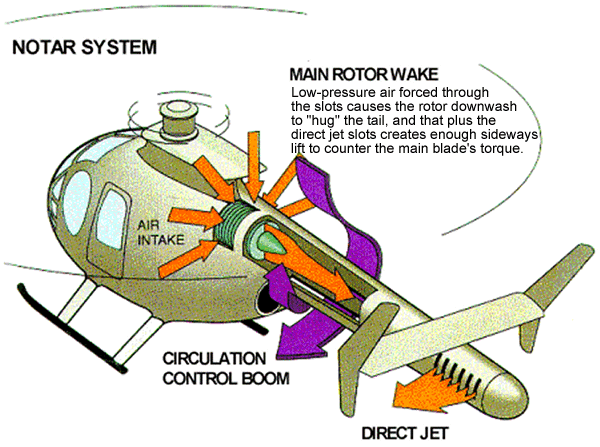
Also, the hospital where my father works has a helipad and occasionally I see a nice blue heli there that has no spinning blade on the back side. Nothing that I can see spinning at all. What kind of setup is this? You need a blade back there to stop the torque-movement opposite direction spinning, right?
 
Also, the hospital where my father works has a helipad and occasionally I see a nice blue heli there that has no spinning blade on the back side. Nothing that I can see spinning at all. What kind of setup is this? You need a blade back there to stop the torque-movement opposite direction spinning, right?

You're probably seeing something that has a fenestron tailrotor instead of the conventional tail rotor. It is still a functional tail rotor, except it is enclosed so it's protected. It provides directional control by operating like a ducted fan.

pilot%20side.jpg
 
Thank you all and esp @MikeD for the heli responses. I think you already hit the nail on the head for my next question, what if you're a news or police chopper just hovering at 0 knots in one place, say at 1,000AGL (or less) and then the engine fails. Right off the bat sounds like a dicey proposition.

Also, the hospital where my father works has a helipad and occasionally I see a nice blue heli there that has no spinning blade on the back side. Nothing that I can see spinning at all. What kind of setup is this? You need a blade back there to stop the torque-movement opposite direction spinning, right?

I'm guessing it's one of these:

AIR_NOTAR_Explanation_lg.gif


PGPD_N520PG.jpeg
 
Back
Top