FAA issues ATIS for MANPADS threat LA area

In general, the warhead on a MANPAD is comparatively pretty small, so I would wager on an airliner it would tear up one engine -- maybe it would separate from the pylon -- but certainly would not blow up the entire aircraft. It might be mortally wounded, it might not.

Or it could ignite a vapor-filled center section tank ....
 
In general, the warhead on a MANPAD is comparatively pretty small, so I would wager on an airliner it would tear up one engine -- maybe it would separate from the pylon -- but certainly would not blow up the entire aircraft.

It might not blow up a plane Die Hard style, but remember that a civilian jet is not built to take any sort of combat damage other than the occasion bird strike, and even those can do some pretty severe damage to the airframe. From what I remember, it was a old Soviet Strela-3 that hit the DHL plane in Baghdad. I'm digging deep from memory, and I'm sure some quick wiki-fu can back this up, but I think the -3 has a 3 pound warhead and hits speeds of about 800mph (for a very short period of time before it runs out of gas). Forget the explosion part, but if a 3 pound block ran into civilian airframe at that speeds it may very well do enough damage (depending on where it hit) to take the thing down. Throw in the potential for a 3 pound shaped charge or frag pattern going off and it's very likely that a civilian jet would not survive the encounter.

This is not something I worry about on the same level as off brand parts being used in critical components of the aircraft and inside the pressure vessel fires, but it is certainly a though in the back of my mind when I fly long flat approaches into say, Philly and BWI.
 
it was a old Soviet Strela-3 that hit the DHL plane in Baghdad.

I understood it to be an SA-7, which is the Strela-2...about one of the least capable (and widely available) MANPADs in circulation.

You point is noted, but let's remember that 3# is about the same size as a single big bird, too. If you look at the actual damage to the DHL wing, while significant, it was nowhere near destroying the entire aircraft, or even 1/4 of it.
 
I understood it to be an SA-7, which is the Strela-2...about one of the least capable (and widely available) MANPADs in circulation.

You point is noted, but let's remember that 3# is about the same size as a single big bird, too. If you look at the actual damage to the DHL wing, while significant, it was nowhere near destroying the entire aircraft, or even 1/4 of it.

From everything I was told it probably wasn't a direct hit. They think it was proximity detonated and most of the blast actually missed the aircraft.

Also, yes, a bird can certainly weigh 3 pounds but it's not solid. There is lots of air and collapsible material. Think, the difference between a chicken and a brick hitting your windshield. From what I know of warheads, which isn't much, they are pretty dense, more like a brick than a chicken.
 
brings a whole new meaning to the concept of bio-warfare, MAN-portable chickens - what would the chaff/ECMs be to counter those?
 
I agree it was probably a prox fuze -- many missile 'hits' are, even from many of the more capable (and more precisely guided) SAMs. You're right that if it is a direct hit, that much mass can do a lot of damage.

In the weeks following 9/11, when my squadron was flying CAPs over Washington DC, we received many briefings from smart weaponeers (guys from Raytheon who'd actually designed and built the missiles) about how to shoot down an airliner. It was a significant point of discussion that an AIM-9 (an IR-guided missile of similar size physically and a larger warhead than most MANPADs) was, at most, going to take off an engine and potentially do some damage to the wing.

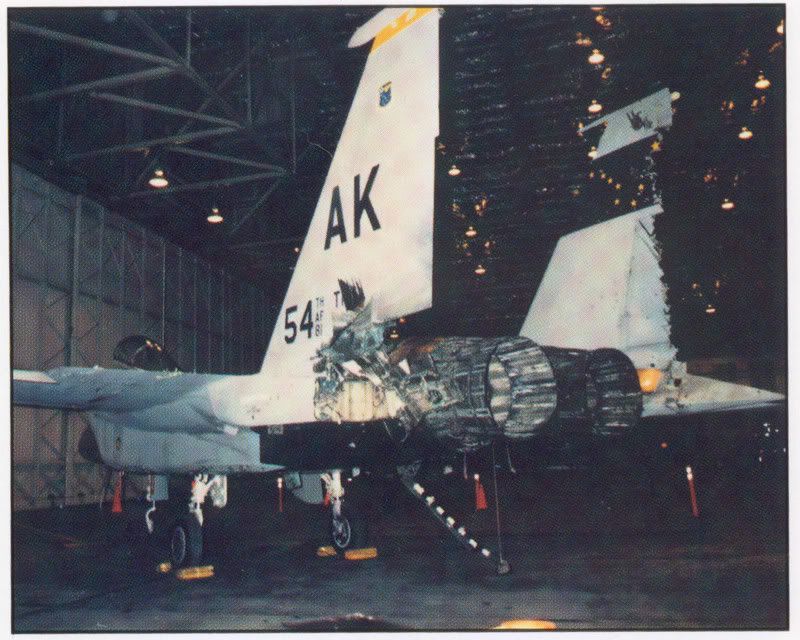
Here's a photo of an F-15C that was hit by an AIM-9 erroneously shot by his wingman. Note that the AIM-9 didn't even hit the actual heat source (the engine burner can), and notice how the "frag" of the exploding warhead tore up the trailing edge of the vertical stab. The left horizontal was likely where the missile actually struck, and it took off the stab, but notice the distinct lack of damage to anything else (including the fuselage or the wing directly in front of it. There's nothing magical about how the F-15 is built, either, that makes this kind of damage atypical.

foxtwoyourflightleadx.jpg


Bottom line, this is the damage from a missile that is "more capable" than a MANPAD.

I agree that a direct hit in a critical spot on an airliner could be devastating, but there's just as much of a chance that it would be damage that would allow that airliner to limp back to a landing (as was seen with the DHL) and not just simply disintegrate in flight.
 
FWIW, when I was in the army, I learned to use the stinger in about 10 minutes. It's a "tab a into slot b" kind of deal. Wait for the seeker to screech, super elevate the launcher and let 'Er loose. Of course there are a few button pushes in there, but ther are all in the launcher grip.

It does take practice to be good of course....
 
Gotta ask, what happened to the wingman who squeezed that one off?

Not sure, actually. It happened in 1990. In 1995 or so I heard about it when I was a Maintenance Officer via weapons safety channels -- those types of safety reports don't include anything about "professional" actions taken against the people involved in the incident.

What was told to us at Maintenance Officer School was that the only regulatory change following the incident was to require weapons/maintenance personnel to verbally tell the pilot that live ordnance is loaded on the aircraft (in addition to the existing written notifications on the aircraft forms -- and in some case, written in chalk or grease pencil on the side of the aircraft -- and the visual differences between live and inert ordnance that can be seen on a walk-around).
 
Not sure, actually. It happened in 1990. In 1995 or so I heard about it when I was a Maintenance Officer via weapons safety channels -- those types of safety reports don't include anything about "professional" actions taken against the people involved in the incident.

What was told to us at Maintenance Officer School was that the only regulatory change following the incident was to require weapons/maintenance personnel to verbally tell the pilot that live ordnance is loaded on the aircraft (in addition to the existing written notifications on the aircraft forms -- and in some case, written in chalk or grease pencil on the side of the aircraft -- and the visual differences between live and inert ordnance that can be seen on a walk-around).

In looking at that picture you posted above, what kind of things run through your head that tell you to NOT simply punch out. Because if that were me, I would have ejected long before I had a chance to poop myself, which would likely take all of about 0.3 seconds.
 
In looking at that picture you posted above, what kind of things run through your head that tell you to NOT simply punch out. Because if that were me, I would have ejected long before I had a chance to poop myself, which would likely take all of about 0.3 seconds.

There is a natural human resistance to making the decision to leave the warm, comfortable womb of the cockpit. There is a binary finality of it that goes against a pilot's human instinct to try and fix whatever the problem is -- with ejection being an admission that he/she cannot save the ship.

One of the significant aspects to learning to fly an ejection seat aircraft is the mantra that, "the decision to eject is made on the ground". In other words, a pilot has to know his ship inside and out, have thoroughly analyzed all the regimes of flight and all of the aspects that can arise out of various emergencies. Based on that knowledge and analysis, a pilot has to decide, "in this situation, I am going to pull the handles and get out, no matter what." There are minimum altitudes for both controlled and uncontrolled ejection (depends on the capabilities of the seat itself, but about 2,000' AGL for controlled ejection and 10,000' for uncontrolled ejection) that are briefed and treated with religiosity.

The reason that methodology is so thoroughly hammered into a new pilot's psyche is because the #1 reason for unsuccessful ejections (in other words, pilots who pulled the handles but did not live through the experience) is "a delayed decision to eject". There is, sadly, a massive body of evidence going back 50 years which they've analyzed to determine this.

So, the statistics and human factors analysis substantiates this idea that pilots don't instinctively want to eject in an emergency, but rather want to instinctively stay with the jet and keep trying to fly it.

I have never bailed out of an aircraft, and I hope I never have to. I do have several close friends, however, who have, and they all describe the temporal distortion they experienced prior to pulling the ejection handles in which they internally debated with themselves over punching out vs staying with it, and that it was ultimately a bigtime gut check fighting their natural instinct when they did eject.

 
Thanks for the commentary Hacker. I'm strictly a Tcat guy (transport category). No military experience whatsoever.

So, lets say you were off of LAX west bound over the ocean in a 767 and someone screams "missile, missile" on tower freq. What would you do? Understand you can't really see behind you in a modern jet airliner. Would you pull the power off and dive for the water or just press on hoping for the best knowing there isn't a damn thing you can do. Let's assume you would never see the missile in any case and had no on board warning or defensive countermeasures. That's what us airline guys have to think about.
 
To be honest, I don't know what would actually make me pull the handle. I think the general public thinks we just chuck jets at will when things go wrong, but that couldn't be further from the truth. I know probably only a half dozen guys that have done it, and they all were within about a second of losing their lives when they did it......I'm not sure what it would take to get me to pull the handle, but the four situations where I think I would do it would be 1) out of control flight below a few thousand feet when I knew it wasn't going to recover (book says 5k, I don't know where my personal limit would be, knowing a few guys who stuck with it below that and saved the jet), 2) dual engine fire that won't go out, 3) departing the runway or flight deck and about to flip over, 4) complete loss of electrical power where there is no hope of controlling the airplane much less landing it. There are other scenarios that would be "maybes" but I feel like in those, I'd stick it out until the ground was rushing up at me. Settle off the cat is a hard one, but I guess that is probably the most important. Most guys go with the radalt warning going off (set at 40' for the cat shot) and a negative VSI. In the sim, I have survived those about half the time, mostly owing to trying to save it for too long while jettisoning stores and trying to do that pilot stuff. With that one, you really only have a second or two to make the decision. If it isn't apparent, ejection is really a last resort in this business. I think most would agree with me.
 
Thanks for the commentary Hacker. I'm strictly a Tcat guy (transport category). No military experience whatsoever.

So, lets say you were off of LAX west bound over the ocean in a 767 and someone screams "missile, missile" on tower freq. What would you do? Understand you can't really see behind you in a modern jet airliner. Would you pull the power off and dive for the water or just press on hoping for the best knowing there isn't a damn thing you can do. Let's assume you would never see the missile in any case and had no on board warning or defensive countermeasures. That's what us airline guys have to think about.

I'd try to do what I'd do in a fighter. What this would be is probably not a discussion topic that can be made here.
 
side topic, but nevertheless fascinating - I want to learn more about these types of things

Ejection Vectors - 1969 United States Air Force Training Film

 
Thanks for the commentary Hacker. I'm strictly a Tcat guy (transport category). No military experience whatsoever.

So, lets say you were off of LAX west bound over the ocean in a 767 and someone screams "missile, missile" on tower freq. What would you do? Understand you can't really see behind you in a modern jet airliner. Would you pull the power off and dive for the water or just press on hoping for the best knowing there isn't a damn thing you can do. Let's assume you would never see the missile in any case and had no on board warning or defensive countermeasures. That's what us airline guys have to think about.

Given the time of flight of most missiles at that altitude, the time it took for someone to visually recognize a missile launch, key up the mic and say something, and the time it takes for you to hear that warning, mentally process the information, and decide to take action, and given the maneuverability of an airliner, I'd brace for impact.

By the time you even started scanning visually for the smoke trail, the missile would be about to hit the aircraft. There's nothing you can really do.
 
Back
Top