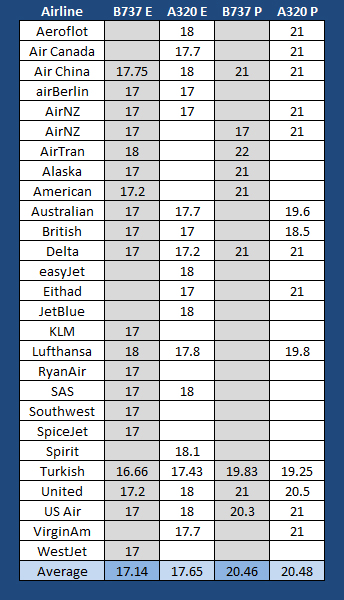
On average, the Airbus A320 seats are wider, but not by much. Only about 1/2″ in economy and almost no difference with premium seats. It seems that airlines and seat manufactures are not using that extra 7″ of cabin width that the Airbus A320 provides.
While the A320 does have a wider diameter fuselage, it doesn’t necessarily mean that airlines will put in a significantly wider seat.
From the owner of SeatGuru,"We’ve found that while there is some variation, we generally see airlines give about 17-17.2″ seat width in coach on a B737, while they give about 17.5″-18″ seat width in coach on an A320. These differences depend on the types of seats airlines use, as well as the overall seating configuration of the aircraft. A320′s fuselage is just marginally wider than a 737NG which does not offer significantly wider seat width.
Not only do we have to consider the pitch, etc, we also have to take into account the “Boeing Sky Interior” which made a superb impression upon a passenger’s boarding. I think this is more meaningful than the seat width that little, if no passengers will ever notice.You also need to take in pitch (legroom) , squab depth, backrest flexibility, etc. As a generalization, I find the B737-800 to be more comfortable in the air than the A320, irrespective of the seats. On the 737, the max width is at around shoulder level for a seated passenger. For the A320, it is at around the hip level to a seated passenger. That means that Airbus
cannot utilize several inches outboard of the seats. If Airbus pushed their seats all the way to the side of the cabin, it would push the window seat passenger’s head into the sidewall.
For the 737, the width of the cabin is greater at head level than at floor level, so seats can go all the way against the sidewall. That’s why a smaller cabin can have similar-sized seats. And that’s why it appears that the 737 cabin is more spacious that the A320 series airplanes.”