Boeing laying off 900 in LGB

When the last -320 goes to the boneyard the crew will be flown back on a 73G.

:D

This sucks - the downward Californian spiral continues. I remember when we had an aerospace industry here :(

Yeah right. At the same time, Airbus has just hired 1500 new workers in Toulouse to work on the new orders. FYI, Airbus in the US represents 120,000 jobs. And has for the 3rd consecutive year delivered more aircrafts than Boeing. It could be blind patriotism on my side, but it's more something like wtf is going on with Boeing ? The 777 is a hugely successful airframe, fantastic aircraft, very Boeingy, but by relying solely on the 737 for short/medium range 100-130 pax market they have shot themselves in the last good foot they had...
They should have seen the rise of the Regional jets, simply see the A320 great success and reflect on that. Why is it selling like hot cakes ? What are they doing differently ?
 
TMK and IMO the problem is deeper than the aircraft themselves. The problem lies in the financing of the Aircraft. Airlines can get a better financing deal from Airbus since they are gov't subsidized. Boeing simply can't offer an airline 5 years with no interest on a plane. JetBlue has actually made of profit on their leases buy selling their older ones off and making a profit on them at the same time. If I had to pick, I personally would rather flying a Boeing as I feel they are better built. Airlines however, only care about their bottom line, which is why Airbus is wining.
 
TMK and IMO the problem is deeper than the aircraft themselves. The problem lies in the financing of the Aircraft. Airlines can get a better financing deal from Airbus since they are gov't subsidized. Boeing simply can't offer an airline 5 years with no interest on a plane. JetBlue has actually made of profit on their leases buy selling their older ones off and making a profit on them at the same time. If I had to pick, I personally would rather flying a Boeing as I feel they are better built. Airlines however, only care about their bottom line, which is why Airbus is wining.

The Gov't subsidized argument is just so old cf. the tanker contract joke. If you want to talk protectionism, I think we're in for a trip. No G8 or G20 country is more protectionist than the US ! Wether it's good or not is not the point, it's just a fact !
What makes you feel that Boeings are better built ? Is this just a feeling or a proven fact ?
 
The Gov't subsidized argument is just so old cf. the tanker contract joke. If you want to talk protectionism, I think we're in for a trip. No G8 or G20 country is more protectionist than the US !
What makes you feel that Boeings are better built ? Is this just a feeling or a proven fact ?

As a sidenote on the tanker contract thing: Even though the planes were built in France, weren't the KC-45/A330 tankers supposed to be getting assembled in Alabama, USA anyway?
 
As a sidenote on the tanker contract thing: Even though the planes were built in France, weren't the KC-45/A330 tankers supposed to be getting assembled in Alabama, USA anyway?

You're right Mike, a plant was/is on order in Mobile to build the planes. Airbus supports directly or indirectly 120,000 jobs in the US. So much for gvt subsidies...
 
I am not sure that you have a true grasp of the situation. Boeing assumes full market risk every time they develop a new airplane. Airbus does not. Boeing can fund a new program like the 7E7 only through their own profits or by borrowing at commercial rates from banks. Airbus gets upfront money in the form of launch aid on noncommercial terms from its sponsor governments.

Boeing has to pay back every dime it borrows-on time and with interest-whether an airplane program is successful or not. Even though Airbus is supposed to repay its launch aid, it has to do so only if the subsidized program is successful.

Under Airbus' agreements with its sponsor governments, the first repayment threshold kicks in when the airplane reaches 40 percent of projected total sales. Only then does Airbus have to start paying the money back-and all that's due at that point is 20 percent of the total it has received in launch aid for a given airplane.

Look at the A380, for example. Airbus has received nearly $4 billion in launch aid for the ultra-big airplane. Airbus claimed in 2004 that was there was a market for 1,500 A380s, so it would have to sell 40 percent of that amount-or 600 airplanes-before it has to pay back just one-fifth of the launch aid it has received for the A380. If Airbus doesn't sell at least 600 A380s, it may never have to repay any of that launch aid.

Over the years, Airbus has received some $15 billion in launch aid. It has not repaid most of that aid. In fact, if Airbus had borrowed that money on commercial terms, its parent companies-European Aeronautic Defence and Space and BAE Systems-would have an additional $35 billion in debt on their books today.

As a result of these very generous government subsidies, Airbus has grown to full maturity, developed an entire product line in record time, and reached market share parity with Boeing. Yet it continues to receive massive government support.

The European Union has poured much more money than the U.S. has into propping up its aviation industry, to Boeing's significant disadvantage. These are simply the facts and the truth.

Interesting info, btw:

http://www.mcclatchydc.com/2010/03/23/90940/wto-final-ruling-airbus-subsidies.html#
 
http://bp1.blogger.com/_Z6lsJqNgS7Y...AFI/M0iWB4zVjNc/s1600-h/airbus-hurts-full.jpgEADS demands a "fair playing field" to compete against American companies for Pentagon tanker and cargo transport contracts. But it hides its own huge subsidies from European gobernments - and thus misrepresents itself to the Department of Defense, Congress and the public.

Here's a summary of how EADS/Airbus unfairly competes with American aircraft companies. The following is an excerpt from testimony by Under Secretary of Commerce Grant T. Aldonas before a House panel in 2001:

"The single largest U.S. civil aircraft competitor is Europe’s Airbus, and the nature and scope of this competition is different from any other kind of competition that we encounter. In the United States, aircraft manufacturers have never been owned by the government. With the exception of military aircraft procured in the interests of national defense, the U.S. Government has not sought to direct what type of aircraft are produced, or when they are produced, or the price at which they are sold. Our industry is dynamic and shaped by market forces.

"European governments have a different orientation. Many governments in Europe view aircraft manufacturing in terms of its contribution to their national economic and engineering capability. These governments point to the aerospace industry as an engine of high technology growth and jobs.

"Airbus and other major aircraft manufacturers in Europe have a history of government ownership and control. Given this direct financial interest, European governments have undertaken steps to boost their industry’s competitiveness. Airbus’s corporate structure is telling. Airbus is owned by two companies: 20 percent is owned by British Aerospace Systems, and 80 percent by the European Aeronautics Defense and Space Company (EADS), which is the result a merger (of France’s Aerospatiale, Germany’s DASA, and Spain’s CASA) that was created at the behest of European governments.

"The Airbus consortium’s 'parent' governments have intervened in sales competitions in an effort to win orders for Airbus. Due to the fact that many foreign airlines are government-owned or substantially government-controlled, political rather than market forces can become decisive factors in purchasing decisions. In the past, some European governments have sought to influence these decisions by potentially offering increased airline landing rights for the purchasing airline, granting preferential trading rights in unrelated sectors to benefit the country purchasing aircraft, and demonstrating willingness to advance the status of countries interested in joining the European Union. The United States makes no such linkages."
 
Given the long tradition of business honesty and fairness in the US I'll just die laughing at that and feel so sorry for Boeing for not having bribed enough congressmen through lobbies and such. In the meantime I'll enjoy my quiet and roomy A320 cockpit while you marvel at the superior built quality of your Boeing.
BTW do you fly for an airline ?
 
Given the long tradition of business honesty and fairness in the US I'll just die laughing at that and feel so sorry for Boeing for not having bribed enough congressmen through lobbies and such. In the meantime I'll enjoy my quiet and roomy A320 cockpit while you marvel at the superior built quality of your Boeing.
BTW do you fly for an airline ?
I flew for a legacy carrier domestically and then internationally and I flew on Boeing planes during the vast majority of my career. I never had a real issue personally with "room" or "noise" either, but then I enjoyed my job.

First it's a slam on Boeing, then trying to connect the closing down of a C-17 plant in relation to pax aircraft, then ignoring the truth of the government funding of AB, ignoring the finding of the WTO against AB, then a slam on the US and now putting words in my mouth that I never said. Interesting and bitter response. Would you care to cite your sources for Boeing attempting to bribe congressmen?
 
Given the long tradition of business honesty and fairness in the US I'll just die laughing at that and feel so sorry for Boeing for not having bribed enough congressmen through lobbies and such. In the meantime I'll enjoy my quiet and roomy A320 cockpit while you marvel at the superior built quality of your Boeing.
BTW do you fly for an airline ?

Okay I didn't realize you were speaking specifically about the cockpit... well that's nice for you, your pax are still stacked like cordwood, but hey as long as you're comfy ;).
 
Pax stacked like cordwood obviously doesn't apply to Airbus, or you obviously have never flown in one. It applies marvelously to the 737 though...
 
I flew for a legacy carrier domestically and then internationally and I flew on Boeing planes during the vast majority of my career. I never had a real issue personally with "room" or "noise" either, but then I enjoyed my job.

First it's a slam on Boeing, then trying to connect the closing down of a C-17 plant in relation to pax aircraft, then ignoring the truth of the government funding of AB, ignoring the finding of the WTO against AB, then a slam on the US and now putting words in my mouth that I never said. Interesting and bitter response. Would you care to cite your sources for Boeing attempting to bribe congressmen?

Let me oblige, the Tanker contract is probably the most famous, but we could also talk about some Boeing execs who bribed Japanese officials (ANA) and so on... Cry all you want against AB but the fact is it is they are selling much more airplanes that are better built and more pax and crew friendly. Don't know if you fly for any airline, but please advise when you turn down an Airbus job because it's Gov't subsidized.
 
Pax stacked like cordwood obviously doesn't apply to Airbus, or you obviously have never flown in one. It applies marvelously to the 737 though...

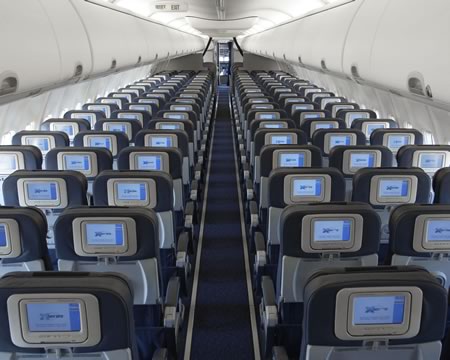
Really? A320:
0996381.jpg


737:
BoeingVideo.jpg


Not exactly a huge difference. 90% of us have probably been in both, and honestly I wouldn't be able to tell the difference between the two from the inside.
 
Pax stacked like cordwood obviously doesn't apply to Airbus, or you obviously have never flown in one. It applies marvelously to the 737 though...
And what about a true comparison of plane type? Let's see for example on two legacy carriers just for fun:


AB 320 short haul economy class -31.0" seat pitch, 18.0" seat width, recliner
B777-200 31.0" seat pitch, 18.0" seat width, recliner
B767-300 31.0" seat pitch, 18.0" seat width, recliner
B757-200 31.0" seat pitch 17.0 seat width, recliner

AB 320 short haul first/business class -38.0" seat pitch, 20.5" seat width, recliner
B777-200 38.0" seat pitch, 21.0" seat width, recliner
B767-300 38.0" seat pitch, 19.5" seat width, recliner
B757-200 38.0" pitch, 20.5 seat width,recliner

AB 320 Long haul premium economy class - 36.0" seat pitch, 18.0" seat width, recliner
B777-200 35.0" seat pitch, 18.0" seat width, recliner
B767-300 35.0" seat pitch, 18.0" seat width, recliner
B757-200 36" seat pitch, 18.0" seat width, recliner

AB 330-200 Long Haul business 60" seat pitch, 20.25" seat width, recliner
B777-200 60" seat pitch, 21.0 seat width, recliner
B767-300 60' seat pitch, 19.5" seat width, recliner
B757-200 38.0" seat pitch, 20.0" seat width, recliner
 
Let me oblige, the Tanker contract is probably the most famous, but we could also talk about some Boeing execs who bribed Japanese officials (ANA) and so on... Cry all you want against AB but the fact is it is they are selling much more airplanes that are better built and more pax and crew friendly. Don't know if you fly for any airline, but please advise when you turn down an Airbus job because it's Gov't subsidized.
Interestingly enough, when I was at a legacy, I turned down an upgrade to the AB320 to stay on the B747-400. You assume much. I do not agree that AB aircraft are "better built" either. That sir, is your opinion.
 
And what about a true comparison of plane type? Let's see for example on two legacy carriers just for fun:


AB 320 short haul economy class -31.0" seat pitch, 18.0" seat width, recliner
B777-200 31.0" seat pitch, 18.0" seat width, recliner
B767-300 31.0" seat pitch, 18.0" seat width, recliner
B757-200 31.0" seat pitch 17.0 seat width, recliner

AB 320 short haul first/business class -38.0" seat pitch, 20.5" seat width, recliner
B777-200 38.0" seat pitch, 21.0" seat width, recliner
B767-300 38.0" seat pitch, 19.5" seat width, recliner
B757-200 38.0" pitch, 20.5 seat width,recliner

AB 320 Long haul premium economy class - 36.0" seat pitch, 18.0" seat width, recliner
B777-200 35.0" seat pitch, 18.0" seat width, recliner
B767-300 35.0" seat pitch, 18.0" seat width, recliner
B757-200 36" seat pitch, 18.0" seat width, recliner

AB 330-200 Long Haul business 60" seat pitch, 20.25" seat width, recliner
B777-200 60" seat pitch, 21.0 seat width, recliner
B767-300 60' seat pitch, 19.5" seat width, recliner
B757-200 38.0" seat pitch, 20.0" seat width, recliner

Totally irrelevant since carriers outfit planes the way they want with their choice of seats, pitch et al. And what's the 777 doing in that comparison ?
 
WTO final ruling: Airbus subsidies illegal, hurt Boeing


WASHINGTON — May 2010- European governments illegally subsidized Airbus, allowing it to overtake Boeing and become the world's largest commercial airplane company, the World Trade Organization found in a final ruling Tuesday that could have trans-Atlantic repercussions, lawmakers who were briefed on the decision said.
The ruling, which upheld interim findings released last September, will remain confidential for several months, but it was delivered to the Office of the U.S. TradeRepresentative and its European counterpart.

"Today's final ruling puts any doubts to rest — launch aid is an illegal subsidy that has cost America jobs, hurt our ability to compete and damaged our overall economy," Sen. Patty Murray, D-Wash., said in a statement after being briefed.
Also briefed was Rep. Norm Dicks, D-Wash., who said later that the WTO had concluded that Airbus "could not have achieved the growth of market share — harming U.S. workers — without its pattern of illegal assistance.

"The ruling validates the U.S. government's long-standing contention that the European Union governments were utilizing this improper launch aid to steal American jobs, and it provides compelling evidence that we should use to demand Airbus begin playing by the rules," Dicks said.

The Europeans are expected to appeal.

The ruling is apparently a victory for Boeing, with the WTO finding that the U.S. aerospace company had been harmed over the years. How Airbus could be punished remained unclear, though, along with what it would need to do to rectify that financial advantage. If it fails to take action, however, the U.S. eventually could impose billions of dollars in punitive tariffs or other sanctions.
Over the next 20 years, the world's airlines are expected to order more than $3.3 trillion worth of jets. Japan, China, Canada, Brazil and even Russia are considering building their own aircraft to compete with Boeing and Airbus.

The Airbus subsidy case is considered the largest and most complicated trade dispute ever.

The WTO said that four European countries — France, Germany, Britain and Spain — provided Airbus with risk-free loans, known as launch aid, to develop and build its aircraft.

Boeing has said that Airbus received more than $15 billion worth of subsidies, which in today's dollars could have a true market value of roughly $200 billion.
Airbus received its first airplane order in 1971 and less than 40 years later had more than half the market for commercial airplanes. Through the late 1980s, Boeing had almost two-thirds of the market.

Boeing called the WTO decision a "powerful, landmark ruling and good news for aerospace workers across America who for decades have had to compete against a heavily subsidized Airbus."

In a statement, Boeing said the ruling should "level the competitive playing field once and for all with Airbus" and established a precedent for other nations that are thinking about launching their own commercial airplane businesses with subsidies.

"Markets, not parliaments, should pick the winners in the global aerospace market," Boeing said.

Airbus, in its own statement, said that the WTO had rejected 70 percent of the U.S. claims in the subsidy case. Airbus also said that the European "reimbursable loan mechanism" was found to be a legal part of any relationship between government and industry.

"Airbus expects the WTO conflict to drag on for at least a few more years," its statement said, adding that the issue will be resolved only with trans-Atlantic negotiations.

The WTO is expected to rule later this year in a separate case brought by the Europeans alleging that Boeing received its own subsidies from the federal, state and local governments.

Tuesday's ruling could further inflame the already testy relationship between the U.S. and Europe over airplanes.
European leaders recently slammed the Pentagon for allegedly designing a competition for a $35 billion aerial-refueling tanker contract that favored Boeing at the expense of the European Aeronautic Defense and Space Co., Airbus' parent company.

French President Nicolas Sarkozy has said he'll raise the issue with President Barack Obama during a visit to Washington in coming weeks. The Pentagon is considering a request from the Europeans to extend the bid deadline for the new tankers.

The WTO ruling covers all of Airbus' aircraft, including the A300, A330, A340 and the A380.

Airbus still owes the four European governments $4 billion in loans for its A380 super jumbo jet. The zero interest or low-interest loans might have to be repaid sooner as a result of the WTO ruling and Airbus might have to take out commercial loans to pay them off.

Also at issue is the $5 billion in launch aid that the European governments have offered Airbus to help develop the new A350, which would compete directly with Boeing's new 787 Dreamliner. The A350 subsidies weren't a direct part of the WTO case, but Boeing supporters say they're crucial to solving the dispute.
"It's amazing to me that at the height of the Cold War when the U.S. was spending billions of dollars in Europe, four countries would get together in an effort to destroy the U.S, aerospace industry," said Loren Thompson, an analyst with the Lexington Institute, a national security research center in northern Virginia.

Thompson has just completed a Boeing-funded study on the subsidies.
"We don't want a trade war here," Thompson said. "But we have to make it clear to the Europeans we won't tolerate it anymore."

Let's not have the facts and truth stand in the way of our opinions though. lol
 
Douglas/McDonnell Douglas/Boeing have been a major staple in Long Beach since before WWII. My grandmother used to work for McD on the MD-11 and then the C-17 when it started up. Before that she worked at Rockwell Space Systems in Downey on the Apollo and Space Shuttle programs. Rockwell Aerospace was also bought by Boeing. It was always clool to dive by the paint shop and see rows of DC/KC-10s, MD-80/90s and MD-11s either waiting for paint of just freshly painted. It sad to see the place now and will be even sadder the day it closes. I hope the airport can revitalize the land for aviation uses.
 
Totally irrelevant since carriers outfit planes the way they want with their choice of seats, pitch et al. And what's the 777 doing in that comparison ?
Again, this is the compilation of two US international legacy carriers. And we all understand that planes are ordered and configured to each carrier's needs. lol You keep harping on how roomy AB is compared to Boeing. Tell that to the pax. Apparently, all facts are "irrelevant" to you.
 
Back
Top