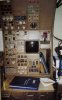
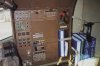
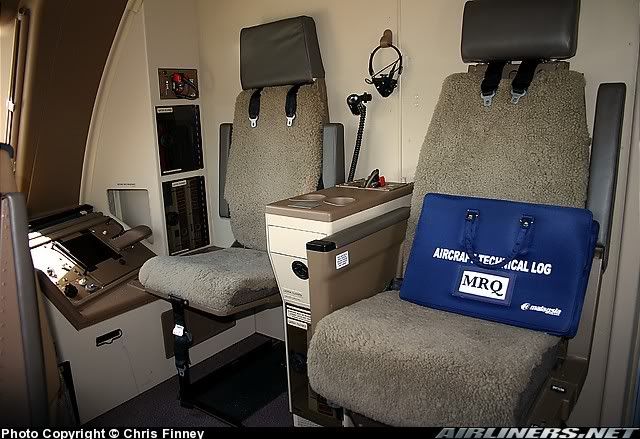
767 Flight Engineer station

MikeD

Administrator
Staff member
Cool pic of one of the five early 767s produced for Ansett that had an FE/SO station onboard.

Reminds me of the early 737s from the late '60s/early'70s, where ALPA required a three-man crew to be onboard; UAL being the last to fly with one of these. The 73's didn't have an FE station, but a pilot manning the jumpseat as a required crew position.
 

Attachments

  • fe767.jpg
    fe767.jpg
    212.6 KB · Views: 10,612
Wonder if the jumpseat has a hard checkride.

The history of the 737 FE requirement:

The part I bolded is interesting history, and probably something that sounds completely weird to the generation of pilots from the last 10-15 years....

In 1967 the airworthiness certificate for the two man B-737 was acquired. In the following year, evaluation tests were conducted on a wide scale to determine whether to implement the two man crew complement with which the airworthiness certificate was acquired or to use the three man crew configuration as advocated by airline flight crew.

The Federal Arbitration Commission assessed that it was possible to fly with two men but that implementation of the three man cockpit would contribute to safety in the early stages of introduction. United Airlines therefore started operation of the B-737 in 1970 with three men. This fact greatly influenced Western Airlines and others; with Western, Wein and Frontier making the decision to ny this aircraft with three men.

In 1971, the crew complement issue of the B-737 was discussed at Aloha Airlines. The Federal Arbitration Commission officer who dealt with the arguments between Aloha and US ALPA assessed that it was possible to operate the aircraft in Hawaii with two men due to the traffic volume and weather conditions there. He nevertheless supported the three crew configuration for B-737 operation in places in the United States other than Hawaii.

In 1973, US ALPA confronted the management of Wien Airlines, which was trying to replace the three man crew of the B-737 with two men. The Federal Arbitration officer at that time judged and approved the implementing of the three-man crew complement. The examples of United and Aloha were referred to, concluding that the flight conditions were most similar to that of United.

In 1976, pilots at Frontier Airlines, after conducting three man operation of the B-737 for six years, accepted the two man crew complement proposal of management. Wien airmen went on strike when the company management tried to forcibly implement the two man crew on their B-737. In answer to the continued strike on the crew complement issue of the B-737, in 1979 the President's Energy Commission set up by President Carter, instructed Wien to operate their B-737 with two crew members. The pilots at Wein were made to accept this leaving United as the only airline operating the B-737 with three men.

Airmen in the United States have consistently fought the crew complement problem in the 1970s within the social environment dominated by the petroleum crisis and deregulation. Arguments regarding the two man crew complement further intensified during the acquisition of the airworthiness certification of the DC-9-80 and at the announcement that the B-757 and B-767 were being developed with a two man crew.

 
I rode on a Delta 767-200 from PHL to ATL in 1992 and went up to the cockpit to take a look.

They had this panel and said that it wasn't used but the plane came with it (that's all I remember about that, I was fairly young).

I wonder how many of them Delta had?
 
I rode on a Delta 767-200 from PHL to ATL in 1992 and went up to the cockpit to take a look.

They had this panel and said that it wasn't used but the plane came with it (that's all I remember about that, I was fairly young).

I wonder how many of them Delta had?

Unless they acquired one of the Ansett birds, as I understand it the only ones were the 5 built for Ansett.
 
Unless they acquired one of the Ansett birds, as I understand it the only ones were the 5 built for Ansett.

Maybe it was then. I'm sure it was one of these stations, because the scene is very clear in my head as I was very excited to be there for almost all of what was probably an hour maintenance delay (they couldn't get a cargo door shut outside).
 
There's still a panel back there on the 757/767 but it's just got a couple of maintenance-related things and nothing functional for pilots.

And leave the damned cargo heat switch alone! Augh! Who's doing that! :)
 
Considering that old FE panel is about 3/4 of the actual overhead panel, what was actually on the original overhead panel? Lights, cabin call? :)
 
I've seen that bizarre FE panel photo before. I thought about the same thing....it would be great if someone could dig up a photo of the overhead!
 
Here's all that's "remains" on the 777, just a CMC terminal and dataloader (the 767 and 777 share a common Section 41 pointy part).

0753101.jpg
 
Here's all that's "remains" on the 777, just a CMC terminal and dataloader (the 767 and 777 share a common Section 41 pointy part).

0753101.jpg

The 777 has one of the best jumpseats...got to sit on a few of them and WOW is it nice. I enjoyed the 76 jumpseat, and the 757 jumpseat was designed by the devil.
 
It sure is, and the DC-10's is right up there in my book. I've heard the L-1011's was just as awesome.

I've always heard that the L-1011 had a great jumpseat...and that sitting in the cockpit felt like sitting in a fishbowl. I think the L-1011 had 42 square feet of glass, I seem to recall that being in an Airliner's Magaizine. I'll check my "new" L-1011 systems manual I got for my birthday, from 1973 and in it's original TWA binder.
 
It was nice getting to ride the 1011 jumpseat with my pops. The left window started below the seat and ended above my head. I sometimes felt like I was going to fall out of the plane.
 
Back
Top