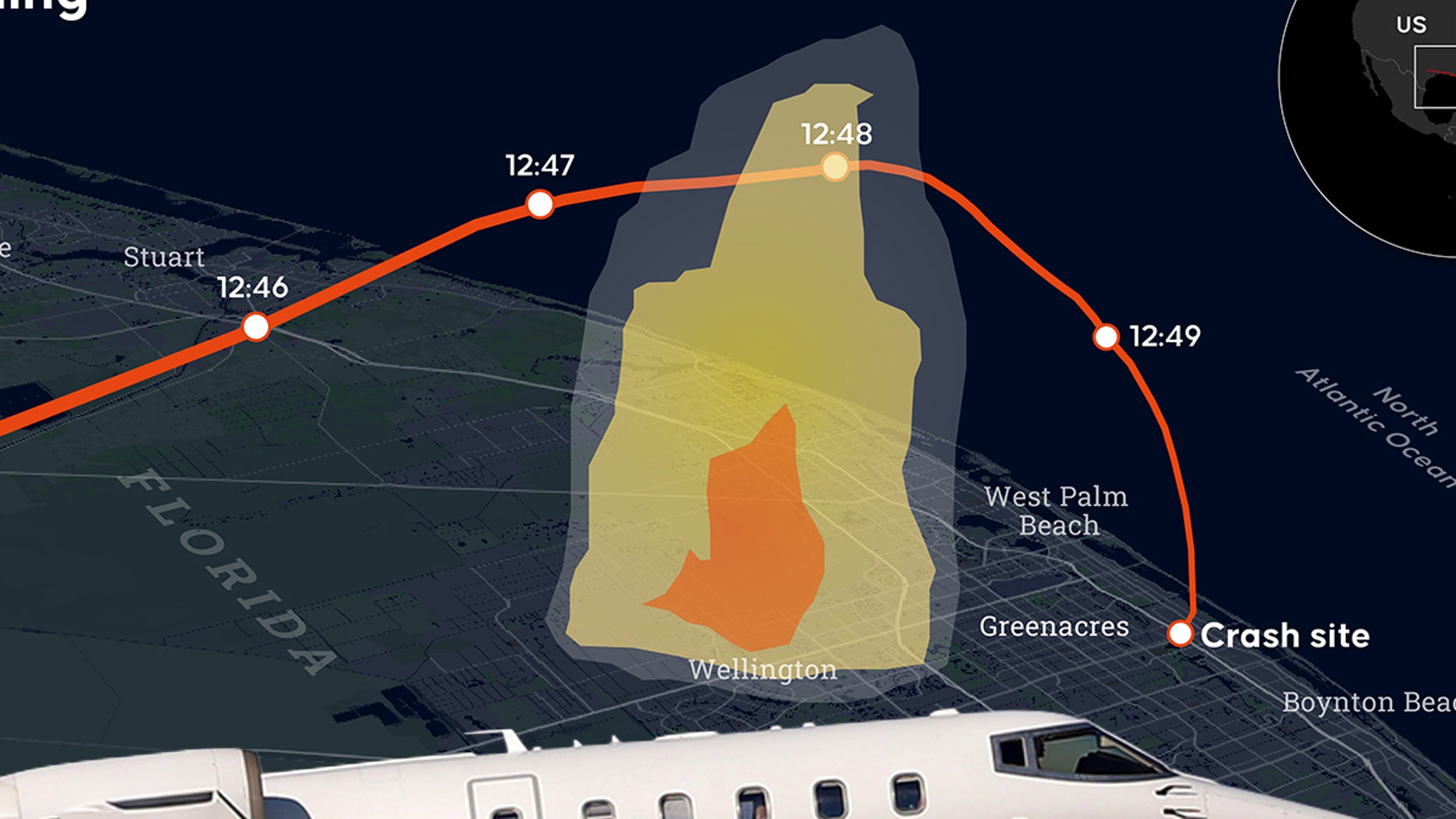
Learjet 60 crash in West Palm Beach

i don’t believe it necessarily happened prior to the dive either. I think any control surface separation was more a resultant factor rather than a causal factor. The latter makes little sense….control surfaces separating for no thing more than turbulence. Is it possible? Well, anything is possible. Preexisting structural fatigue exacerbated by the turbulence? Pretty far out there of a scenario, but i still don’t think enough wreckage exists thus far, to go one way or another…..although post-dive and past VNE is most likely. Another one we may never know, unless a horizontal stab is found somewhere back along its flightpath.
I think that makes sense.

One thing that really made a big impact on me with the new UPRT/EET we started doing several years ago is high altitude stalls or nose down unusual attitudes. It is extremely easy to overstress the airplane in recovery if you’re not careful and methodical.

Throw in the old startle factor, and who knows.

I’m not throwing shade at this crew, as I have no clue what happened. But just bringing this up as part of the discussion.
 
I’m assuming they were at climb power when this went down, would pulling the throttles to idle have had any benefit or does that not really matter at that point?
As part of a nose low unusual attitude recovery, the steps for attitude recovery are as follows for most Boeings:

(Disconnect autopilot and autothrottle)

1)Recover from stall (if required)

2)Roll in the shortest direction to wings level (unload and roll if bank angle > 90°).

3)Apply nose up elevator, using trim as necessary.

4)Adjust thrust and drag as required. For overspeed, that would be thrust idle and spoilers.

These steps must be done very quickly depending on how screwed up your unusual attitude is.

Most other transport category aircraft I’ve flown have a very similar flow for recovery, I’d assume the Lear 60 is similar.
 
Yes I mean before that part
Yes. That's why reducing power is step one in a nose low unusual attitude.

If the tail was totally stalled then it might not have helped much except cause then to hit the ground at a slightly lower extremely high speed.
 
I hate saying this, but TMZ is reporting the name of the PIC. I have to give TMZ credit, they aren't wrong very often. 55 year old Jeff Gregory. Looks like he *may* have worked for East Coast Jets.


View attachment 91159

Wait, how are they both
Subject to an SOE limitation? I mean, I hope he’s got his 25 hours in 5 years- but, that would be a no-go for us
 
Yes, as in so many areas the basics should be understood if only to learn how much the tech is helping us.

Can’t speak personally to the Lear 60 as it’s an oddball neither fish nor fowl… at heart it’s still a 55 which is a derivative of the original Lear 23, but very much dressed up with fancy avionics and completely different engines from the rest of the turbofan Lears. But the wing, IIRC, is still at heart a Lear 31 wing, which traces its lineage again back to the 23, but with various leading edge cuffs and fixed devices and extensions and winglets etc so folks on here who’ve flown them would have to elaborate on the handling qualities. I was a bit surprised to read someone say that it did not have anti ice on the horizontal stab, as I thought all the LR-JET derivatives had the electrically heated blankets controlled by an electromechanical timer dating way back to the oldest Lears.

But that’s really just picking nits if you fly into the top of a developing Florida thunderstorm, and I hope we can all learn something from the NTSB investigation other than “don’t do that”.
Having flown a 60 its very much what you described I call it "squirrelly" esp at higher altitudes, and you are correct, it does not have Anit-ice on the horizontal stab.
 
I think that makes sense.

One thing that really made a big impact on me with the new UPRT/EET we started doing several years ago is high altitude stalls or nose down unusual attitudes. It is extremely easy to overstress the airplane in recovery if you’re not careful and methodical.

Throw in the old startle factor, and who knows.

I’m not throwing shade at this crew, as I have no clue what happened. But just bringing this up as part of the discussion.
And the amount of altitude required to get the plane flying again.
 
More debris found in a location other than the impact site.
 

Attachments

  • 7BE4B348-770C-4C58-998A-D83D59CDD80D.jpeg
    7BE4B348-770C-4C58-998A-D83D59CDD80D.jpeg
    700.9 KB · Views: 69
in the sim, sure
UPRT is the worst thing we simulate. your primary G loading instrument in the recovery in a transport category airplane is your butt in the seat

I mean, for some of us- it’s when the airplane out votes us and doesn’t let us pull anymore.
 
in the sim, sure
UPRT is the worst thing we simulate. your primary G loading instrument in the recovery in a transport category airplane is your butt in the seat
Totally agree. We go to APS every few years and I think UPRT is way less about the type and way more about technique. Push till you’re light in the seat to unload the wing, roll, (continue APS mantra). Feeling the plane unload and load isn’t something you can do in the sim. Cost prohibitive for most large operators I’m sure, but a few days in an Extra is amazing for basic stick and rudder.
 
I was flying in and out of Boca around the time this accident occurred. The arrival quadrant into South Florida had closed (Miami and Palm Beach were completely closed) and we were routed all the way down to Marathon and up to Bimini to get in. All we got enroute and in the descent was light chop and no icing. I really hate that they weren't routed South and then back up North like we were.
 
in the sim, sure
UPRT is the worst thing we simulate. your primary G loading instrument in the recovery in a transport category airplane is your butt in the seat
Absolutely, and I’m lucky enough to have done aerobatics in the past.

But there are plenty of stories about pilots overloading airframes during startle recover events in situations like this.
 
Absolutely, and I’m lucky enough to have done aerobatics in the past.

But there are plenty of stories about pilots overloading airframes during startle recover events in situations like this.

pilots either don’t wait for wings level and begin pulling to the horizon with serious asymmetric G loading, which is always a lower limit than awaiting wings level and then pulling with symmetrical G loads. Then, honking on the stick/yoke that does nothing but change your nose pitch angle…..often into an accelerated stall where the nose stops tracking…..but your velocity vector is still headed downward to the ground, just with the nose pointing above the horizon. Much akin to pilots trying to recover from a loop on the backside when they topped out inverted in the maneuver at too low an altitude.
 
Push till you’re light in the seat to unload the wing, roll, (continue APS mantra).

and even roll with rudder to get the plane upright quicker than ailerons and spoilers can. Not a boot full of rudder, but just a little bit of pro-rudder, as the vertical stab and rudder are large on airliners and extremely effective at roll, almost too effective if you use too much. Just a little does the trick. One of the very few times you positively use the rudder in the air.
 
Having taught UPRT for over a decade, the most difficult thing to simulate is the loading of a part 25 aircraft when recovering. I teach it in my Extra 300 and have previously contracted with flight departments over the years. There are very few ways to simulate high-altitude upsets in a meaningful way. Either you do it like how I do it, and you don't get the high-altitude aerodynamics, or you do it in the sim where you can show G but you can't get the feeling of what 2 Gs and chage feels like, which is the load limit of transport category aircraft.

Lear upset recovery procedure (as is most swept-wing aircraft) is to roll knife-edge in nose-high situations to drop the nose.

It is simply damn near impossible to simulate a loaded, high altitude upset and stall, realistically.

APS, Prevelance, Patriots Saberliner UART and others do a great job but even in the Marchettis at APS, it doesn't do a high-altitude swept-wing event justice.
 
Back
Top