I think you may have this idea that mass can stop a force; it can't. Our intuition tells us otherwise, because our intuitions are based on our experience on earth, where massive objects develop a great deal of friction with the ground and are almost unmovable.
However, if you put an aircraft carrier on a frictionless surface and breathed on it, it would move. Yes, its rate of acceleration would be slow, because its mass is great, but move it would. If you kept breathing on it, it would continue to accelerate and get faster and faster. Now, if you tried the same experiment with a mote of dust, it would accelerate rapidly because its mass is low.
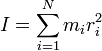
The point is that mass only affects the rate of acceleration when exposed to a force, not whether it moves at all, a fact which is revealed in Newton's second law: Force = mass * acceleration. The same thing applies to our two airplanes. If the rudder force and the engine thrust force do not balance out, then the airplane will start to rotate around the vertical axis. If you loaded the nose luggage compartment and the rear luggage compartment with massive iron dumbbells, the rotational acceleration would be slower than if these compartments were empty, but the rotation would happen regardless. So you're going to end up inverted in 5 seconds versus 3. Even so, this reduction in rotational acceleration isn't caused by the increase in mass, but rather its distribution within the airplane. This is called, in fact, the "dumbbell effect".
Directional control requires that the rotational forces (moments) be in balance and those are unrelated to mass or weight.
Because of what I stated above; the regulations allow up to a 5 degree bank into the good engine during the measurement of Vmc. When such a bank is used, the heavier airplane has a larger amount of sideslip into the good engine, which increases rudder authority. The lighter airplane could achieve the same amount of sideslip if it could exceed 5 degrees, but that's not allowed. The extra rudder authority allows the pilot to counteract the rotational moment of the working engine to a lower airspeed than a lighter one.
Take a look at this page from an article by Dennis Newton in "Business and Commercial Aviation":
http://www.boundvortex.com/Downloads/dn page 4.tif