Multi-Engine Controllability Question

SkyScratcher

New Member
Hi all. I'm working on multi-engine rating and can't seem to grasp the concept of how maximum gross takeoff weight increases controllability with an inoperative engine.

I know the horizontal component of lift is affected by the gross weight - horizontal component of lift required increases as weight increases. But how does a reduced gross weight require a steeper bank angle?

Is it because the reduced gross weight requires a lower angle of attack (to sustain correct vertical component of lift) which means less of a horizontal component of lift at a given bank angle?

Can anyone help qualify this for me? Thanks!
 
which means less of a horizontal component of lift at a given bank angle?

Yes, and the "given bank angle" is 5 degrees, which is the maximum allowed in the regulations. So if you have a heavy airplane with a bank of 5 degrees and a light airplane at 5 degrees, the heavier airplane has a larger horizontal component of lift and thus has a larger sideslip into the good engine, which increases controllability.

Without this limitation in the regulations, there would be no controllability benefit to a heavier airplane.

Still, the point is moot. In general, we don't take advantage of the 5 degree limit in real life, because sideslipping into the good engine is almost as bad as slipping into the dead one. Rather, we seek a zero sideslip amount of bank and will use whatever bank is necessary to achieve this, almost always between 2-3 degrees. In this scenario, there is no controllability advantage to a heavy airplane and it degrades performance.
 
Rather, we seek a zero sideslip amount of bank and will use whatever bank is necessary to achieve this, almost always between 2-3 degrees. In this scenario, there is no controllability advantage to a heavy airplane and it degrades performance.

Why ? Every flight instructor's favorite question. A heavier twin isn't more controllable ?
 
The magnitude of the horizontal lift vector that offsets yaw is a function of weight, also adding weight lowers Vmc.
 
The magnitude of the horizontal lift vector that offsets yaw is a function of weight, also adding weight lowers Vmc.

Lift cannot offset yaw, because they happen around two different axes of the airplane. What the horizontal component of lift does is produce a sideslip into the good engine which increases rudder authority, leading to a reduction in Vmc. Without a bank limitation, the lighter airplane can just bank more in order to get the same Vmc reduction as the heavier airplane.
 
think inertia
an object in motion tends to stay in motion, an object at rest tends to stay at rest
it takes more force to turn (or alter the flight path) a heavy airplane than a light airplane
this was according to the guy who did my MEI checkride. he said they used to determine vmc wings level..
 
SkyScratcher,

Think of throwing a large rock versus throwing a pebble. Which one will travel the furthest distance without outside forces deflecting it?
 
this was according to the guy who did my MEI checkride.

Unfortunately, examiners don't receive any special secret training on this stuff and he is tripped up by basic physics; inertia (mass) can play no role in whether the rotational moment around the vertical axis produced by the thrust can overcome the moment produced by rudder. Considering that Moment = Force * Arm, where is there a role for the aircraft's mass in that simple formula? There is none.

If the moment produced by the thrust is even slightly greater than what rudder authority provides, control is lost. Now, the moment of inertia will govern the angular acceleration of the resulting yaw, but not whether the yaw occurs. Even so, the moment of inertia doesn't necessarily increase with weight, since that it depends on where the extra weight is located. If you pile it on that the location of the CG, it would have no effect on the moment of inertia.

This is fundamental: Vmc is determined by the moments acting around the vertical axis of the airplane. If they don't balance, control is lost.
 
Lift cannot offset yaw, because they happen around two different axes of the airplane. What the horizontal component of lift does is produce a sideslip into the good engine which increases rudder authority, leading to a reduction in Vmc. Without a bank limitation, the lighter airplane can just bank more in order to get the same Vmc reduction as the heavier airplane.

Correct lift doesn't offset yaw, weight does. Note "lift vector"
 
Correct lift doesn't offset yaw, weight does. Note "lift vector"

Weight can't do it either. Yaw is a rotational moment around the CG; weight acts THROUGH the cg and can't produce a rotational moment at all.

Fundamental concept: Only aerodynamic forces can stop the yaw.
 
Weight can't do it either. Yaw is a rotational moment around the CG; weight acts THROUGH the cg and can't produce a rotational moment at all.

Fundamental concept: Only aerodynamic forces can stop the yaw.

Ok, so your saying a heavy twin and a light twin will require the same amount of force to control yaw?
 
Ok, so your saying a heavy twin and a light twin will require the same amount of force to control yaw?

Absolutely. This equation must be in balance:

(Thrust * distance to the CG) = (rudder lift * distance to the CG)

If you bank into the good engine, you get more rudder lift in proportion to the sideslip achieved. This is the only way that weight can sneak into the balance equation.

Edit: If you'll take a look at AC 23-8B, Flight Test Guide for the Certification of Part 23 Airplanes, you'll find this sentence regarding Vmc determination:

Minimum practical test weight is usually the most critical because the beneficial effect of banking into the operating engine is minimized.​
 
Thanks guys. Now, sort of a follow up question...since I'd need a higher bank angle for the lighter airplane, wouldn't I need to increase rudder pressure toward the operating engine side to counteract the induced drag on the high wing?

Albeit the aircraft would be less efficient if not banking but sideslipping using rudder pressure only, isn't it counter-productive having to add rudder pressure while banking since the purpose of banking is to eliminate the required rudder pressure needed to control yaw?

I'm assuming it's due to the horizontal lift compontent having a greater affect on controlling yaw than the rudder would without an bank.
 
isn't it counter-productive having to add rudder pressure while banking since the purpose of banking is to eliminate the required rudder pressure needed to control yaw?

That isn't the purpose of the bank at all; the purpose is to increase rudder authority, not eliminate rudder pressure. However, it does follow that a reduction in the required rudder authority at any given airspeed will result in less required rudder pressure. Although you could fantasize about an airplane design that had so much adverse yaw that deflecting the ailerons would do more harm than good, I'm skeptical that such an airplane could exist. You mostly need the aileron to stop the roll into the dead engine; you may need a little extra to initiate the bank, but you don't really need to have them deflected to maintain it, assuming you maintain zero sideslip. If you actually begin sideslipping into the good engine, you will need to counteract the dihedral effect with more aileron. Still, the overall effect seems to be an increase in control, so the adverse yaw can't be too significant.
 
wouldn't I need to increase rudder pressure toward the operating engine side to counteract the induced drag on the high wing?

Induced drag is drag that results from AOA. If AOA goes up, induced drag goes up. Vice versa for reducing AOA. The only induced drag on the wing in a bank is when you enter the bank, not when you are established in a bank.

That misconception is probably screwing up your mental image of the dynamics involved.
 
Absolutely. This equation must be in balance:

(Thrust * distance to the CG) = (rudder lift * distance to the CG)

If you bank into the good engine, you get more rudder lift in proportion to the sideslip achieved. This is the only way that weight can sneak into the balance equation.

Edit: If you'll take a look at AC 23-8B, Flight Test Guide for the Certification of Part 23 Airplanes, you'll find this sentence regarding Vmc determination:
Minimum practical test weight is usually the most critical because the beneficial effect of banking into the operating engine is minimized.

OK I'm hard headed, so if you have a twin at gross weight and you lose an engine (which I suggest you go back and find it ) since you said it degrades performance wouldn't it have less yaw (gross weight twin) v.s a twin with one pilot and a empty cabin? I would think you would have less yaw at the moment the engine quits, cause if it didn't why is there a drop in Vmc for a heavier twin? It would seem to me that the engine would have more force in the lighter twin ?Sorry if I keep asking the same ???'s.
 
wouldn't it have less yaw (gross weight twin) v.s a twin with one pilot and a empty cabin?

I think you may have this idea that mass can stop a force; it can't. Our intuition tells us otherwise, because our intuitions are based on our experience on earth, where massive objects develop a great deal of friction with the ground and are almost unmovable.

However, if you put an aircraft carrier on a frictionless surface and breathed on it, it would move. Yes, its rate of acceleration would be slow, because its mass is great, but move it would. If you kept breathing on it, it would continue to accelerate and get faster and faster. Now, if you tried the same experiment with a mote of dust, it would accelerate rapidly because its mass is low.

The point is that mass only affects the rate of acceleration when exposed to a force, not whether it moves at all, a fact which is revealed in Newton's second law: Force = mass * acceleration. The same thing applies to our two airplanes. If the rudder force and the engine thrust force do not balance out, then the airplane will start to rotate around the vertical axis. If you loaded the nose luggage compartment and the rear luggage compartment with massive iron dumbbells, the rotational acceleration would be slower than if these compartments were empty, but the rotation would happen regardless. So you're going to end up inverted in 5 seconds versus 3. Even so, this reduction in rotational acceleration isn't caused by the increase in mass, but rather its distribution within the airplane. This is called, in fact, the "dumbbell effect".

Directional control requires that the rotational forces (moments) be in balance and those are unrelated to mass or weight.

why is there a drop in Vmc for a heavier twin? It would seem to me that the engine would have more force in the lighter twin
Because of what I stated above; the regulations allow up to a 5 degree bank into the good engine during the measurement of Vmc. When such a bank is used, the heavier airplane has a larger amount of sideslip into the good engine, which increases rudder authority. The lighter airplane could achieve the same amount of sideslip if it could exceed 5 degrees, but that's not allowed. The extra rudder authority allows the pilot to counteract the rotational moment of the working engine to a lower airspeed than a lighter one.

Take a look at this page from an article by Dennis Newton in "Business and Commercial Aviation":

http://www.boundvortex.com/Downloads/dn page 4.tif

 
I think you may have this idea that mass can stop a force; it can't. Our intuition tells us otherwise, because our intuitions are based on our experience on earth, where massive objects develop a great deal of friction with the ground and are almost unmovable.

However, if you put an aircraft carrier on a frictionless surface and breathed on it, it would move. Yes, its rate of acceleration would be slow, because its mass is great, but move it would. If you kept breathing on it, it would continue to accelerate and get faster and faster. Now, if you tried the same experiment with a mote of dust, it would accelerate rapidly because its mass is low.

The point is that mass only affects the rate of acceleration when exposed to a force, not whether it moves at all, a fact which is revealed in Newton's second law: Force = mass * acceleration. The same thing applies to our two airplanes. If the rudder force and the engine thrust force do not balance out, then the airplane will start to rotate around the vertical axis. If you loaded the nose luggage compartment and the rear luggage compartment with massive iron dumbbells, the rotational acceleration would be slower than if these compartments were empty, but the rotation would happen regardless. So you're going to end up inverted in 5 seconds versus 3. Even so, this reduction in rotational acceleration isn't caused by the increase in mass, but rather its distribution within the airplane. This is called, in fact, the "dumbbell effect".

Directional control requires that the rotational forces (moments) be in balance and those are unrelated to mass or weight.

Because of what I stated above; the regulations allow up to a 5 degree bank into the good engine during the measurement of Vmc. When such a bank is used, the heavier airplane has a larger amount of sideslip into the good engine, which increases rudder authority. The lighter airplane could achieve the same amount of sideslip if it could exceed 5 degrees, but that's not allowed. The extra rudder authority allows the pilot to counteract the rotational moment of the working engine to a lower airspeed than a lighter one.

Take a look at this page from an article by Dennis Newton in "Business and Commercial Aviation":

http://www.boundvortex.com/Downloads/dn page 4.tif


Thanks ! Great read !
 
this reduction in rotational acceleration isn't caused by the increase in mass, but rather its distribution within the airplane.

This claim isn't sitting right with me. Say we have two aircraft:

A: Weight 2000 lb CG 50"
B: Weight 2000 lb CG 50" + a 500 lb lead weight placed directly on the 50" CG point

Are you saying the rotational acceleration of each would be identical since the added weight was perfectly, talking theoretically, applied to the CG?

See, in my head I am picturing two round disks, say 2 feet in diameter, balanced identically with one weighting more than the other. Have a rod sticking out so you can push on them to rotate them. If x force was applied to the rod, I would suspect the acceleration of the lighter one to be higher than that of the heavier one.
 
Are you saying the rotational acceleration of each would be identical since the added weight was perfectly, talking theoretically, applied to the CG?

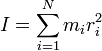
Correct, since the moment of inertia would not increase. Here's the formula for the moment of inertia:

0038e89803b9aeefad5b1fc299b0d086.png


Since r = 0 in the scenario you describe, the moment of inertia is zero.

See, in my head I am picturing two round disks, say 2 feet in diameter, balanced identically with one weighting more than the other. Have a rod sticking out so you can push on them to rotate them. If x force was applied to the rod, I would suspect the acceleration of the lighter one to be higher than that of the heavier one.
Well, it would, assuming the mass density on the two disks was uniform. The heavier disk would have a greater moment of inertia.
 
Back
Top