Aerodynamics Question

Jeremy

New Member
First off, I don't know much about aerodynamics. I pretty much only know the very basics, if that. I understand that an aircraft lifts off the ground from the air flow that is moving over the wings.

So, wouldn't it make for sense to put the engine in front of the wing to increase the amount of air flow substantially?

Thanks, and this is probably a stupid question, so please be patient! :D
 
So, wouldn't it make for sense to put the engine in front of the wing to increase the amount of air flow substantially?

An aircraft design is a compromise of several competing design goals. One goal is to have the thrustline of the powerplant operate through the center of gravity; otherwise, thrust changes cause undesirable pitching moments, either nose up or nose down. Or, if it's offset left or right, it cause disastrous yawing moments left or right.

Next, you must have a place to attach the engine. The airplane already has a passenger compartment, so attaching the engine to the structure that already exists reduces weight and drag.

Realistically, having the propeller slipstream blow over the wings doesn't really buy you much, other than better short field performance. The most generally useful aircraft characteristics are low drag and high thrust, which aren't helped by blowing air over the wings. (Note: Airplanes don't climb due to lift, they climb due to thrust.)
 
An aircraft design is a compromise of several competing design goals. One goal is to have the thrustline of the powerplant operate through the center of gravity; otherwise, thrust changes cause undesirable pitching moments, either nose up or nose down. Or, if it's offset left or right, it cause disastrous yawing moments left or right.

Next, you must have a place to attach the engine. The airplane already has a passenger compartment, so attaching the engine to the structure that already exists reduces weight and drag.

Realistically, having the propeller slipstream blow over the wings doesn't really buy you much, other than better short field performance. The most generally useful aircraft characteristics are low drag and high thrust, which aren't helped by blowing air over the wings. (Note: Airplanes don't climb due to lift, they climb due to thrust.)

Okay, I figured if that would make the airplane have shorter take off length, then it would affect its speed or other things.

But then what you said about not climbing to do lift... If an airplane has a really strong headwind, it can still takeoff without a lot of thrust, right?

<object width="425" height="344"><param name="movie" value="http://www.youtube.com/v/dAx8BT6vcBw&hl=en&fs=1&"></param><param name="allowFullScreen" value="true"></param><param name="allowscriptaccess" value="always"></param><embed src="http://www.youtube.com/v/dAx8BT6vcBw&hl=en&fs=1&" type="application/x-shockwave-flash" allowscriptaccess="always" allowfullscreen="true" width="425" height="344"></embed></object>
 
800px-Antonov-An-74.jpg
 
Tgrayson:

Question - Don't planes climb from having a surplus of lift versus weight? Then isn't lift affected by AOA and A/S (at least those are the elements that we have control over)? You always say things that make me scratch my head but then you are the undisputed expert in aerodynamics so I am just trying to understand your take on it.
 
If an airplane has a really strong headwind, it can still takeoff without a lot of thrust, right?

Yes, but what happens AFTER it lifts off depends on its thrust, or rather, its excess thrust. Don't get me wrong, aircraft need lift, but they only need Lift = Weight. That relationship remains true in any unaccelerated flight, which includes climbs and descents.
 
Don't planes climb from having a surplus of lift versus weight?

Nope. If you actually do the vector math, lift in a climb is slightly less than weight....part of the weight of the airplane is supported by thrust. Same in a descent, except that drag helps out. Regardless, the vertical forces are in equilibrium or there would be a vertical acceleration. Like, falling. ;)

However, your transitions to climbs will require lift > weight, such as via a pullup or increasing thrust, but that extra lift goes away once the climb is established.

Then isn't lift affected by AOA and A/S (at least those are the elements that we have control over)?
Yes, but the natural stability of the aircraft reestablishes the Lift = Weight relationship; otherwise, you'd be pulling a continual load factor. Adding thrust tends to accelerate the airplane, but that increases lift and the aircraft will arc upwards until the rearward component of gravity cancels out the increased thrust, and the aircraft slows to the original airspeed, and the aircraft is established in a climb.
 
Yes, but what happens AFTER it lifts off depends on its thrust, or rather, its excess thrust. Don't get me wrong, aircraft need lift, but they only need Lift = Weight. That relationship remains true in any unaccelerated flight, which includes climbs and descents.

As subpilot said, you seem like the expert on aerodynamics, and I haven't even taken physics in high school yet. Sorry for the stupid questions.

So in the Lift = Weight relationship, does this mean lift is measured by pounds/kilograms?
 
Sorry for the stupid questions.

None of these questions are even remotely stupid.

So in the Lift = Weight relationship, does this mean lift is measured by pounds/kilograms?
Pounds, yes, kilograms, no, because the latter is a unit of mass. Weight is a force and is measured in pounds or Newtons, most commonly. Thrust and drag are also forces, measured in pounds and Newtons.
 
I haven't even taken physics in high school yet. Sorry for the stupid questions.

They are not stupid questions. In our early years we tend to build up misconceptions about how things work that simply require unraveling in physics classes. Once that is done everything makes a lot more sense. Since you are new to science I recommend taking a step back and beginning with basic Newtonian physics. This is the best place to start if you are after a good understanding of aerodynamics. One short book you could read for starters is Six Easy Pieces by Richard Feynman. You can always PM me with any questions you encounter.
 
Or does a headwind count as thrust? :confused:

Headwind counts as airspeed.

It's all potential and kinetic energy. The total is thrust. When you add power you can either take that energy and place it into the potential category (height/Altitude) or kinetic (airspeed). Having a headwind reduces the total amount of energy you need to get to your goal speed for takeoff.

It's like this, what requires more total energy to move... a Cessna 172 or a Boeing 737? The C172 is obvious, but why? The C172 needs less total lift to takeoff, and the wing is designed as such to fly at a lower speed. So, the c172 has less drag, and less speed requirements to takeoff, resulting in lower energy needs from the engine (thrust). Where that thrust comes from doesn't really matter. However, headwinds are just free energy that they engine didn't have to put out. If you rolled an airplane down a hill it could get enough speed to takeoff. Then you would either need to lose more altitude to maintain speed (convert potential to kinetic, aka glide) or get thrust to overcome the drag (drag does occur always, even at .0001 kts). BTW, when you get to commercial, ask why winglets create thrust.
 
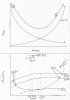
So it's early, forgive the wobblyness of the picture but I couldn't find a curve I liked online so I just drew one out.

Hopefully you all know the drag curves by now. The point of lowest drag is not necessarily where induced and parasite meet. Just wanted to cover that while we're here.

The bottom graph is of power available. There is a certain about of ram air pressure for the engine as it speeds up, but most of this curve is due to propeller efficiency. The prop needs a certain amount of airspeed to work properly. At that point it is most efficient, past that point in either direction it loses efficiency, hence the curve. Where power and drag meet at low speed, that is your Power On Stall Speed. Where they meet at high speed is your Max Cruise Speed.

Now, max rate of climb over time occurs at max power/drag. This is Vy. Vx can be calculate by a percent from power on stall speed to Vy if I remember correctly from this graph, but I'm not sure. Either way as you increase altitude you lose power from less air going in the engine and less air the propeller can push against. So, max cruise speed decreases, power on stall speed increases, Vx increases and Vy decreases.

Your rate of climb depends on the power available with this graph. Real example, an F-18 has more thrust than weight at times and can accelerate while going vertical. A Piper Cub at max weight has a great wing, but a small engine and on some days can have a hard time getting into the traffic pattern. Power matters.

Also note how drag increases at the end. To go twice as fast, you need 4x the thrust. This even increases dramatically when you go past mach 1.

This is why your C172 has 160hp and does 120, while a Mooney might have 350+ horsepower and goes 200+, a bit more than double, not quite double the speed.

The lowest power curve is power at the absolute ceiling (or close to it, it's 6am here... so still waking up). Power on stall, Vx, Vy, and Max cruise speed are all at the same point. This this never happens? A twin engine aircraft loses an engine loses 1/2 the thrust, and gains another 25% drag from control inputs to keep it going straight. This is very common in twin aircraft.

An example where it's not a twin... ok, the U2 spy plane flies as close as it can to an absolute ceiling.

Any questions, feel free to post, these are very intelligent questions we got here and this is a bit of an overkill answer. I do believe in primacy and learn it right the first time.

 

Attachments

  • ThrustDrag.jpg
    ThrustDrag.jpg
    111.2 KB · Views: 64
Where power and drag meet at low speed, that is your Power On Stall Speed..

Stall speeds have nothing to do with the thrust or power curves. The point you have labeled the power-on stall speed is simply the slowest speed that level flight occurs.
 
Stall speeds have nothing to do with the thrust or power curves. The point you have labeled the power-on stall speed is simply the slowest speed that level flight occurs.

Uh... wouldn't this be the same thing... what am I missing here? As you slow you need increased AOA to maintain lift, the power will assist in reducing some weight off the wings and give a slightly increased airflow over the wing root allowing it to go a tiny bit slower before stalling. How is this not a power on stall?
 
Back
Top