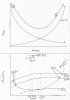
So it's early, forgive the wobblyness of the picture but I couldn't find a curve I liked online so I just drew one out.
Hopefully you all know the drag curves by now. The point of lowest drag is not necessarily where induced and parasite meet. Just wanted to cover that while we're here.
The bottom graph is of power available. There is a certain about of ram air pressure for the engine as it speeds up, but most of this curve is due to propeller efficiency. The prop needs a certain amount of airspeed to work properly. At that point it is most efficient, past that point in either direction it loses efficiency, hence the curve. Where power and drag meet at low speed, that is your Power On Stall Speed. Where they meet at high speed is your Max Cruise Speed.
Now, max rate of climb over time occurs at max power/drag. This is Vy. Vx can be calculate by a percent from power on stall speed to Vy if I remember correctly from this graph, but I'm not sure. Either way as you increase altitude you lose power from less air going in the engine and less air the propeller can push against. So, max cruise speed decreases, power on stall speed increases, Vx increases and Vy decreases.
Your rate of climb depends on the power available with this graph. Real example, an F-18 has more thrust than weight at times and can accelerate while going vertical. A Piper Cub at max weight has a great wing, but a small engine and on some days can have a hard time getting into the traffic pattern. Power matters.
Also note how drag increases at the end. To go twice as fast, you need 4x the thrust. This even increases dramatically when you go past mach 1.
This is why your C172 has 160hp and does 120, while a Mooney might have 350+ horsepower and goes 200+, a bit more than double, not quite double the speed.
The lowest power curve is power at the absolute ceiling (or close to it, it's 6am here... so still waking up). Power on stall, Vx, Vy, and Max cruise speed are all at the same point. This this never happens? A twin engine aircraft loses an engine loses 1/2 the thrust, and gains another 25% drag from control inputs to keep it going straight. This is very common in twin aircraft.
An example where it's not a twin... ok, the U2 spy plane flies as close as it can to an absolute ceiling.
Any questions, feel free to post, these are very intelligent questions we got here and this is a bit of an overkill answer. I do believe in primacy and learn it right the first time.