
You are using an out of date browser. It may not display this or other websites correctly.
You should upgrade or use an alternative browser.
You should upgrade or use an alternative browser.
WWII Helldiver Discovered in San Diego Lake
- Thread starter ladder360
- Start date


trafficinsight
Well-Known Member
As others have mentioned, many WWII aircraft had teething problems. Some never really excelled in their designed roll, but performed well in other rolls. Good examples are the bf-110's success as a night fighter. Here is one of my favorites. It too had many teething problems. It never had a lot of success in its intended roll as a fighter, but became one of the best ground attack fighters of the war.
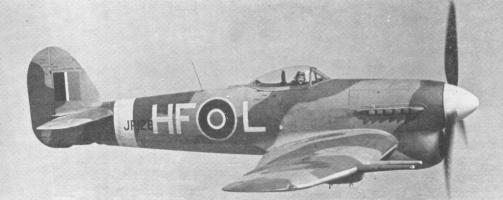
Ah yes, Typhoon/Tempest.... we didn't need that tail section anyway

Actually as far as looks go, I love that airplane, it just looks mean.

ladder360
Well-Known Member
Update on the Helldiver...
http://www3.signonsandiego.com/stor...on-hopeful-salvage-plane/?metro&zIndex=140065
Couple of interesting quotes, including the Pilot's bio, which I think was very well written...
http://www3.signonsandiego.com/stor...on-hopeful-salvage-plane/?metro&zIndex=140065
Couple of interesting quotes, including the Pilot's bio, which I think was very well written...
Recovering the Navy bomber that was ditched 64 years ago in Lower Otay Reservoir will require further analysis that involves dredging, said officials overseeing the project.
“We have to get rid of silt that's covering the plane so we can study the plane's structure and integrity,” said retired Capt. Bob Rasmussen, director of the National Naval Aviation Museum in Pensacola, Fla.
If the SB2C-4 Helldiver is salvaged and restored, it will go to his exhibit space — not the San Diego Air & Space Museum in Balboa Park. Jim Kidrick, president and CEO of the local museum, had expressed interest in keeping the World War II aircraft in San Diego.
“I'd like to clear up that there is no conflict between Jim Kidrick and me,” Rasmussen said. “There won't be any argument as to where the plane will go. It's coming to Pensacola.”
The Frazar clan gathered for a meal last night, and the major topic was E.D. Frazar's life.
He was born April 11, 1923, in the tiny community of Winfree, Texas. His mother died when he was 9, and his father was left to raise nine children on the meager income earned from selling whatever fish he could catch from the nearby Trinity River.
Eventually, the father realized he couldn't provide for the entire household. So he sent some of his children, including 11-year-old E.D. Frazar, to live with relatives.
After conflicts arose between E.D. and his caretaker aunt, he struck out on his own with some clothes stuffed into a cardboard box. He stayed in a rice field where farmers had built a small shed to shelter their animals.
“He told me that he walked into town daily to find work and get whatever food the staff at one of the hotels could sneak to him,” Richard Frazar said.
Leaders of the local Lions Club became aware of E.D.'s situation and asked if anyone could help. Club member Leonard Ansel and his wife, Lela, agreed to adopt the boy because they had no child of their own.
They raised E.D. and eventually celebrated his graduation from high school, then sent him to a military junior college in Kerrville, Texas. A physics teacher there taught students how to fly airplanes, and that sparked E.D. Frazar's love of aviation.
In 1943, Frazar combined his passion for flying and his sense of national duty by enlisting as a naval aviation cadet. He trained in Corpus Christi, Texas, and Pensacola before being transferred to San Diego.
After World War II ended, he left the active-duty Navy in December 1945.
In honor of his adopted parents, E.D. Frazar named the first of his five children Richard Ansel Frazar. He went into ranching and then worked for the U.S. Department of Agriculture until his death at age 56.
Growing up, Richard Frazar heard his father profess a lasting fondness for flying Navy aircraft.
“He missed being in the skies,” Richard Frazar said. “My dad was a very, very patriotic person. He was just part of that whole generation of people who didn't hesitate to serve their country.”

ctab5060X
Well-Known Member
Recovering the Navy bomber that was ditched 64 years ago in Lower Otay Reservoir will require further analysis that involves dredging, said officials overseeing the project.
“We have to get rid of silt that's covering the plane so we can study the plane's structure and integrity,” said retired Capt. Bob Rasmussen, director of the National Naval Aviation Museum in Pensacola, Fla.
If the SB2C-4 Helldiver is salvaged and restored, it will go to his exhibit space — not the San Diego Air & Space Museum in Balboa Park. Jim Kidrick, president and CEO of the local museum, had expressed interest in keeping the World War II aircraft in San Diego.
“I'd like to clear up that there is no conflict between Jim Kidrick and me,” Rasmussen said. “There won't be any argument as to where the plane will go. It's coming to Pensacola.”
As it should (in my opinion).
Considering this could very well end up being the only -4 example in any museum anywhere, it should go to Pensacola.
Now, who is saying Pensacola might not place it "on loan" to the museum in San Diego...

ladder360
Well-Known Member
As it should (in my opinion).
Considering this could very well end up being the only -4 example in any museum anywhere, it should go to Pensacola.
Now, who is saying Pensacola might not place it "on loan" to the museum in San Diego...
I don't disagree, but what caught my attention was that the actual quote (if in fact it is actual - thanks distrust in media!) seemed very assertively aggressive. Makes me wonder what the debate was like on the inside.