WWII Helldiver Discovered in San Diego Lake

ladder360

Well-Known Member
Cool looking aircraft, but it sounds like it was kind of a POS. Waco? Ctab? What say you?

http://www3.signonsandiego.com/stories/2009/jul/21/search-fish-unearths-history/?metro&zIndex=135432

Just a snippet of the article.....

“I turned to my fishing buddy and said, ‘That looks like a plane,’ ” Johnson said.


He downloaded the images from his Humminbird Fish Finder and shared them with Bryan Norris, reservoir keeper for the city of San Diego's water department. An investigation began and now Johnson's incredible discovery in February has led divers to uncover a Navy bomber that was forced into a water landing 64 years ago.


On Thursday, Navy divers from Coronado, ranger-divers for the city's lakes system and a private company from Chicago experienced in recovering aircraft from the Great Lakes will try to see whether the SB2C-4 Helldiver is worth salvaging.
 
Dang, that's pretty cool! That'd be awesome if they recover it and restore it! Such history!
 
cool article. Wish they posted some pics of the fish finder or something like that.

=Jason-
 
Blasphemy!

Fundamental rule of avitation:

All WW2 aircraft are cool. Some are cooler than others, but even a Brewster Buffalo has a round engine and a tailwheel.

Anyone who get excited about winglets on a kerosene burner, but doesn't drool over a DC-3, needs to have their certificate revoked.


FYI the Helldiver helped sink the largest battleship ever afloat.
 
Blasphemy! The Helldiver was a cool Curtiss aircraft and very rare.

:laff:

I don't know what constitutes "rare", and I don't know much about the aircraft, but according to the article there were 30,000 of these built and attrition was pretty high due to mechanical failures?

The United States built about 30,000 planes in the overall Helldiver family, but most of them crashed or were shot down during World War II. The aircraft suffered from structural weaknesses, an unreliable electrical system and engines that often stalled — the problem that caused the landing at Lower Otay Reservoir.
 
Fundamental rule of avitation:

All WW2 aircraft are cool. Some are cooler than others, but even a Brewster Buffalo has a round engine and a tailwheel.

Anyone who get excited about winglets on a kerosene burner, but doesn't drool over a DC-3, needs to have their certificate revoked.


:yeahthat: Much agreed!
If it ain't leakin' oil - it's out.
 
Cool looking aircraft, but it sounds like it was kind of a POS. Waco? Ctab? What say you?

You called? :)

Seems the question here is whether or not the Curtis SB2C Helldiver was a POS airplane or not... so here is my opinion... (with that and $0.50, you can put a downpayment on a cup of coffee :cool:)

The answer to the POS question is both yes and no.

Aha... whaaatttt??? yes and no???? :confused:

Confused... good. :D

Like several other WWII aircraft (including the beloved Mustang), the Helldiver suffered from massive growing pains. Not saying it was a bad airplane, but it had "issues". It was originally designed to replace the Douglas SBD Dauntless (of Midway fame). Much larger airframe capable of varied armament, including an internal bomb that that reduced drag when carrying larger payloads. For reference, the Dauntless carried everything externally.

As a testament to the airplanes issues, both prototypes crashed. Issues included structural weakness, poor handling, and instability among other things. Before the airplane even went to production, it was heavily modified design wise to correct these problems. These large changes delayed the Helldiver's apperance in the fleet until late 1943. And when it got to the fleet, it flat out failed to impress.

It was larger and heavier than the Dauntless, the -1 variant crews were forbidden to dive bomb in a clean configuration due to structural issues. Now, keep in mind, dive bombing was what this airplane was designed to do! :banghead: It also had issues with range, electrical system, hydraulics... you name it, it probably had a problem. :panic:

HOWEVER....

By the time the SB2C-4 made it to the fleet, most of these problems had been solved. With the problems fixed, the airplane finally started to fly like it was designed... keeping up with escorts on longer missions with larger payloads. The Helldiver would go on to see service in the Marianas, Leyte Gulf, and Okinawa, among others. During the Okinawa campaign, the Helldiver participated in the attack that led to what USMCmech said... the sinking of the largest battleship afloat, the Yamato.

It was an airplane designed for dive bombing, and once it got past its growing pains, the airplane did it's job and did it well enough.

In my opinion, the airplane was good, but I don't think the airplane was as good as it could have been. It was designed as a replacement for the Dauntless, but it didn't fully replace it's predecesor. The Dauntless remained in the fleet for another year after the introduction of the Helldiver.

... but according to the article there were 30,000 of these built...

Not sure where that reporter is getting that kind of number... there were less than 8000 built. Heck, there were just under 13,000 B-17s built! The only way I can see the 30,000 number being plausable is they use the term "Helldiver family" This theoretically could be applied to the Helldiver, Avenger, Dauntless, and Devastator. Total production of those was about 25,000 during the war.


I did notice the article listed it as an SB2C-4 and would take $400,000 to recover and restore. Funny thing is... I think this needs to be done. If this airplane (a -4) can be recovered and restored, it would be the only surviving SB2C-4 airframe in the world! FYI, there is only one surviving Helldiver that is flying... the CAF owns it and it is a SB2C-5.

helldiver_12.sized.jpg
 
Issues included structural weakness, poor handling, and instability among other things. Before the airplane even went to production, it was heavily modified design wise to correct these problems. These large changes delayed the Helldiver's apperance in the fleet until late 1943. And when it got to the fleet, it flat out failed to impress.

It was larger and heavier than the Dauntless, the -1 variant crews were forbidden to dive bomb in a clean configuration due to structural issues. Now, keep in mind, dive bombing was what this airplane was designed to do! :banghead: It also had issues with range, electrical system, hydraulics... you name it, it probably had a problem. :panic:


The main thing about WW2 that fascinates me is the industrial might that the USA brought to bear in a remarkably short period of time. How did we take the B-29 from a sheet of paper to 3,000 airframes in under 4 years? Liberty ships were launched in under a week. Ford was rolling out a B-24 every 90 minutes.

One of the ways that this was done was that in many cases these planes were flying deathtraps. Safety precautions were bypassed, fundamental design flaws were simply accepted and dealt with, rather than slowing down production. The rear facing engineers pannel im the B-29 was instantly determined to be a mistake but the design had been set and could not be changed,

Once a B-29 was completed, it was imeadiately flown to a modification factory to "fix" all the problems that had been discovered.


The same thing was true for training, pilots were checked out in high performance aircraft with less than 300 hours TT.
 
Various sites list production around 7100. I was at St. Simons in south Georgia. At one time SB2Cs were based there. The story was the nickname was 'SonofaBit*h 2nd class'. It was not the best of performers but it sufficed at the time.

What I did not know is the French bought more than 100 in the late 40s and flew it until 1958 including a few tours in Vietnam. Never saw any airframes on plinths or on display but there was 1 Bearcat at the VNAF Officers Club at Bien Hoa.

The only problem may be the response from the Navy. What was the find a few years ago? Some guy found a rare bird and the Navy said if he salvaged it, it belonged to the Navy?

story found here.

http://www.history.navy.mil/branches/org12-7f.htm
 
Once a B-29 was completed, it was imeadiately flown to a modification factory to "fix" all the problems that had been discovered.

Not only fix but also incorporate lessons from the field. B-24s were ferried from Willow Run to Alabama for refit. Lindbergh complained about the way airplanes were accepted. Contracts called for FULL tanks but the short trip from MI to AL left the fuel tanks mostly full. The fuel was however downloaded and considered contaminated and therefore not to be reused.

Like lots of other events, LOTS of waste and no real incentive to correct the problem.
 
Ctab got here first, and he gave you the run down.

I would also agree that ALL WW2 aircraft were cool. In fact, a Brewster Buffalo would be my choice of a fighter mount simply because of its rarity - I mean, everyone has a Corsair or Mustang.

One airplane that I always really liked the looks of, but have never seen an example of at an airshow, is a TBD Devastator. Would LOVE to grab one of those. Again, not a good or great airplane, but rare and neat.
 
It was an airplane designed for dive bombing, and once it got past its growing pains, the airplane did it's job and did it well enough.

Minus the dive bomber portion of your comment, the F-111 was the same ala growing pains, yet look at the success it turned out to be.
 
One airplane that I always really liked the looks of, but have never seen an example of at an airshow, is a TBD Devastator. Would LOVE to grab one of those. Again, not a good or great airplane, but rare and neat.

BOY!!! Talk about rare!

130 total were built. 35 of them wiped out at Midway without ever hitting thier targets...

No examples exist in any condition (flying, museums, or personal collections)

In my opinion, this particular airplane (the Devastator) and subsequent airframes were the exact opposite of the Helldiver.

While the so-so Helldiver replaced a good airplane in the Dauntless, the outdated Devastator was replaced by the Avenger.

Devastator:
TBD_Devastator_2.jpg
 
Various sites list production around 7100. I was at St. Simons in south Georgia. At one time SB2Cs were based there. The story was the nickname was 'SonofaBit*h 2nd class'. It was not the best of performers but it sufficed at the time.

What I did not know is the French bought more than 100 in the late 40s and flew it until 1958 including a few tours in Vietnam. Never saw any airframes on plinths or on display but there was 1 Bearcat at the VNAF Officers Club at Bien Hoa.

The only problem may be the response from the Navy. What was the find a few years ago? Some guy found a rare bird and the Navy said if he salvaged it, it belonged to the Navy?

story found here.

http://www.history.navy.mil/branches/org12-7f.htm
The Navy has a complete record of all aircraft that has ever been part of it's inventory; which is kept by the Naval Historical Society with the help of the Naval Aviation Museum (Pensacola) at the Washington D.C. Naval Yard. All aircraft remain on the books until they are destroyed. Wrecks remain on the books and remain property of tha Navy. All those Naval aircraft on diplay at museums around the country are either property of the Navy or have been sold. Most remain property of the Navy.
 
The Navy has a complete record of all aircraft that has ever been part of it's inventory; which is kept by the Naval Historical Society with the help of the Naval Aviation Museum (Pensacola) at the Washington D.C. Naval Yard. All aircraft remain on the books until they are destroyed. Wrecks remain on the books and remain property of tha Navy. All those Naval aircraft on diplay at museums around the country are either property of the Navy or have been sold. Most remain property of the Navy.

If I remember correctly, the fact that the aircraft still belong to the Navy is how the Naval Aviation Museum got a fair portion of their collection.
 
If I remember correctly, the fact that the aircraft still belong to the Navy is how the Naval Aviation Museum got a fair portion of their collection.
Well the Naval Aviation Museum is actually a branch of the Naval Historical Society, which is actually part of the Navy and funded by the National Defense Bill each year. The Marine Corps Museum at Quantico is also another branch of the Naval Historical Society. That's why they are both located on the actual military bases. The Air Force Museum at Wright Patterson is run more loosly than the Navy runs theirs. That's why you'll find aircraft that are in the Air Forces current inventory on display like the F-22 and the B-2. NAVAIR won't give up an aircraft until it's lived it's service life and is no longer needed, but the first one always goes to the Naval Aviation Museum. I actually helpd deliver one of our H-46's to the museum and it's now on display down there in Pensacola. I do wish the Navy would part with some more funds so they could build a bigger facility to hold the aircraft and protect them from the elements, and also allow visitors to see all the aircraft up close versus seeing them from a tram ride on the ramp.
 
The Navy has a complete record of all aircraft that has ever been part of it's inventory; which is kept by the Naval Historical Society with the help of the Naval Aviation Museum (Pensacola) at the Washington D.C. Naval Yard. All aircraft remain on the books until they are destroyed. Wrecks remain on the books and remain property of tha Navy. All those Naval aircraft on diplay at museums around the country are either property of the Navy or have been sold. Most remain property of the Navy.

...and that sis policy. But why am I going to salvage a rare bird to have it taken and put on display by the Navy? And as noted in the article, the Navy policy is starkly different from the USAF. One has to wonder how some guys got around the policy with such notables as this one.

2735739955_86c5a0bdd5.jpg


The policy is almost as stupid as the one at ICE/Homeland Security which recently seized an A-1 in Alabama. The A-1 was coming in from France. Like someone is going to use an A-1 for a delivery platform. (Note.. the aircraft was delivered originally as a AD-4N) Meanwhile, you can buy an L-39Z or even a MiG. ???
 
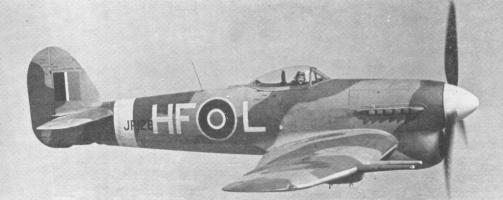
As others have mentioned, many WWII aircraft had teething problems. Some never really excelled in their designed roll, but performed well in other rolls. Good examples are the bf-110's success as a night fighter. Here is one of my favorites. It too had many teething problems. It never had a lot of success in its intended roll as a fighter, but became one of the best ground attack fighters of the war.

typhoon5.jpg
 
Back
Top