What's a TRU?

coolpilot06

New Member
Saw this on an interview gouge...What is a TRU? (I'm assuming it's some kind of system - but we all know what they say about assumptions :)) I tried to google it and ran a search here but couldn't find it. If anybody has any incling it's appreciated. Thanks!
 
Part of an electrical system on some aircraft.

Transformer
Rectifier
Unit

Converts AC to DC electricity
 
Well to my understanding -
T - Transformer part - steps voltage up or down
R - Rectifier part - converts AC power to DC power
 
I think it's on the Pinnacle written test, too. CRJ has 5. I think the question actually asks how many are on the plane.
 
well my seminole supp says it is a diod. gotta start learning this plane. why cant every plane be a simple as a cessna?
 
Completely unrelated to this thread, but related to Fly4Pay's company and avatar, CHA was like an Airtran parking lot yesterday. 3 737s and a pair of 717s. You'd almost have thought they had started another hub.
 
diode is used to convert ac to dc...so, it's a part of the transformer.

I've learned a lot about electricity and electronics in the air conditioning industry, and I find it very interesting.

Transformers step voltage either up or down using a coil wire. A voltage is introduced to the coil, which generates a magnetic field. Another coil next to the first coil passes through the field and voltage is generated in the second coil, with an iron bar between the two coils. Voltages are determined by the number of turns in the coil:

280px-Transformer_under_load.svg.png


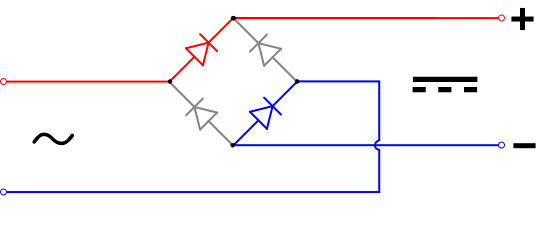
Diodes act like electrical check valves. They only allow current to flow in one direction. Looking at the diode symbol below, the direction of flow is the same as the point of the triangle. When you assemble 4 diodes to form a bridge rectifier you convert A/C to D/C. The curved line represents A/C and the solid/dashed line represents D/C.

557px-Diode_bridge_alt_1.svg.png
 
Completely unrelated to this thread, but related to Fly4Pay's company and avatar, CHA was like an Airtran parking lot yesterday. 3 737s and a pair of 717s. You'd almost have thought they had started another hub.

Woah. How? I thought CHA was closed for diverts? At least, that's what I saw in the NOTAMs the other day (and every other time I've flown in there).

As for the -200.....well, I don't fly the -700 or -900, so I wouldn't know about that. :) Plus, the written test here for the interview is based on the -200 anyway. Why anyone needs to know that stuff BEFORE ground school boggles my mind.

What did they do on the -700/900? Combine two DC buses to one TRU?
 
I didn't know that about CHA. There were the Trannies plus a Frontier BabyBus and two ASA CRJs. Pretty busy ramp.

They dropped the Service TRU on the 700/900. Also, they are uprated to 120 amps. The really cool thing is that in addition to the DC ties that are the same as the 200 there is a link between ESS TRU 1 and ESS TRU 2 that is upstream of the TRUs. So if you loose power to ESS TRU 2 due to an AC failure you can still power it by the same AC power source as ESS TRU 1.
 
So it's pretty much the opposite of an inverter, right?
Correct.
An inverter converts D/C to A/C.

300px-Squarewave01CJC.png


The red line above represents D/C, and is converted into A/C which is the full sine wave of the blue line. Remember D/C is direct current, and A/C is alternating current. So when you see a sine wave like the blue line, it is alternating, usually at 60 Hz in the USA. Some countries use 50 Hz.

A simple inverter:

180px-Inverter_ckt_01cjc.png

Here the D/C circuit starts where the + symbol is, goes through the transistors, and into the coil. This generates a magnetic field. An iron core separates the D/C coil, from the A/C coil. The A/C coil is energized by the magnetic field and is converted to A/C where it shows output.

It can get pretty complicated when you have 3 phases, and multiple transistors. This is the principle behind variable speed motors, like some home Air conditioning blower motors. You can vary the speed of the motor by changing the frequency of the sine wave. This technology is used in commercial and industrial buildings to control motor speed of pumps and fans, saving money on electricity bills.
 
Back
Top