I was reading Sled Driver (excellent book btw) and the author was saying how the SR-71 would take on about 70,000 lbs worth of fuel after takeoff. This lead me to wonder how tankers deal with w/b changes during air to air refueling. Is the effect noticeable during refueling?

You are using an out of date browser. It may not display this or other websites correctly.
You should upgrade or use an alternative browser.
You should upgrade or use an alternative browser.
Tanker W/B
- Thread starter BCTAv8r
- Start date
gulfstreampiper
Well-Known Member
For us(KC-10), the flight engineer monitors it during the refueling. He shifts fuel around before, during, and after refueling to keep the weight and balance within limits. As the tanker, with the autopilot on, it isn't quite noticeable just a small decrease in power as the weight decreases. With the autopilot off, it requires a slight change in trim every 5-10 thousand pounds of transfer.
For us(KC-10), the flight engineer monitors it during the refueling. He shifts fuel around before, during, and after refueling to keep the weight and balance within limits. As the tanker, with the autopilot on, it isn't quite noticeable just a small decrease in power as the weight decreases. With the autopilot off, it requires a slight change in trim every 5-10 thousand pounds of transfer.
Interesting. Thanks for the response.
What's the most challenging aircraft to refuel?

Lucky8888
Well-Known Member
Interesting. Thanks for the response.
What's the most challenging aircraft to refuel?
Any aircraft where the co-pilot is doing it for the first time.

The Fez
Analog Millennial
As others have said, the autopilot makes trim inputs that make the CG shift somewhat unnoticeable during refueling. However, poor offload planning will have some pretty serious consequences as to where the CG ends up and what fuel there is left to manage it. I've heard stories where KC-135's began tipping back on their tails when a crewmember hopped off the ladder after shutdown.I was reading Sled Driver (excellent book btw) and the author was saying how the SR-71 would take on about 70,000 lbs worth of fuel after takeoff. This lead me to wonder how tankers deal with w/b changes during air to air refueling. Is the effect noticeable during refueling?

///AMG
Well-Known Member
I like to b**ch about tanker TTPs such as driving into the only thunder cloud on an otherwise sunny day, or hot nosing the joining receiver until they have to make a 7-9G turn to make the join happen, but I do respect them for managing the ancient equipment they are working with, and for how helpful they mean to be in spite of it.

ppragman
No pasa nada.
For us(KC-10), the flight engineer monitors it during the refueling. He shifts fuel around before, during, and after refueling to keep the weight and balance within limits. As the tanker, with the autopilot on, it isn't quite noticeable just a small decrease in power as the weight decreases. With the autopilot off, it requires a slight change in trim every 5-10 thousand pounds of transfer.
That's pretty damn cool. How long do these transfers take? I mean, if opsec is an issue, I get it, but I can picture a scenario where you either need monster pumps to move fuel around quickly or you have an insanely busy flight engineer.

Hacker15e
Who am I? Where are my pants?
I like to b**ch about tanker TTPs such as driving into the only thunder cloud on an otherwise sunny day, or hot nosing the joining receiver until they have to make a 7-9G turn to make the join happen, but I do respect them for managing the ancient equipment they are working with, and for how helpful they mean to be in spite of it.
Ah, yes...the combination "tanker-lead-turn-fighter-turn-on" that ends up with both jets meeting high aspect.
In the spirit of that, here's shot of whales humping, or, chubbies doin' it animal style over Afghanistan in 2007. Cheers, tanker bros -- you make the fight possible.
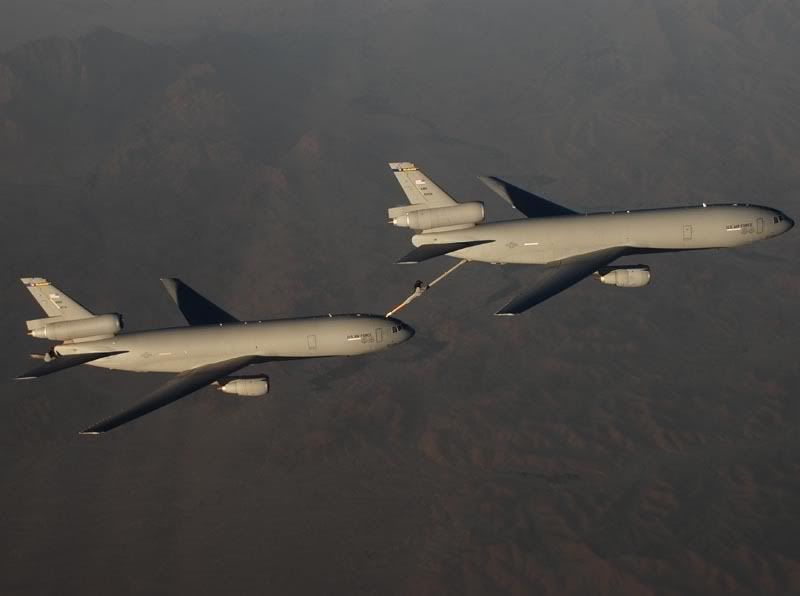
Ah, yes...the combination "tanker-lead-turn-fighter-turn-on" that ends up with both jets meeting high aspect.
In the spirit of that, here's shot of whales humping, or, chubbies doin' it animal style over Afghanistan in 2007. Cheers, tanker bros -- you make the fight possible.
I wonder if you could get another behind there. lol
///AMG
Well-Known Member
I wonder if you could get another behind there. lol
That's the tanker version of human centipede……
gulfstreampiper
Well-Known Member
Interesting. Thanks for the response.
What's the most challenging aircraft to refuel?
C-130s because they are so slow.
That's pretty damn cool. How long do these transfers take? I mean, if opsec is an issue, I get it, but I can picture a scenario where you either need monster pumps to move fuel around quickly or you have an insanely busy flight engineer.
All depends on the airplane we are refueling. Some can allow us to use more pumps than the others. Usually the ones that can use more fuel pumps are the larger airplane that are usually taking larger quantities of as gas anyways.
We try to accommodate the receiver as much as we can. I usually let them coordinate the rejoin. They are smaller and more maneuverable, and have radar. "Tell me where you want me and I'll be there." I can't see a tiny fighter jet until he is within a mile from me. Then there is other things like keeping them in a certain area so they can get back in the fight quicker, try turning to keep the sun out of their eyes as much as possible, etc. I like to think of it as a customer service job, we are there so they can get the gas to get the mission done. Provide the most gas and best service you can. Yeah things don't always go as planned and you have to make sacrifices by putting the receiver in the sun or flying him through a cloud but trust me, that stuff is never done on purpose or intentionally.

Refueling in the A-10 was always a pain, as at altitude we were struggling to keep our speed up, and the tanker was struggling to not fall out of the sky. If we had room to tobaggan, then no biggie, but if we're hard altitude or at the bottom of our block, well....then it's catch the tanker in the inside of his next turn, and hope to have enough power to push through precontact.
With out A/R port in front of the canopy, as opposed to behind it, there were many times when it seemed like the boomer didn't want to move to plug me, even as I'm sitting about a foot or two from the boom knuckle. A number of times, I've maneuvered in to the boom and self-plugged, which the boom didn't seem to have an issue with. Problem with the front located port was that now I'm staring at the A/R boom. The negative of it is, that I can't see the director lights, or at best can only see one side of them if I bend my head around to look around the boom. The positive of it is I can easily see the colors of the boom shaft to know if I'm drifting too far in/out. Up/down was easy, as all you do is place the G-meter and compass located midpoint on the canopy front bow, place those "behind" the two inboard engines of the tanker, and that takes care of the up/down positioning.
What sucked, was if there was a tanker with a leaky boom knuckle. Whereas if the A/R receptacle was behind me like on the F-117/F-4/F-16, I wouldn't even notice; with it in front of me, all the leaking JP goes all over the front windscreen, blurring anything I'm looking at including the boom, and now making all I can do hold the compass/G-meter references in place, tough enough. On the KC-10, at the end of the boom and facing the receiver, are these two white lights, which I figure are to illuminate the A/R receptacle for night refueling. Again, with the A/R receptacle behind me, no big deal. But a few times, the boomer would turn those on to illuminate the A/R door on the A-10 (if my own illum light was dim or out) and now I have two bright white lights shining in my face about 3 feet in front of me, lol. Always made for good times.
Always loved the KC-10 director lights, bright as heck, marked/labled as to what they were so I didn't have to remember the Don't F Up Again mnemonic, and shows trending information of where I'm moving/drifting to as I'm doing it, rather than just a box of lights changing from this box to the next, and with arrows pointing in the direction of what/how I need to be correcting. And colored from green to yellow to red. All good stuff.
With out A/R port in front of the canopy, as opposed to behind it, there were many times when it seemed like the boomer didn't want to move to plug me, even as I'm sitting about a foot or two from the boom knuckle. A number of times, I've maneuvered in to the boom and self-plugged, which the boom didn't seem to have an issue with. Problem with the front located port was that now I'm staring at the A/R boom. The negative of it is, that I can't see the director lights, or at best can only see one side of them if I bend my head around to look around the boom. The positive of it is I can easily see the colors of the boom shaft to know if I'm drifting too far in/out. Up/down was easy, as all you do is place the G-meter and compass located midpoint on the canopy front bow, place those "behind" the two inboard engines of the tanker, and that takes care of the up/down positioning.
What sucked, was if there was a tanker with a leaky boom knuckle. Whereas if the A/R receptacle was behind me like on the F-117/F-4/F-16, I wouldn't even notice; with it in front of me, all the leaking JP goes all over the front windscreen, blurring anything I'm looking at including the boom, and now making all I can do hold the compass/G-meter references in place, tough enough. On the KC-10, at the end of the boom and facing the receiver, are these two white lights, which I figure are to illuminate the A/R receptacle for night refueling. Again, with the A/R receptacle behind me, no big deal. But a few times, the boomer would turn those on to illuminate the A/R door on the A-10 (if my own illum light was dim or out) and now I have two bright white lights shining in my face about 3 feet in front of me, lol. Always made for good times.
Always loved the KC-10 director lights, bright as heck, marked/labled as to what they were so I didn't have to remember the Don't F Up Again mnemonic, and shows trending information of where I'm moving/drifting to as I'm doing it, rather than just a box of lights changing from this box to the next, and with arrows pointing in the direction of what/how I need to be correcting. And colored from green to yellow to red. All good stuff.

Soku39
Well-Known Member
F-117/F-4/F-16
Dude, I didn't know you flew vipers too. What haven't you done?
That's pretty damn cool. How long do these transfers take? I mean, if opsec is an issue, I get it, but I can picture a scenario where you either need monster pumps to move fuel around quickly or you have an insanely busy flight engineer.
Just to go off topic... Transferring 1.5 million gallons from the tanker through 2 double STREAM rigs (4 connections) took 14 hours connected alongside. 1 million gallons of DFM for the ship and 500,000 gallons of JP-5 for the aircraft.
The million gallons is enough to get the ship all the way across the pacific, 500,000 gallons is enough for the embarked Marine HMM squadron (36 helos - I guess Ospreys now - and Harriers) to fly 5 cycles daily for a month before we need to hit the tanker again off Guam.
The tanker actually gets heavier as fuel is offloaded as their fuel tanks are back filled with seawater which is obviously heavier than fuel.
Crappiest thing I had to refuel were a pair of minesweepers. I wasn't even a tanker just an amphib that must have pissed someone off to get the minesweep escort tasking. Their max speed was 10 knots on a good day with tailwinds and following seas. Had to astern fuel those things every 5 days at a speed of 5 knots. It to us 6 weeks to drag the mine sweeps across the Pacific to Korea. No more After that the navy paid commercial barges to transport minesweeps across the ocean in similar fashion how they got USS Cole home after she got bombed in Yemen.
Hacker15e
Who am I? Where are my pants?
Dude, I didn't know you flew vipers too. What haven't you done?
I believe he was listing jets with the aft-of-the-canopy location of the A/R receptacle, not listing jets he's flown with it there.
Dude, I didn't know you flew vipers too. What haven't you done?
Never assigned to Vipers, just a few rides in them. A number of flights on the F-4. But yeah, was generally speaking of jets with A/R receptacles behind the cockpit.
Soku39
Well-Known Member
Never assigned to Vipers, just a few rides in them. A number of flights on the F-4. But yeah, was generally speaking of jets with A/R receptacles behind the cockpit.
Ah, got it.

Springer
Well-Known Member
Any aircraft where the co-pilot is doing it for the first time.
Or if the Wing Commander is flying. As his IP I guarded the stick closely.
Am I the only one here that has refueled from a KC-97?
Springer
Well-Known Member
What sucked, was if there was a tanker with a leaky boom knuckle.
It was leaked so bad in the A-37 it looked like one of those planes in a wind tunnel with a smoke generator in front showing the airflow across the fuselage. Like you Mike we went IFR. Another time after a disconnect fuel continued pour out of the boom directing into our intake flaming out one of the engines. Surprised we did not blow up.