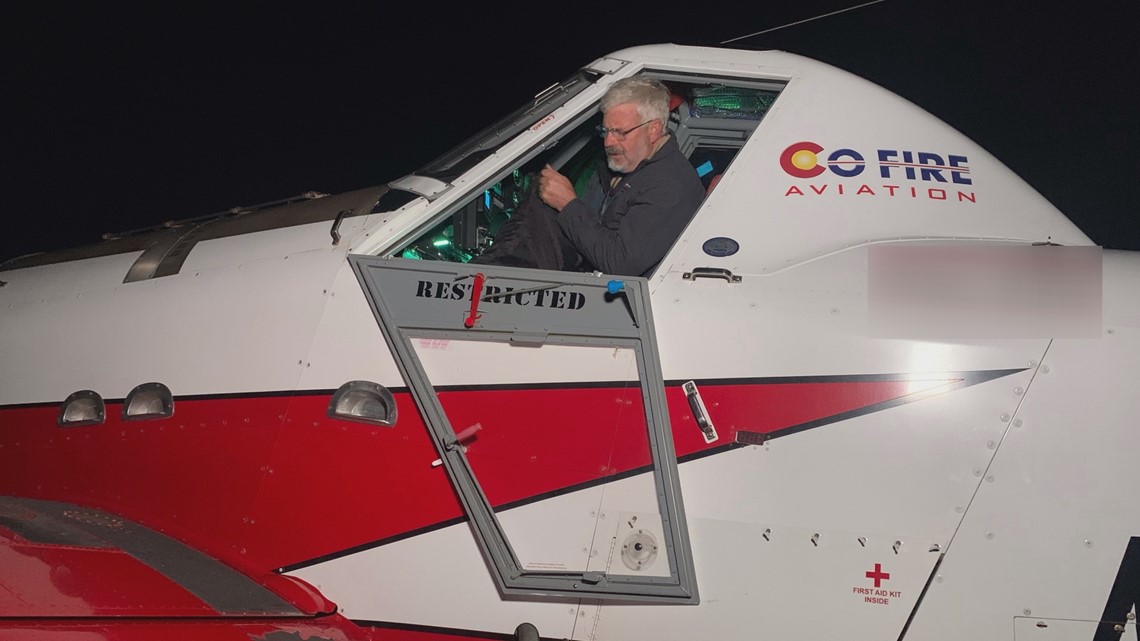
Tanker crash battling November fire

bike21

9-5 Ruins Lives
So we had a fresh fire start this morning in Colorado just outside of Estes Park. Sadly hearing reports that what was to be the first tanker ever to fight a fire at night has reportedly crashed. Hope it’s not the case and if so somehow the pilot makes it out alive.

 
Last edited:
View from earlier climbing out of DEN…

EDEE1507-0315-4C42-8267-6D10FEC22B67.jpeg
 
Nothing much to be gained fighting the fire by air at night, from a risk vs reward standpoint. Wildfire behavior and activity is generally reduced at night anyway, making further defensive ground firefighting operations more feasible and effective, such as control line construction by personnel or tractors, and the beginning of slow burnout operations anchored to those and projecting inward towards the fire also at a slow pace. A fixed wing, or even a helicopter, isn’t going to accomplish much when compared to the high risk of undertaking aerial suppression operations at night. Sure, being the first guy to undertake them is cool and has some bragging rights in the aerial firefighting community; but is mostly impractical.
 
There is nothing about fighting fires like this that makes sense. MAYBE a grass or field fire on fairly level ground, but not in mountainous terrain. RIP!
 
Nothing much to be gained fighting the fire by air at night, from a risk vs reward standpoint. Wildfire behavior and activity is generally reduced at night anyway, making further defensive ground firefighting operations more feasible and effective, such as control line construction by personnel or tractors, and the beginning of slow burnout operations anchored to those and projecting inward towards the fire also at a slow pace. A fixed wing, or even a helicopter, isn’t going to accomplish much when compared to the high risk of undertaking aerial suppression operations at night. Sure, being the first guy to undertake them is cool and has some bragging rights in the aerial firefighting community; but is mostly impractical.
This was the first I'd heard of nighttime ops possibly being a thing and thought daytime was sketchy enough. It would seem they did plenty of training and risk assessment but yeah, fire growth at night especially right now when the temps dipped below freezing last night and it snowed - just doesn't seem worth the risk.

The terrain around there is punchy too, the town sits in a bowl of sorts and fire was on the southwest side into rising terrain. Lots of points where things could go wrong.
 
Just absurd that they would even try such operations and I was godsmacked when I heard Larimer County was ordering the asset for this op. Maybe, MAYBE, a multi crew aircraft could get away with it but single pilot?!! Once again companies/controlling agencies playing cowboy with a pilots life for a fire that had absolutely no need for it. Jesus the WX alone and overnight recoveries predicted had little need for such a brazen operation. What a waste.
 
This was the first I'd heard of nighttime ops possibly being a thing and thought daytime was sketchy enough. It would seem they did plenty of training and risk assessment but yeah, fire growth at night especially right now when the temps dipped below freezing last night and it snowed - just doesn't seem worth the risk.

The terrain around there is punchy too, the town sits in a bowl of sorts and fire was on the southwest side into rising terrain. Lots of points where things could go wrong.

The risk assessment seemed to be lacking, especially the risk vs reward portion. I’d mentioned to someone else that the air tanker community has already had its ass handed to it once back in 2002c when they were all grounded due to aircraft literally falling apart in midair and crews being killed.

Believe me, I loved the airtanker community back then, with so many old school aircraft still flying missions…..PB4Y, A-26, and even the 80s with C-119, B-17, PV-2. But these planes were getting old and worn out…..the continuous dropping of 10,000 lbs in the span of a few seconds, multiple times a day, eventually wore out structural components similar to the constant bending back and forth of a paper clip. Wasn’t as much of a problem with the more solidly structured aircraft like the P-2 and P-3 and the Douglas DC-4/6/7 series, and hence why those lasted longer.

Now, it seems the clock is winding back to 2002 not with old aircraft that are falling apart, but with fire suppression tactics methodology that is very high risk, with low reward.

The 2002 grounding and its aftermath sought to revamp the cowboy nature of the airtanker business, but it may have popped its head up again 20 years later.
 
The risk assessment seemed to be lacking, especially the risk vs reward portion. I’d mentioned to someone else that the air tanker community has already had its ass handed to it once back in 2002c when they were all grounded due to aircraft literally falling apart in midair and crews being killed.

Believe me, I loved the airtanker community back then, with so many old school aircraft still flying missions…..PB4Y, A-26, and even the 80s with C-119, B-17, PV-2. But these planes were getting old and worn out…..the continuous dropping of 10,000 lbs in the span of a few seconds, multiple times a day, eventually wore out structural components similar to the constant bending back and forth of a paper clip. Wasn’t as much of a problem with the more solidly structured aircraft like the P-2 and P-3 and the Douglas DC-4/6/7 series, and hence why those lasted longer.

Now, it seems the clock is winding back to 2002 not with old aircraft that are falling apart, but with fire suppression tactics methodology that is very high risk, with low reward.

The 2002 grounding and its aftermath sought to revamp the cowboy nature of the airtanker business, but it may have popped its head up again 20 years later.
Good history, I guess change my 'seemed' to do risk assessment to would have 'hoped'. I prefer to give the deceased the benefit of doubt but this does seem like some shall we say interesting decision making.
 
Good history, I guess change my 'seemed' to do risk assessment to would have 'hoped'. I prefer to give the deceased the benefit of doubt but this does seem like some shall we say interesting decision making.

i give benefit of the doubt, but risk assessments do involve weighing the risks of known factors. Being the first to undertake some kind of new operations that haven’t been done before, it’s very possible that some or more unknown factors may have been encountered that may not have been taken into account. Hard to say.
 
Nothing much to be gained fighting the fire by air at night, from a risk vs reward standpoint. Wildfire behavior and activity is generally reduced at night anyway, making further defensive ground firefighting operations more feasible and effective, such as control line construction by personnel or tractors, and the beginning of slow burnout operations anchored to those and projecting inward towards the fire also at a slow pace. A fixed wing, or even a helicopter, isn’t going to accomplish much when compared to the high risk of undertaking aerial suppression operations at night. Sure, being the first guy to undertake them is cool and has some bragging rights in the aerial firefighting community; but is mostly impractical.
With all due respect, I think you're missing some really important points here. If you think of fighting fire as warfare, there are many positive tactical advantages to be gained by fighting at night:

1. Winds are usually much lower.
2. Temps are usually much lower.
3. Fire intensity is usually much lower.

4. With good IR, visibility of target is usually MUCH more acute.
5. The heat targets are usually much more confined and defined.
6. It's easier to hit ambiguous/blended targets when they are more clearly differentiated from their background environs.

7. There is less turbulence/ mountain wave/ nutball wind at night.
8. There is less "other stuff going on in the skies and on the comms" at night.
9. Night is calm. Night is peaceful.

High stress performance is always enhanced by beta and gamma... resulting from calm and focus and lack of distraction. The conditions defining "Nighttime" damned near define the set of external conditions conducive to eliciting the desired high-performance set of internal brainwaves.

So, yeah, as opposed to your "nothing much", I'd argue there is actually "quite a lot" to be gained from night ops.

All that said... all that presumes that artificially fighting fires at all is any kind of good idea.

 
Last edited:
With all due respect, I think you're missing some really important points here. If you think of fighting fire as warfare, there are many positive tactical advantages to be gained by fighting at night:

1. Winds are usually much lower.
2. Temps are usually much lower.
3. Fire intensity is usually much lower.

4. With good IR, visibility of target is usually MUCH more acute.
5. The heat targets are usually much more confined and defined.
6. It's easier to hit ambiguous/blended targets when they are more clearly differentiated from their background environs.

7. There is less turbulence/ mountain wave/ nutball wind at night.
8. There is less "other stuff going on in the skies and on the comms" at night.
9. Night is calm. Night is peaceful.

High stress performance is always enhanced by beta and gamma... resulting from calm and focus and lack of distraction. The conditions defining "Nighttime" damned near define the set of external conditions conducive to eliciting the desired high-performance set of internal brainwaves.

So, yeah, as opposed to your "nothing much", I'd argue there is actually "quite a lot" to be gained from night ops.

All that said... all that presumes that artificially fighting fires at all is any kind of good idea.
To summarize: be the tree
 
With all due respect, I think you're missing some really important points here. If you think of fighting fire as warfare, there are many positive tactical advantages to be gained by fighting at night:

1. Winds are usually much lower.
2. Temps are usually much lower.
3. Fire intensity is usually much lower.

4. With good IR, visibility of target is usually MUCH more acute.
5. The heat targets are usually much more confined and defined.
6. It's easier to hit ambiguous/blended targets when they are more clearly differentiated from their background environs.

7. There is less turbulence/ mountain wave/ nutball wind at night.
8. There is less "other stuff going on in the skies and on the comms" at night.
9. Night is calm. Night is peaceful.

High stress performance is always enhanced by beta and gamma... resulting from calm and focus and lack of distraction. The conditions defining "Nighttime" damned near define the set of external conditions conducive to eliciting the desired high-performance set of internal brainwaves.

So, yeah, as opposed to your "nothing much", I'd argue there is actually "quite a lot" to be gained from night ops.

All that said... all that presumes that artificially fighting fires at all is any kind of good idea.

I’m thinking you don’t have any wildland firefighting experience nor experience in low level ops under NVG. Your points, below.

1. true, and already acknowledged.
2. See above
3. See above
4. NVGs will be washed out. Flying unaided, one will only be able to see the fire area and most else will be blacked out, particularly terrain and obstacles.
5. See # 4
6. You can’t see the background environments due to the intensity of the fire, either washing out any NVG picture, or killing night eyeball vision to where surrounding elements can’t be seen.
7. True, but there is still the ground and stuff attached to the ground. That may or may not be able to be seen during a actual drops or other low level ops.
8. Irrelevant to the actual operation and risk.
9. Ground probability of kill when impacting it, is 99.5%

From someone who does low level, NVG ops nightly, and has worked around wildfires in the course of same. As well as being a former wildland firefighter.

Risk does not match the reward. Use the low intensity fire conditions to get a gain on ground firefighting operations, offensive or defensive.

Night firefighting by air is not the same as night crop dusting.
 
I just noticed that this crash site is only about 2 miles from where the PB4Y-2 of Hawkins & Powers Aviation, that I talked about above, crashed in 2002 while fighting the Big Elk wildfire, after a wing separated from the fuselage while they were orbiting the scene waiting on their turn to drop.
 
I just noticed that this crash site is only about 2 miles from where the PB4Y-2 of Hawkins & Powers Aviation, that I talked about above, crashed in 2002 while fighting the Big Elk wildfire, after a wing separated from the fuselage while they were orbiting the scene waiting on their turn to drop.
Pretty sure they lost a helicopter on that fire as well. Estes does not treat aerial firefighting assets well.
 
I just noticed that this crash site is only about 2 miles from where the PB4Y-2 of Hawkins & Powers Aviation, that I talked about above, crashed in 2002 while fighting the Big Elk wildfire, after a wing separated from the fuselage while they were orbiting the scene waiting on their turn to drop.
H&P was amazing and terrifying all at the same time. But what the hell would a guy like me with no wildland firefighting experience know about Greybull, or boxcars, or dark-hour C130s? Joey, have you ever watched Gladiator movies or done a low pass at Lancaster?
 
Back
Top