QNE

BravoHotel

Well-Known Member
In class today we are talking about transition altitude where you input standard pressure into your altimeter etc. In the US that altitude is obviously FL180. But the question is where do you find that altitude for other countries or oceanic? I asked that question and the instructors looks at me like I had a arm growing out of my forehead. Any input would be most appreciated.
 
As mentioned above they are on either departure or approach charts for the individual airports. If I remember correctly; if not specified in a departure, the altitude shown on the arrival that is from the same direction as the departure to be flown should be used.
One note of caution: even airports within the same country and within short distances MAY have different transition altitudes.......be vigilant!
 
In class today we are talking about transition altitude where you input standard pressure into your altimeter etc. In the US that altitude is obviously FL180. But the question is where do you find that altitude for other countries or oceanic? I asked that question and the instructors looks at me like I had a arm growing out of my forehead. Any input would be most appreciated.

As mentioned above they are on either departure or approach charts for the individual airports. If I remember correctly; if not specified in a departure, the altitude shown on the arrival that is from the same direction as the departure to be flown should be used.
One note of caution: even airports within the same country and within short distances MAY have different transition altitudes.......be vigilant!

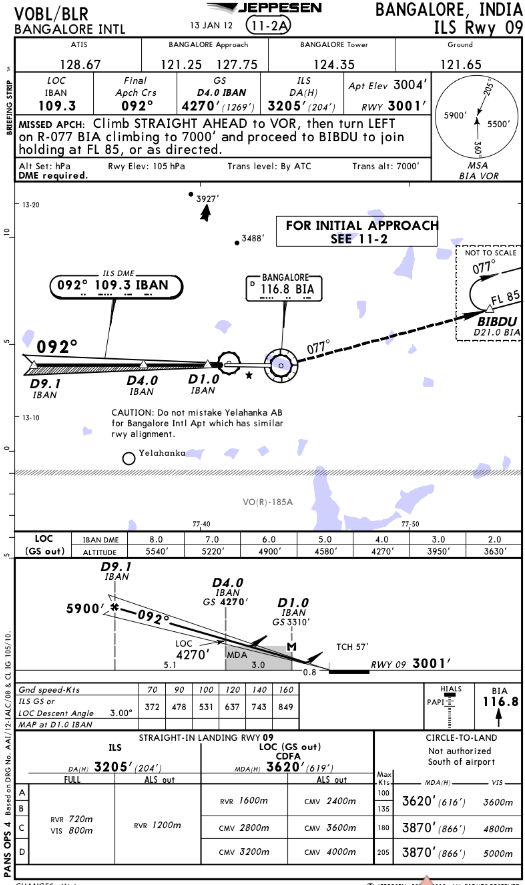
Yup and often Transition Level (setting local QNH when arriving) will be assigned by ATC, but will be noted on the chart. Fourth row on the briefing strip:

cdfa-grey-area-vobl09.jpg
 
Why on the missed procedure does it not say straight ahead to BIA, instead of VOR? Is this common overseas? Just curious.
 
Why on the missed procedure does it not say straight ahead to BIA, instead of VOR? Is this common overseas? Just curious.

You know, I look at this stuff all the time from all kinds of different places. I never noticed. You see so much different stuff it's impossible for me to memorize all the nuance. Straight ahead to the VOR then turn? OK. Straight ahead to BIA then turn? OK, I can do that too.

There are some interesting things you see overseas. Stuff we theorize about in the US or only do in IFR training, but you actually fly a lot overseas. I'm very thankful for the universal presentation of Jepps.
 
@Hawks have you been issued Area Planning guides? In there it lists each country and a breakdown of unique differences that countries Aviation authority has/does.
If you don't have one, go to your ops, or set up an NGA account.
 
You know, I look at this stuff all the time from all kinds of different places. I never noticed. You see so much different stuff it's impossible for me to memorize all the nuance. Straight ahead to the VOR then turn? OK. Straight ahead to BIA then turn? OK, I can do that too.

There are some interesting things you see overseas. Stuff we theorize about in the US or only do in IFR training, but you actually fly a lot overseas. I'm very thankful for the universal presentation of Jepps.
At 400' - "FMS AND HEADING (LNAV)". :cool:
 
@Skåning brings up another thing to think about. Remember that there is a Transition Altitude and a Transition Level. Both will vary from airport to airport. Be sure to check the charts for both...some are in print and some are assigned by ATC.

P.S. The way I remembered the difference between Transition Altitude (TA) and Transition Level (TL) is that T"A" is moving towards the AIR (climbing) and T"L" is moving towards the LAND (descending)
 
@Skåning brings up another thing to think about. Remember that there is a Transition Altitude and a Transition Level. Both will vary from airport to airport. Be sure to check the charts for both...some are in print and some are assigned by ATC.

P.S. The way I remembered the difference between Transition Altitude (TA) and Transition Level (TL) is that T"A" is moving towards the AIR (climbing) and T"L" is moving towards the LAND (descending)

Plus, Transition Levels are also reported on the ATIS. Transition Altitudes are generally on the departure procedure.

Another way to look at it is:

You descend from flight levels to altitudes at the "Transition Level."
You climb from altitudes to flight levels at the "Transition Altitude."
 
It was 14,500' in Pakistani and Arabian Gulf airspace. Not that it really mattered.....not enough english being understood or spoken on one side of that conversation to ever pass as "air traffic control".
 
Back
Top