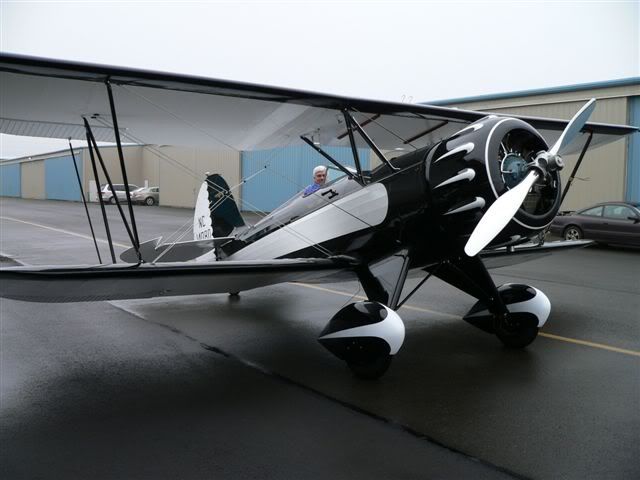
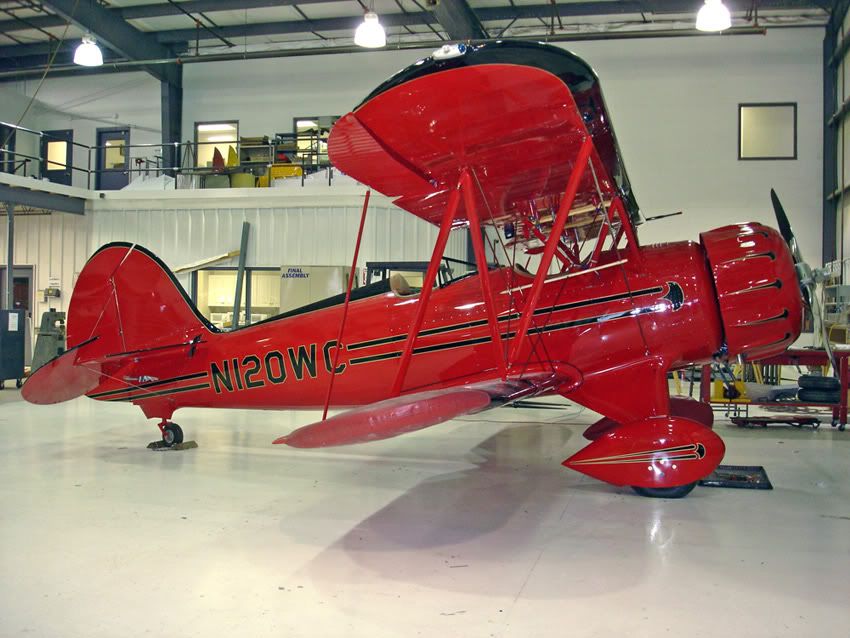
Is it just me or does this look a little nuts?

Except that if you teach someone to drive a 57' Chevy, they'll probably be able to get in a 2010 model and drive away without any trouble at all. But if you teach a kid to drive in a 2010 Chevy and then put them in the 57'? Well they probably wouldn't be able to get it started. And if they did, they certainly wouldn't be able to get it to move very far*.


*Assuming of course that the 57' is a carburated engine/manual trans as most were back then and the 2010 is a fuel injected engine/auto trans as most are today.

As a man who has owned an actual '57 Bel Air, I can attest that driving one can be a major handful. It requires your full attention.
 
I've never seen a Garmin G1000 or Avidyne PFD/MFD installation (hands down the two most popular glass cockpits in light GA aircraft) that provides an OBS indicator as part of the standby instruments.

Just as an FYI, I fly a Piper Malibu equipped with an Avidyne PFD/MFD that has a Garmin GI-106A CDI (glideslope capable) mounted as part of the standby instrumentation from the factory. It's hidden behind the yoke and two miles from the rest of my scan, but at least it's there!

Anyway, FWIW, I fully agree with everything jrh and MikeD have said on this issue.
 
First, I am speaking in terms of a private pilot only and nothing beyond that! So when you read this reply and think, "you can't do this on an ILS" I would like you to come back and reread that first sentence again. In fact, to avoid forgetting, let me be redundant: I am speaking of private pilot training in this reply!

Before moving on to the quotes, I do have one issue with glass. We still haven't learned to properly train in steam gauges (75% of error is still the poorly trained pilot) and we are swapping to glass. I wonder how much this will slow the process at perfecting aviation training.


rvg203 said:
Starting my training (real world), I wanted to go back to square one and learn the art of flying with a compass and watch while looking out the window. Real stick and rudder stuff.

I couldn't agree more. However, I think the argument for glass or steam gauges is moot. It is actually easier, IMO, to press the power off button on 3 or 4 big screens than it is to tape an old sectional across the panel so all you can see is ASI, ALT, and engine gauges.

I believe the problem isn't glass or steam, the problem is few pilots trust themselves to fly an airplane without any of them. Not simple pattern work either. I mean utilizing the airplane.

It isn't because they were in glass or in steam. It is because they spent most of their training trying to figure out what those instruments do and not learning basic flight.

A pilot must know and be able to use this basic flight information perfectly IMO:

  • THEIR SENSES: I call them the pilots instruments. As an instrument pilot you make a turn and verify your six stack for results. As a private pilot you should be able to make a turn and verify your body is feeling the right pressures, the sound is remaining constant, and the visual picture looks right. A simple senses cross check, something that should be inherent it a pilots scan.
  • AIRCRAFT INHERENT STABILITY: How can you be ahead of something if you have no damn clue what it will do? Within this category is 3 finger flying, or relaxed flight.

    I'd like to interject a recent experience with ex student (150 hour just got his private, not from me) that feels he doesn't get it. We were at around 2500 and wanted to descend to the airport. The student pulls the power but keeps the pitch attitude the same, letting the power control the descent but fighting the new trimmed airspeed (centerline thrust anyone?). He didn't know that the aircraft wouldn't dive into the ground. :banghead:
  • BASIC CONTROL UNDERSTANDING/APPLICATION: The understanding involves teaching what the controls do. That means you cannot tell a pilot the power gives them speed. The application has to do with the procedure. You can tell them if they are slow to increase power and lower the nose, but ensure they still understand what is doing what in this process.
  • VISUAL CUES: Finally, for god sakes would you look outside? It is a beautiful day out. Oh wait, shoot, nobody ever told you what to look at did they? Oh, you were told level flight is the horizon 3 fingers above the glare shield? Mind showing me slow fight and let's take a look at this 3 finger rule. The problem, IMO, isn't that they can't do it. The problem is they are not told what to look at or how to interpret/use the information. Maybe because the instructor didn't know, I am not sure.
  • A SCAN: I don't care what the scan is, so long as it is primarily visual (90/10 FAA rule IMO) and is beat into the student. Including drilling them with the dangers of fixation and pointing it out. The one thing we know for sure, unquestionably, is that fixation plays a roll in the majority of aviation accidents. Teach a scan and teach to avoid it.

This list for me is incredibly basic stuff. It should be taught early, before solo, and beat into the student until they get their license. At least some part of it is missing in every pilot I have flown with (student - 20k hr airline captain), except one WWII guy.


Someone who is a member of JC said:
If someone's getting their private ticket, they should be flying by looking outside the window anyway, so glass, six pack, whatever, it doesn't matter.

I think we know where I stand, people don't look outside. Too much fun stuff in the airplane (steam or glass) for us to play with and learn about.

Especially for our first 10 hours when looking outside is certainly useless anyway. Do I need to say sarcasm?


jrh said:
Failing both screens and expecting the pilot to fly an ILS is absolutely unrealistic.

Yall running a solar powered system in there? Or do your aircraft just not have electrical failures, ever?


miked said:
Again, safer and easier are relative terms.

Yes, relative to what they are being compared with. In this case you can compare relative safety of one with relative safety of another. For instance, you say this "Glass doesn't create SA, it simply provides info....same as with steam gauges." What you don't mention is the sheer quantity of information available to the glass pilot.

I believe glass to be safer, assuming both pilots are adequately/equally trained. The glass guy would be safer because he/she has access to more information. Sure the glass guy can get it, but it isn't in front of them. Such as radar/map overlay using nexrad.

Ease; that is more person dependent, truly relative, so I won't speak on it.
 
Post of the month. Thank you!


Xzactly! It is a scary idea but having the FAA introduce yet another training requirement is even more scary. I just wish they'd add;

91.1 No pilot at any time shale do anything stupid.


I would think it reasonable for the FAA to mandate some sort of transition training endorsement for glass panel and steam gauge aircraft. (ie...in order to operate under IFR, must recieve and log ground and flight instruction in aircraft utilizing glass cockpit displays.....) A similar requirement should exist for glass panel trained instrument pilots looking to fly on steam gauges. This could be a great way to increase safety without requiring a costly amount of instruction for proficiency.

:pirate:Oh and by the way....lets try not to blame a lack of pilot proficiency in "real flying" on technology. Yes, a lack of practice will hurt any pilot over time. Any decent instructor, however, should be engraining a sense of scepticism and constantly using "what if" scenario based training with any student learning with glass panel a/c. I LOVE flying glass panel aircraft when I get the opportunity. The amount of information available is nothing short of phenomenal!
 
Yes, relative to what they are being compared with. In this case you can compare relative safety of one with relative safety of another. For instance, you say this "Glass doesn't create SA, it simply provides info....same as with steam gauges." What you don't mention is the sheer quantity of information available to the glass pilot.

I don't need to mention that. It doesn't matter how much info is available or not; it matters what the pilot does with the info he has. Sometimes, too much info can saturate someone. Would you consider that safe? No, you wouldn't. Would that be the fault of the aircraft? Of course not. It'd be on the pilot.

I believe glass to be safer, assuming both pilots are adequately/equally trained. The glass guy would be safer because he/she has access to more information. Sure the glass guy can get it, but it isn't in front of them. Such as radar/map overlay using nexrad.

Ease; that is more person dependent, truly relative, so I won't speak on it.

Safe is person dependant too. I can tell you from firsthand experience that I'm just as safe in a steam aircraft as I am in a glass one. How do I know that? Because in my SA bag of tricks, I have one set of skills used for the steam plane, another for the glass plane; apart from the basics which are common to both and to all airplanes. Same with helos. I flew steam gauge Hueys, and glass cockpit Hueys. I can do the same with both, just by different methods. In the steam aircraft, I have a sectional hard copy in front of me; in the glass, I have a moving map. That same comparison goes between the two.

They're both equally safe, assuming the trained pilot in both that we've been talking about. Each pilot (or the same pilot, such as the case with me), used methods particular to each airframe.

It's as simple as that. And hence, why the terms "safe" and "easy", are both moot.
 
Don't get me wrong Jim, I love these antique airplanes. Thing is, I dont want to regularly trust myself to an antique. :D
F5C120Panel.jpg


A glass WACO:confused:
 
Before moving on to the quotes, I do have one issue with glass. We still haven't learned to properly train in steam gauges (75% of error is still the poorly trained pilot) and we are swapping to glass. I wonder how much this will slow the process at perfecting aviation training.

I don't think it will affect the process much. The problem with poorly trained pilots isn't because of technology changing faster than instructors can keep up. It's because flight instructors have a high turnover rate, industry-wide. About the time an instructor *really* figures out how to teach, they're moving on to another job, away from instructing.

Yall running a solar powered system in there? Or do your aircraft just not have electrical failures, ever?

First, I'd like to point out that if there is a catastrophic electrical failure in *any* aircraft, the NAV radios and OBS display will be useless. It's not like the screens will die and the NAV radios will magically keep clicking along.

Second, I'd like to point out that in most G1000 installations, there are three electrical busses and two independent batteries. The chances of a complete failure is very, very rare. In the event of an alternator failure, the batteries can power the system for 45-60 minutes....quite a bit of time to either shoot an approach or get to VFR conditions.
 
Second, I'd like to point out that in most G1000 installations, there are three electrical busses and two independent batteries. The chances of a complete failure is very, very rare.

Truth be told, if that exact scenario is happens to you in IMC, you've got FAR bigger problems.......like someone telling you in a not-so-subtle way that your number was up that morning.

May as well just roll inverted and pull.
 
F5C120Panel.jpg


A glass WACO:confused:

Pure, unadulterated Blasphemy, of the highest order.

Oh man, the Church of Classic Aviation would burn such a heretic at the stake!
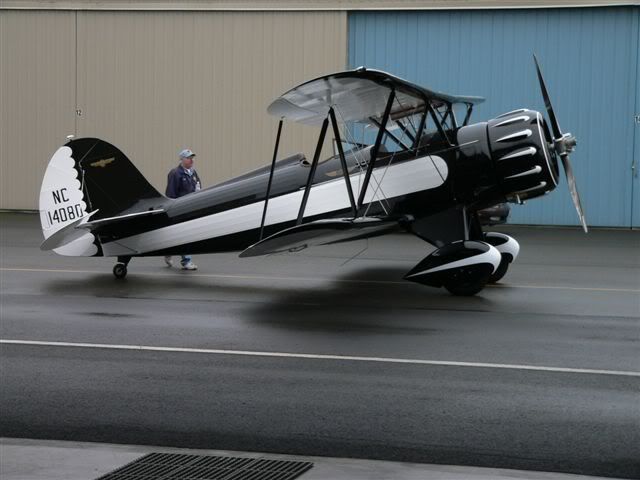
And for $400-500k new you can have a new, glass Waco. They made some changes to it - tailwheel is higher, main gear legs are shortened somewhat (the effect of both makes the airplane sit "flatter" that original) and they are apparently god-awful heavy. Just heavy beasts. Original YMF-5's, of which there are VERY few, will apparently fly circles around the new machines being produced in Michigan. I have no firsthand knowledge of this - never having been in an original OR a new one - but I am passing along what people who have flown both have said. I will post pictures of an original and a new one - see if you can tell the difference in stance and geometry:

The original
Waco_roll_out_party_047.jpg


Waco_roll_out_party_004.jpg


New one:

F5C120_pa01.jpg
 
I have glass in my cockpit too:

6328_1141877719748_1611614665_335483_3047005_n.jpg


Bonus coolness points if you can name the instrument with the LCD display and white-on-blue arrows.on the upper right.
 
I have glass in my cockpit too:

6328_1141877719748_1611614665_335483_3047005_n.jpg


Bonus coolness points if you can name the instrument with the LCD display and white-on-blue arrows.on the upper right.

Cant name the instrument off the top of my head, but we do mosquito spraying and had something like that installed along with a wind sensor on the plane that will adjust the course of the plane to compensate for the wind drift of the application.

pretty neat stuff, actually.
 
Heres what the NTSB found regarding glass cockpits in light aircraft.

http://www.avweb.com/pdf/ntsb_glass-cockpit-lsa_report.pdf

Its not exactly "safer" from an accident statistic standpoint, although this little slide show is far from complete, it presents some data on the subject

Old steam gauges have worked just fine since Doolittle took the first intentional instrument flight. I am of the school of thought that a traditionaly equiped aircraft with a GPS is just as capable as anything with a glass panel AND since there are no accident statistics to prove that the glass cockpits enhance safety, I feel that the argument over which is "better" doesnt really matter! I look at it this way; the information you recieve from a G1000 is the same as you get from the good old 6-pack, its simply displayed better... other than that, what does it do for you?

Of course it is much cooler to have a G1000 in your 172 than the old 6 pack, but youre still gonna go 100 knots and get there in the same amount of time
 
often the load is worth more than the aircraft. and my boss reminds me of that fact.

Same in the A-10 why the weapons station carrying the ECM pod didn't have ejector squibs installed, hence the pod couldn't be jettisoned in an emergency. Pod cost more than the plane.
 
Same in the A-10 why the weapons station carrying the ECM pod didn't have ejector squibs installed, hence the pod couldn't be jettisoned in an emergency. Pod cost more than the plane.

LOL!

Umm, whut?!
 
Back
Top