IN REMEMBRANCE

A Life Aloft

Well-Known Member
p09_00000008.jpg


p08_00000007.jpg


p10_00000009.jpg


p11_00000010.jpg


p13_00000011.jpg


p21_12070281.jpg


p29_20701116.jpg


p30_12070455.jpg


p31_12070414.jpg


p32_00000018.jpg


1942-air-force-still.jpg


6a00d83451cb8069e20128762f7aea970c-pi


1344.jpg


DID YOU KNOW ME THEN
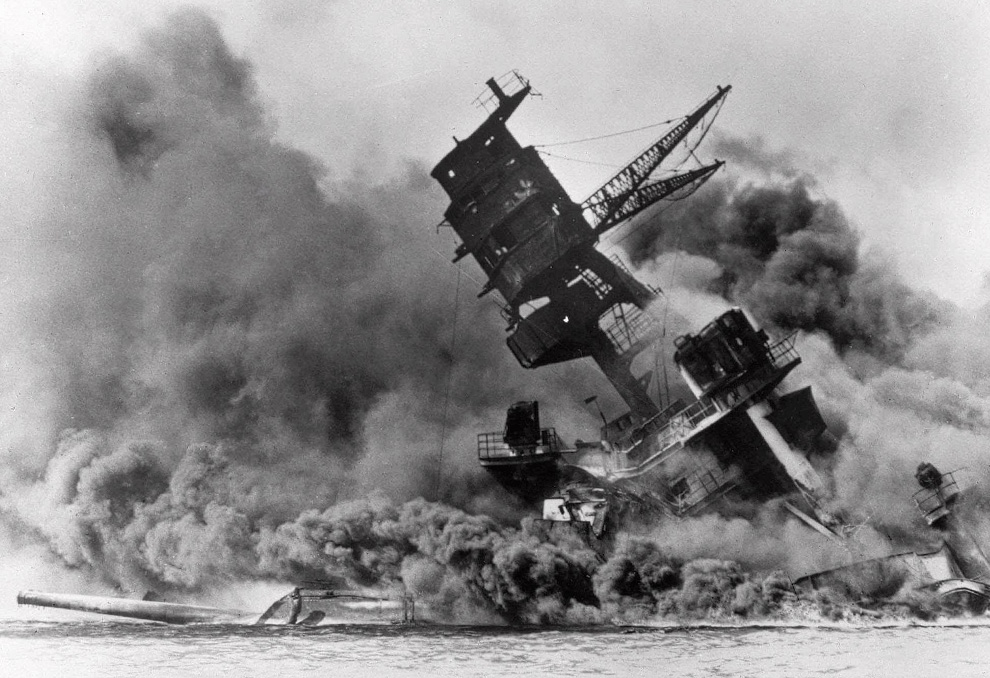
I was born in a small town in the mid-west or was it a large city back east? I can’t remember anymore. Did you know me then? I remember getting the chores done so I could go to the Saturday matinee or was it the baseball game. I can’t remember anymore. Did you know me then? I remember the depression of the 1930’s and Papa working so hard to care for the family, Anyway he could with odd jobs. I especially remember Mama making ends meet. Papa was stern with the family but, Mama sweet Mama , what an angel she was. Did you know me then? I remember the swimming hole that we swam in, the bicycle rides, the picnics. Did you know me then? I remember school, Boy, do I remember School. I remember the soda shop and the good times after school. I remember Mary the girl next door or was it Sue the girl I met at the dance. I can’t remember anymore. Did you know me then? I remember people talking about the war in Europe, But we’re in America why worry about what’s going on there. This is America, the land of opportunity. We would never get involved in their problems. Did you know me then? I remember my brother Bob and I enlisting in the Navy together. I remember Mama insisting that we serve on the same ship together, so we could take care of each other. Did you know us then? I remember our being assigned to the battleship USS Arizona, she was a beautiful sight to behold. I remember when we were told we were to be home ported in Pearl Harbor, Honolulu. Wow! Hula girls, grass skirts, beautiful beaches. Paradise, a dream come true. Did you know us then? I remember December 6, we all went to Bloch Arena to watch the battle of the music competition. The music played by the bands was great. Did you know us then? I remember Sunday, December 7, not too much going on, just lying around. Then that thundering noise that broke the Sunday morning quiet. It sounded like hundreds of aircraft. I remember the explosion, my breath and whole being taken away from me. Did you know me then? I can hear Mama crying, Papa hasn’t cried yet. I want to tell him “It’s ok to cry , Papa, every tear is a prayer” We’ve been home ported here for a very long time. I can see our buddies aboard other ships saluting as they pass by. I hope they see me returning their salute. Do they know me? My buddies and I are at peace now. Pray for us! Did you know me? Then if you knew us, remember us always.

John Vierra, Park Ranger, USS Arizona Memorial
 
Last edited:
Having been stationed at Pearl Harbor for three years I have been to the memorial many times. I was there for the 50th anniversary and was able to meet and speak to some of the survivors. It was a very humbling experience. When I go to the Memorial I would always find a quiet spot and just look around the harbor and the neighboring hills and try to imagine that day. It was just unimaginable.

I was able to purchase a flag that was run up the pole of the USS Arizona on the 50th anniversary. It was a gift to my father who was a 20-yr Navy Vet. It is something that I know he treasures to this day.
 
My dad enlisted ... Army Combat Engineer ... Battlefield promotion from Sergeant to 2nd Lieutenant and Platoon command. Normandy D-day and ETO. His war ended with orders to deploy to PTO.

His close friends as I grew: Pat Blanchard (wounded M4 Sherman commander), Al Hicks, US Army 8th Air Force, and John Hull, USS Indianapolis, CA-35, survivor. My mom remarried later in life to Gene Tighes, B-17 pilot with 22 missions, 8th Army AF, ETO, before his war ended with Germany's surrender.

Walker "Bud" Mahurin was a regular guest at our home and a valued friend of my dad (Google the book "Honest John" by same name).

They made their peace with the Germans and Italians, never with the Japanese to their dying day.

I have lived among giants.
 
Some excerpts from the diary of a survivor, Henry A. Lachenmayer, of Oxon Hill, Md. Lachenmayer says he wrote his account on a Royal portable typewriter, long since gone, which he kept in his berth aboard the battleship Pennsylvania.

Lachenmayer, who moved to the Bronx from Germany as a child, was a 22-year-old musician second class at the time of Pearl Harbor. He doubled as a medic when bombs raked the Pennsylvania. Lachenmayer retired from the Navy in 1960 after having risen to the rank of band master aboard the battleship Wisconsin.

"It was Sunday again, you might say just another Sunday, but to us in the fleet it meant more than that, it meant the one day of the week that granted us true relaxation, the one day apart from drills maneuvered and work of all sorts. A day for church, and a day for play.

We, the band on the Pennsylvania, had a strenuous day on Saturday. A landing force inspection in the morning and a dance band contest in the evening which, incidentally, we won. We were still speaking of this same contest the next morning as we heard band call go at 10 minutes of 8 and we proceeded to the quarter deck in preparation for morning colors. . . .

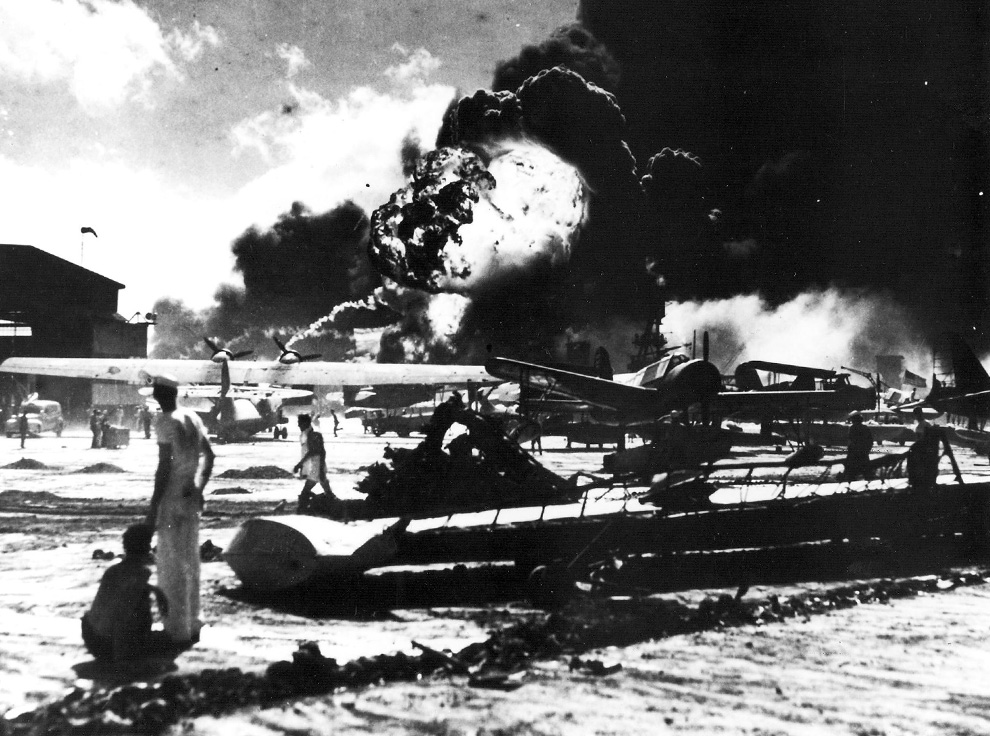
At exactly three minutes of eight, looking over toward the Naval Air Station on Ford Island, we could see a group of planes proceeding gently from a high altitude and then leveling off about 150 feet from the ground.

To our unsuspecting eyes it was just another drill, though it was somewhat peculiar that they would pick Sunday morning for maneuvering. Not until we saw the flames shoot out of the large hangar at the head of the small island did we realize the significance of the situation.

Lachenmayer scrambled to reach his battle station, where he helped put out a fire ignited by an explosion in the main deck and in the case mate, the enclosure where anti-aircraft shells were stored:

The bandmaster marched us back on the double and the officer of the deck screamed for all hands to man their air defense stations. . . .

A plane that looked half like a Stuka and half like one of our own dive bombers was just leveling off and I could see the bombs dropping out of its bottom. It was a silver-gray plane with a reddish gold ball or sun painted on its side. I still don't know how I got my instrument in my case and back to the shelf in the band room but I must have made Superman's speed look amateurish. By this time all hands were manning their battle stations and I proceeded towards mine, stopping on the way to get my gas mask.

Arriving at my station, which incidentally is the second deck patrol and repair station where I am a stretcher bearer, I commenced the process of . . . closing all ports and hatches which would be highly detrimental if left open. . . .

Down below once more, I was asked by an ensign to assist him in reaching some of the officers on shore leave by telephone and this was my job for the next half hour. I succeeded in reaching Commander Holden, who almost refused to believe the inevitable but once convinced, arrived on board ship with the greatest of speed.

For the next part I returned to my station and found work enough; a fire had broken out on the second deck and had to be attended to with haste. . . .

The fire was precipitated by the bursting of a 500-pound bomb in the case mate and the main deck. The havoc created by this one bomb hit can never be exaggerated.

All our fire extinguishers were used up in no time. . . . Due to the cooperation of all hands concerned, the fire was eventually put out. . . ."

He was also witness to the tremendous damage inflicted on other vessels, and to the Navy's efforts to fight back:

"Ahead of us in dry dock were two destroyers also under repair, despite their wonderful barrage and cooperation; (they fought like wild cats) a number of bomb hits were scored and their crews were forced to abandon. . . .

Directly aft of us, moored at ten-ten dock, were the U.S.S. Oglala and the U.S.S. Helena. These two vessels, the former a mine layer and the latter one of our latest 10,000-ton cruisers, were tied or moored together. An enemy torpedo plane headed directly for the Oglala . . . and launched its torpedo. The old ship, severely injured, immediately turned on its side, and sank.

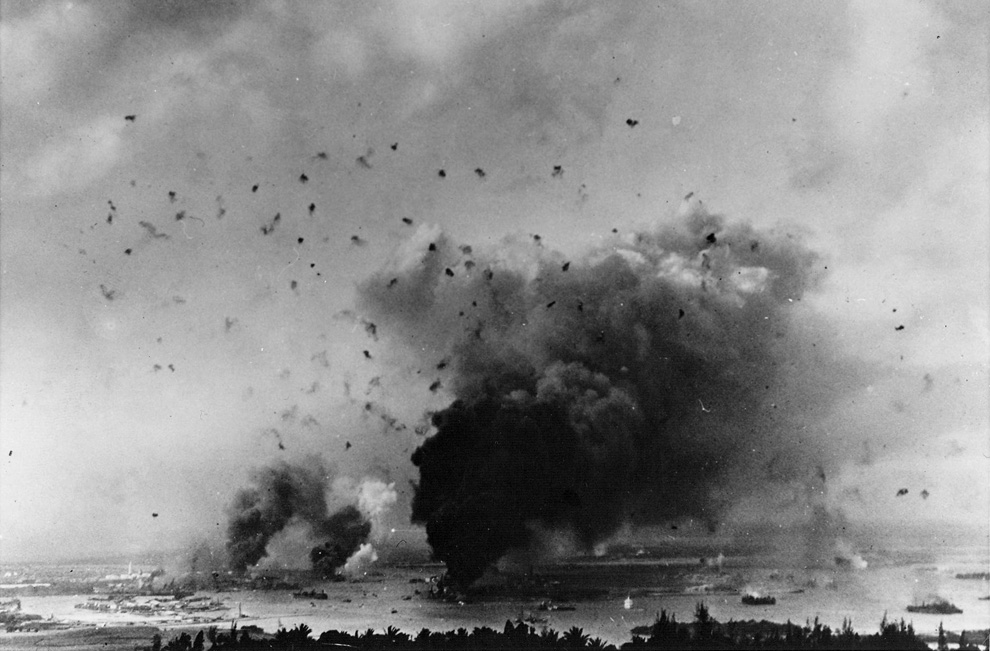
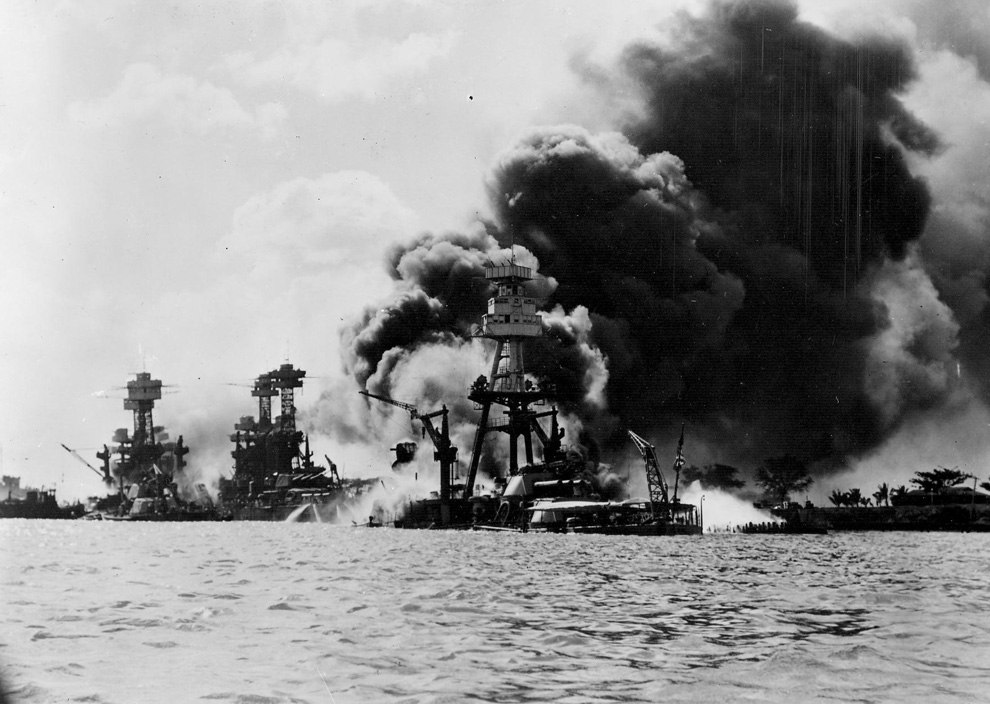
On the other side of the harbor . . . our battleships were receiving a merciless pounding. The U.S.S. Arizona received two bomb hits amidship and a great number of torpedoes. She split in half and her forward magazines burst. Directly forward of her, the U.S.S. Oklahoma received many torpedo hits and capsized.

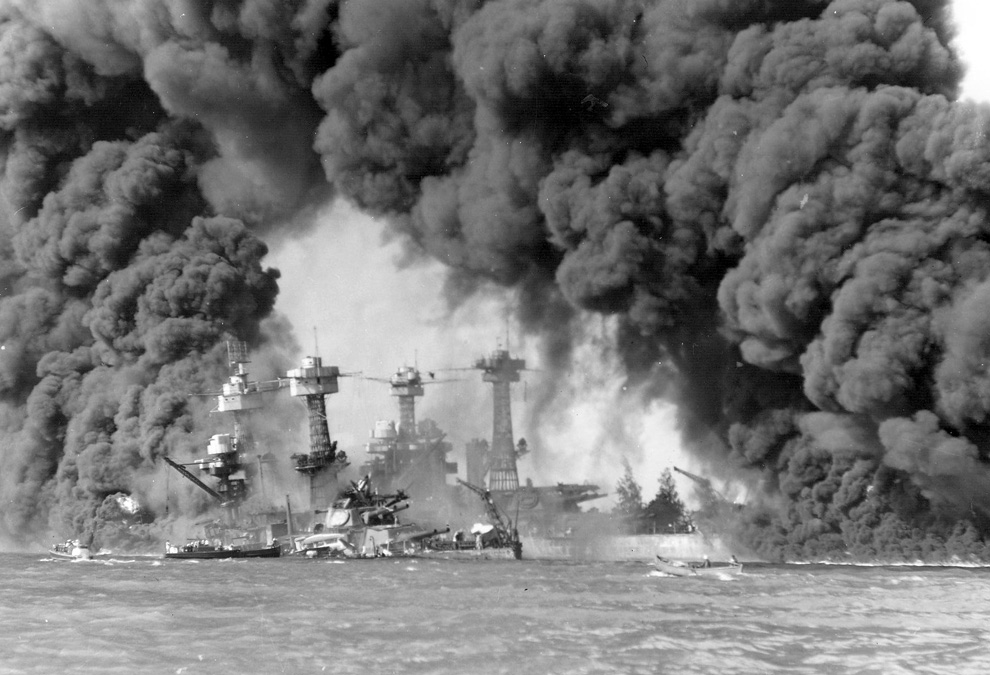
Next to her the U.S.S. West Virginia received a tremendous amount of bomb hits and her whole port battery was wiped out. . . . The U.S.S. Tennessee stood up fairly, or rather, remarkably well considering the pounding she took. The U.S.S. Maryland stood as solid as a piece of granite and fought the enemy. She remained in one piece.

Directly forward of the Maryland, though some distance away . . ., the U.S.S. California received torpedo hits and listed on her port side. The U.S.S. Nevada, in a daring attempt to reach the open sea through the channel, was torpedoed and her wary skipper grounded her on the right side of the harbor in order to keep the channel clear.

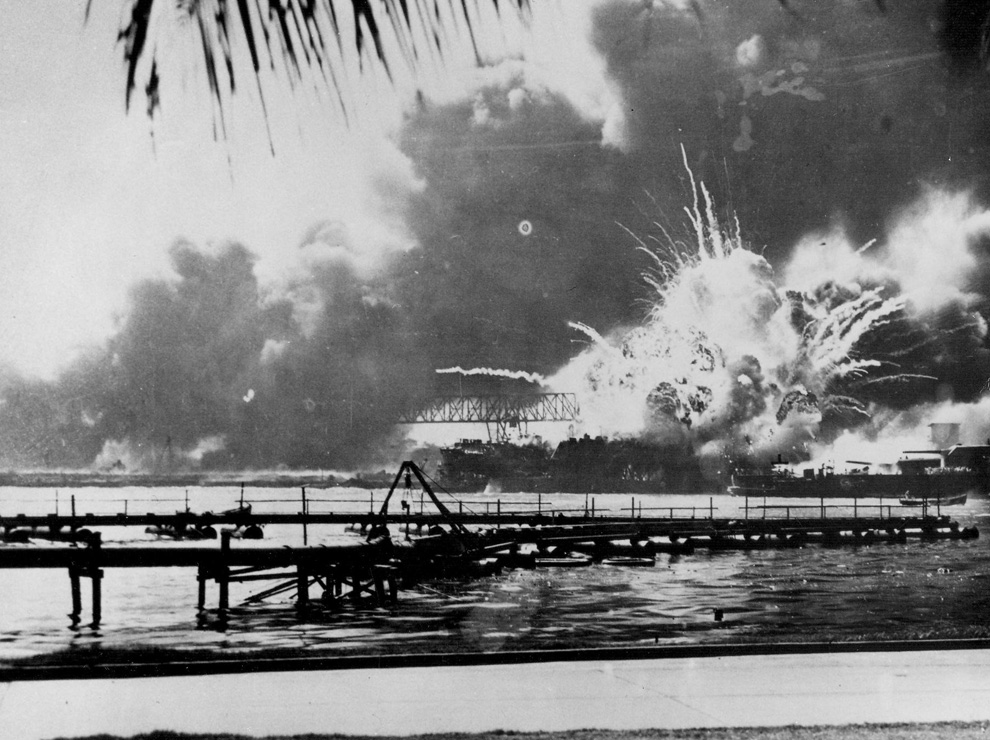
One destroyer in the floating dry dock on our starboard was hit and went on fire, burning right at the bridge.

The human toll was horrific.

Now to the casualties, and I write this with a heavy heart. On our own ship, the one bomb hit pierced the boat deck abreast of No. 7 A.A. gun and tore through the No. 9 case mate and down to the main deck. All this area exploded with vigor. The Marine division suffered the severest losses.

First Lieutenant Craig, standing near the three-inch gun, had both legs blown off and received other injuries; he died almost on the spot.

Doctor Rall, a lieutenant junior grade, and a pharmacist's mate were mangled and killed instantly. This information I received from one of the musicians, Andrew Lambert, who, standing near by, saw it happen and was shell-shocked. His fellow stretcher bearer, Musician S.W. Craig, survived with minor injuries.

I wandered around the dressing station, my eyes not believing what they saw. I gave a drink here and loosened an article of clothing there; there was not much else I could do.

Many were badly burned and screamed for relief of pain; they had already received drug injections, and a glass of water to the lips was in many cases the only human assistance possible. . . .

Later in the day I assisted in taking the dead off the ship and in bringing on board many rounds of ammunition.

As far as other casualties are concerned I am in complete ignorance, though I know that they were severe. In the case of the capsized Oklahoma I have heard that there were from 500 to 1,100 men trapped inside her hull, I believe that the majority of them were extricated.

I am proud to say that the U.S.S. Pennsylvania was the first in action and that we accounted for not less than eight enemy planes.

We had two more alarms yesterday, but these proved to be only scares. Our men are now and forever on the alert, and woe to the enemy if they try it again."
 
They made their peace with the Germans and Italians, never with the Japanese to their dying day.

If I had lived through what they lived through, I don't know if I could either.

IMO, this was the last great generation, as it has been called so many times. They did what needed to be done, and if it offended a few people along the way, that was just to bad. They did things because they were right morally, not politically.
 
On the day of the attack, more than 2,400 Americans (military and civilians) lost their lives. 1,178 others were wounded. Their average age was just 23 years old. The average age of those aboard the Arizona, was 19 years old.

One survivor, John Rauschkolb later recalled....."that he was on the signal bridge of the USS West Virginia when the attack began.
"I could see the planes headed towards the ship. I could see that they were Japanese and watched the torpedoes drop from the aircraft headed for the USS West Virginia," he said.

"I felt six torpedoes and two bombs hit the ship. You could hear the tremendous explosions, feel the vibration in the metal throughout the ship and see the fire. The U.S. Navy said the ship was hit by seven torpedoes, the Japanese Navy said nine."

As Mr. Rauschkolb moved from the signal bridge to the starboard side of the bridge, he saw the ship's captain get hit by shrapnel and die. When he arrived on the main deck, it was strafed by machine gun bullets from a Japanese Zero fighter plane, and he ducked for cover under the overhang of a gun mount.

To avoid incoming fire, he then dived overboard and swam underwater to avoid burning oil on the water's surface, bobbing up for air periodically. He swam to the USS Tennessee where, without an oxygen mask, he helped extinguish a dangerous fire amidships. In the process, Mr. Rauschkolb rescued a friend who collapsed from smoke inhalation while working alongside him.

Later, Mr. Rauschkolb was dispatched to the USS Arizona, where he assisted in the collection of the bodies of fallen comrades.

"The most difficult job that I have ever had in my whole life was handling the dead bodies," he later recounted. "They were terribly burned, and the stench of human flesh burning is a smell that remains with me to this day.

"We could not identify the dead, no dog tags and no DNA then," he said. "We only had parts of the bodies anyway. It was very, very difficult."
____________________________________________________________________________________________

Ken Sweet looked up into the bright blue Hawaiian sky to see the line of silver planes banking toward Oahu, sunlight glinting from the shiny wings, and thought - there go the Navy pilots, showing off again.

And when he heard gunfire, he thought - that's the Marines, firing their weapons in another training exercise.

In a few minutes, Sweet's all-night guard duty shift at Wheeler Field was due to end. He was looking forward to breakfast. Then the 19-year-old aircraft mechanic from Milwaukee noticed a couple bombs fall away from a plane. As the pilot banked, Sweet saw the plane's insignia.

A rising sun.

"Instantly I knew we were at war," said Sweet, who later realized he had seen some of the first bombs dropped on Hawaii on Dec. 7, 1941. "I grew up that day."

Even though it was seven decades ago, Sweet, 90, still vividly recalls seeing Jeeps loaded with stretchers filled with the wounded.

After seeing bombs dropped on Wheeler Field, he ran to his barracks to rouse anyone still in bed. Just as Sweet ran outside, a bomb crashed through a hangar, blowing him out the door. As self-preservation took over, Sweet began sprinting away from the flight line but "a fellow running ahead of me got shot so I stopped running." He eventually found shelter and waited out the second attack wave.

In the summer of 1941 while stationed in Hawaii, Sweet wanted to volunteer for the Flying Tigers, a group of American military pilots flying with the Chinese air force. But since he was only 18 he needed his mother's permission to go to China. She said no, it was too dangerous.

She wanted him to stay in Pearl Harbor where he would be safe.

_______________________________________________________________________________________________

On this day, remember those who did not survive and remember those who did. Let us never forget how swiftly the world can change, how in an instant, everything can be taken from you. Try to relish and value your own life and the lives of those around you, and the lives of those you do not know. Try to remember that we are all connected in some ways that we may not understand, but certainly, they do exist. Do your best to live a decent life, a life with a conscience, with hope, with love, with courage and with honor.

And for all Vets especially, may your minds and spirits be healed. May you find some peace and your burdens lifted from you. I wish for you to find and regain some of what may have been taken away from you and know that you are loved, valued and respected. Be strong. Embrace hope.
 
Last edited:
My grandpa served in the Pacific Theater as a WWII Marine in the 1st Division. He grew up in upstate NY and most of his friends were Jewish. When he found out what Germany was doing(not sure if the death camps had been discovered but he at least knew about the violence and other atrocities), he lied about his age and signed up for the guard at 16 then went to the Marines from there. One thing he told me that stuck with me was shortly before the attack on Pearl, he was told by a superior at the firing range to "look down the barrel of the rifle and pretend there's a Jap on the other end". He says he often looked back on that and forever questioned how much of a "surprise" the attack really was. Either way, he was laying in a field with some buddies either on 12/7 or 12/8 when a big wig pulled up in a jeep and told them in the same sentence that Pearl was attacked and they were headed to the Pacific. Crazy stuff.
 
Last edited:
Today more than 100 vets who survived WWII and the attack at Pearl attended the memorial service there. Among them were 4 survivors from the USS Arizona. Only 9 survivors from the Arizona are still alive.

d71d77a44e2ec7f58631ec071df51178-620x409.jpg


141207-pearl-harbor-survivors-jms-1516_63da06f5b044746516df7f0a21e15799.jpg


Donald Stratton, 92, of Colorado Springs, Colo., was one of the few survivors of a gun director in the forward part of the ship. More than 65 percent of his body was burned. Stratton was hospitalized for more than year and then was medically discharged from the Navy.

He re-enlisted a year later. "The good Lord saved just a few of us," he said.

e77492036f269cdc050c54d04ec8f78a-620x407.jpg


861a31c6c05532e7f45bd053f0db4ca8-620x409.jpg


"I learned something about faith," said John Anderson, 97, of Roswell, New Mexico, recalling that he had just gone to church services and was heading to breakfast when someone said they saw the planes coming. He became teary-eyed as he discussed his twin brother dying in the attack.

"It's always like yesterday when we're out here," Conter said.


Pearl-Harbor-Anniversary-12-7.jpg


364Pearl%20Harbor-Anniversary.JPEG


450x276_q95.jpg
 
I have an uncle who survived. Jumped into the water and was swimming to outrun the fire on the water. He got tired and climbed up onto an anchor chain. While he was out of the water, one of the ships exploded and all who were in the water at the time died from the concussion of the explosion in the water. Dumb luck that he was tired and climbed out for a spell.
 
Pops wasn't there, but he was on the Pennsylvania (which, of course, was) shortly after she completed her refit. Lied about his age and joined up in 1943 at the ripe old age of 16. Assistant Gunner on a 5" DP. Got a taxpayer-funded tour of the Pacific for the next couple of years (and a taxpayer-funded education, which I expect is the only reason he ever got out of the coalfields of Eastern Kentucky...and thus the only reason you have me to put up with). Saw the next 5" up get hit by a kamikazi...nobody got out (or so the story goes). We weren't what you'd call close, but according to my Mom he was "afraid the War would be over before he got in it". Different world. I give the old man a lot of latitude for this reason (amongst others).

In any case, much respect and appreciation for all the WW2 vets. I'm not sure there are any "good wars", really, but they make as good a case as anyone.

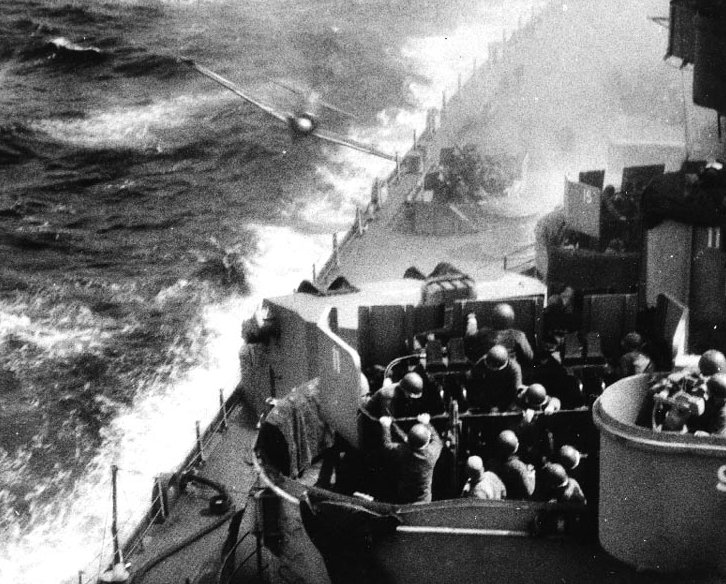
Edit: Made me think of this iconic shot. This is the USS Missouri (upon which, as you may well know, the surrender was signed). Hard to imagine, isn't it?

kamakazi.jpg


Second edit: As per above, he never had anything nice to say about the Japanese, either. To the point it was uncomfortable at times. I hope he won't be spinning in his grave when I say that it's worth thinking about all the Japs who grew up in a religio-feudal mess one step out of the Dark Ages and wound up self-immolating, dying for no benefit, or otherwise sacrificing themselves for the benefit of an out of touch, self-perpetuating, belligerent, self-appointed system.
 
Last edited:
Second edit: As per above, he never had anything nice to say about the Japanese, either. To the point it was uncomfortable at times. I hope he won't be spinning in his grave when I say that it's worth thinking about all the Japs who grew up in a religio-feudal mess one step out of the Dark Ages and wound up self-immolating, dying for no benefit, or otherwise sacrificing themselves for the benefit of an out of touch, self-perpetuating, belligerent, self-appointed system.
What's interesting is my grandpa was unintentionally racist all the time just because of what was acceptable for growing up in the 20s, but he never held hard feelings against Japanese people despite watching so many of his best friends die at their hands. We had Japanese neighbors when I was growing up and he was very buddy-buddy with them and they liked to hear his stories. I brought it up the subject a few times when I was younger, but he just liked to say war is hell and they did "what they had to do in the mindset they had to have". When I got older, he told me gruesome stories. The worst was when out scouting after an artillery attack leading his platoon(correct term?) through an open field in Guadalcanal. There were thousands of Japanese bodies piled up as far as the eye could see. While he stood there, gun fire erupted from behind him and on both sides of the jungle, it was a Japanese ambush pitting his group of less than 20 against dozens of hidden Japanese. All at once he heard the riffles going off and saw his friends dropping bullets flying through them, he screamed for everyone to dive. He said in the midst of all this, he crawled through the field of artillery shells and dead Japanese for 20 minutes that felt like hours to the part of the Jungle that wasn't firing at him. While he was doing this, a nearby ship laid very inaccurate covering fire down into the jungle with some of the shells exploding very close by and 2 Navy fighters began strafing the treeline(where it was later found they destroyed a tank that was headed to the open field). When he got to safety, most of his fellow Marines had been killed, some likely by friendly fire. But that's not what he used to recall when he told the story. What stuck with my grandpa was the scared look on all the Japanese faces as he crawled across the field. He said most of them looked 12-15, he couldn't get over how they looked like children. He was only about 22 himself. It would actually make him tear up sometimes as he talked about it, he never once told me if he personally killed anybody though I think he did and was far from proud of it.

Despite all that, he managed to see people for what they were and made several Japanese friends later in life. He went on to be a Police chief with a reputation of being tough as nails. But he had a heart of gold, and was a great representative of that generation. The few other servicemen I met who fought Japan still hated the Japanese with a passion. Yet, I grew up with a Grandfather who had been through all that and taught me to never judge someone by the color of their skin. The older I get, the more I admire my grandpa for able to get out of the war mindset and see people for who they were as individuals. It's easy to hate, it's very hard to forgive, and I'm honestly not sure how he did it. But he harbored no hate in the end.
 
Back
Top