Emirates saves the A380

bike21

9-5 Ruins Lives
Well maybe...

NANTES, France (Reuters) - Emirates announced a deal for up to 36 Airbus (AIR.PA) A380 aircraft on Thursday worth as much as $16 billion at list prices, saving the world’s biggest passenger jet from death row and securing its future for at least another decade.

https://www.reuters.com/article/us-...-lifeline-with-16-billion-order-idUSKBN1F71KJ

Still a fugly airliner but a bit of fun engineering to see flying at the same time. Pretty sure SJI needs a few to do ATL-MCO.

And apologies to @RDoug for stealing your headline thunder ;)
 
It's going to take them a decade to make 36 of them or they actually have a substantial enough order book now that 36 takes it to 10 years?
 
If the operating cost per passenger mile economics don't match up for a four-engine behemouth today, I don't see that somehow magically changing by 2030. Apparently neither do Boeing, since the 747 is being phased out.
 
If the operating cost per passenger mile economics don't match up for a four-engine behemouth today, I don't see that somehow magically changing by 2030. Apparently neither do Boeing, since the 747 is being phased out.

Think labor costs divided by pax - and think beyond crew. It’s the same reason cruise ships are getting bigger.
 
A380 is gonna be another great example of engineering marvel not being the sole criteria for commercial success.

Same as Concorde and a whole lot of sports cars.

It’s no Concorde - it was designed with an increasingly congested airspace in mind. One 340 using system resources instead of three guppies. Based on pax forecast trends, particularly for SE Asia and the growing Chinese middle class, the logic is sound - or will be when more Asian markets become slit constrained.


Sent from my iPhone using Tapatalk
 
Airbus didn’t learn the lesson from the Lockheed L-1011. In a few years Harvard will write a case study on the A-380/Emirates situation and MBA candidates will have another discussion on breakeven and subsidies.
 
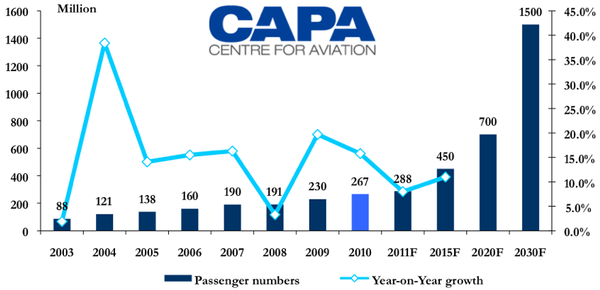
What happens in 2030?

China1.png
 
If the operating cost per passenger mile economics don't match up for a four-engine behemouth today, I don't see that somehow magically changing by 2030. Apparently neither do Boeing, since the 747 is being phased out.

You do understand that by 2030 there will be 9 billion people on earth right? Granted most of them will be in absolute abject poverty in Africa and Asia, today's large cities will all be mega cities and people will still travel by air over long distances despite VR and other technology that we haven't even imagined yet. That sheer scale of humanity will make the economics of the A380 profitable.
 
Yes, I understand that the population is growing. I also understand that two 777s or 787s can carry more people more efficiently between two points than can one A380. That simple math is what's killing both the A380 and the 747, and I don't see that math changing in 2030.

I could be wrong, but I just don't see it. And neither do Boeing, apparently.
 
You do understand that by 2030 there will be 9 billion people on earth right? Granted most of them will be in absolute abject poverty in Africa and Asia, today's large cities will all be mega cities and people will still travel by air over long distances despite VR and other technology that we haven't even imagined yet. That sheer scale of humanity will make the economics of the A380 profitable.

2030 is only 12 years away.

You know what we were doing 12 years ago in 2006? Arguing, literally on this exact forum, about FO qualifications at the regionals and when the robots were going to come take our jobs.

To tell you how little the world changes in 12 years, I'm using the same keyboard from 12 years ago. And the fact that I'm using a keyboard and not controlling my computer with my mind should tell you something.

We still haven't cured cancer, haven't cured AIDS, haven't figured out a better way to move airplanes around than by burning dead dinosaurs in jet engines, Boeing hasn't updated the 737 overhead panel, and the Subaru Outback generation I own is the exact same one that was being produced in 2006.

The biggest change? I'm using an Android phone instead of a Palm Treo (@BobDDuck, you still have the picture?), but it does a lot of the same stuff. And unlike you, in late 2005 I was being paid to get computers to do something useful. Took me 12 months, 3 programmers and a lot of pain to figure out how to figure out how to convince the university I was attending that there was a better way to print in the computer labs that didn't involve Novell's print server, and then design a new system.
 
Yes, I understand that the population is growing. I also understand that two 777s or 787s can carry more people more efficiently between two points than can one A380. That simple math is what's killing both the A380 and the 747, and I don't see that math changing in 2030.

I could be wrong, but I just don't see it. And neither do Boeing, apparently.

I think the point is that the single large aircraft takes up significantly less airspace/airport/support volume than two or more smaller aircraft. The "efficiency" factor will be in the number of required ground operations people, gate space, arrival/departure slots, maintenance technicians, et al that go into keeping airframes airborne.
 
2030 is only 12 years away.

You know what we were doing 12 years ago in 2006? Arguing, literally on this exact forum, about FO qualifications at the regionals and when the robots were going to come take our jobs.

To tell you how little the world changes in 12 years, I'm using the same keyboard from 12 years ago. And the fact that I'm using a keyboard and not controlling my computer with my mind should tell you something.

We still haven't cured cancer, haven't cured AIDS, haven't figured out a better way to move airplanes around than by burning dead dinosaurs in jet engines, Boeing hasn't updated the 737 overhead panel, and the Subaru Outback generation I own is the exact same one that was being produced in 2006.

The biggest change? I'm using an Android phone instead of a Palm Treo (@BobDDuck, you still have the picture?), but it does a lot of the same stuff. And unlike you, in late 2005 I was being paid to get computers to do something useful. Took me 12 months, 3 programmers and a lot of pain to figure out how to figure out how to convince the university I was attending that there was a better way to print in the computer labs that didn't involve Novell's print server, and then design a new system.

The point was that a large segment of travel is for business, if you can have a VR meeting, why fly to India? I doubt entire deals will be done that way, most people still want to "shake hands" at the end, but it still begs the question. Also, if I can "red eye" on a self driving bus from LA to SF, not be raped by the TSA, not subject myself to SFO ground stops due to fog AND do it cheaper than an airline ticket, while being comfortable and getting a full nights rest, why would I not? http://www.chicagotribune.com/lifes...san-francisco-sleeper-bus-20171106-story.html (by the way if if planes are flying themselves all the dispatch requirements for ceiling and vis are gone, the plane will use differential GPS and can do everything zero zero, so you no longer have to deal with diversions because the meat sacks didn't have the vis they needed) I could see a decrease in the need for business travel. That said, would I rather see Victoria Falls or the Eiffel Tower in real life vice VR, absolutely and if made affordable enough, more people would. I would also like to point out that 12 years ago I did not think I would in very short order be shopping in a store with no cashiers https://www.nytimes.com/2018/01/21/technology/inside-amazon-go-a-store-of-the-future.html.

Despite all this, as large cities become mega cities I think the market for long haul international travel between those cities will only grow and the A380 will indeed be more useful 12 years from now, than now.
 
The point was that a large segment of travel is for business, if you can have a VR meeting, why fly to India? I doubt entire deals will be done that way, most people still want to "shake hands" at the end, but it still begs the question. Also, if I can "red eye" on a self driving bus from LA to SF, not be raped by the TSA, not subject myself to SFO ground stops due to fog AND do it cheaper than an airline ticket, while being comfortable and getting a full nights rest, why would I not? http://www.chicagotribune.com/lifes...san-francisco-sleeper-bus-20171106-story.html (by the way if if planes are flying themselves all the dispatch requirements for ceiling and vis are gone, the plane will use differential GPS and can do everything zero zero, so you no longer have to deal with diversions because the meat sacks didn't have the vis they needed) I could see a decrease in the need for business travel. That said, would I rather see Victoria Falls or the Eiffel Tower in real life vice VR, absolutely and if made affordable enough, more people would. I would also like to point out that 12 years ago I did not think I would in very short order be shopping in a store with no cashiers https://www.nytimes.com/2018/01/21/technology/inside-amazon-go-a-store-of-the-future.html.

Despite all this, as large cities become mega cities I think the market for long haul international travel between those cities will only grow and the A380 will indeed be more useful 12 years from now, than now.

We've had video meetings since the 1980's, and people still travel for business. Every time someone says, "BUT WAIT, THIS TIME IT'S DIFFERENT WITH MY TECHNOLOGY!" it means they're trying to sell you something.

Even with differential GPS, how are you going to do an autoland with GPS when one or more of the GPS boxes stops working? Haven't ever seen it happen in flight? I have. What happens when a bird takes out your GPS antennas. Can't happen? Ask Sully or Al Haynes about things that can't happen.

As to Amazon's deal, they're not talking about how it works, but they're saying it isn't using RFID. If that's true, then I'll be impressed. Translating the analog work that we live in to the digital world that computers understand is the real challenge with computers and automation. The guys out at Boston Dynamics are doing some real cutting edge stuff with their biped robots.
 
2030 is only 12 years away.

You know what we were doing 12 years ago in 2006? Arguing, literally on this exact forum, about FO qualifications at the regionals and when the robots were going to come take our jobs.

To tell you how little the world changes in 12 years, I'm using the same keyboard from 12 years ago. And the fact that I'm using a keyboard and not controlling my computer with my mind should tell you something.

We still haven't cured cancer, haven't cured AIDS, haven't figured out a better way to move airplanes around than by burning dead dinosaurs in jet engines, Boeing hasn't updated the 737 overhead panel, and the Subaru Outback generation I own is the exact same one that was being produced in 2006.

The biggest change? I'm using an Android phone instead of a Palm Treo (@BobDDuck, you still have the picture?), but it does a lot of the same stuff. And unlike you, in late 2005 I was being paid to get computers to do something useful. Took me 12 months, 3 programmers and a lot of pain to figure out how to figure out how to convince the university I was attending that there was a better way to print in the computer labs that didn't involve Novell's print server, and then design a new system.

Can you think of anything that happened in 2006 that might have stymied technology investment and growth for the next several years? Anything at all?

To be fair, in 2006 I would still (begrudgingly) get in a taxi.
 
Back
Top