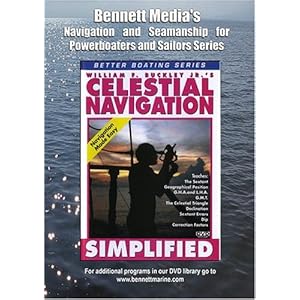
If you intend to navigate upon the ocean, out of sight of land, using only celestial bodies as your "lighthouses," there are three absolute necessities: a sextant (or other means of getting the exact altitude of the sighted body); a nautical almanac or ephemeris, preferably the current issue (or a considerable ability with spherical trigonometry and an encyclopedic knowledge of the movement of celestial bodies--particularly the one you are using); and an accurate timepiece set to, or correctible to, Greenwich meridian time (Coordinated Universal Time).
Given those things, and some paper and a pencil--and ideally, a chart and a few simple instruments, like a pair of dividers or compasses, a straightedge and perhaps a set of parallel rules or a pair of triangles, you should do very well--provided that you also know how to use all of the above.
With American Practical Navigator, you can find the knowledge you need to use the above tools. It's all in there.
It is one of the textbooks used by the United States Naval Academy to teach celestial navigation, as well as the United States Power Squadrons. I am a full certificate member of the latter.
American Practical Navigator is not an essential book. There are other texts that are useful in learning celestial navigation; but, it is by far the best.
Nathaniel Bowditch, the original author of the American Practical Navigator, was born in 1773, in Salem, Mass. He sailed as a ship's master, and worked as a cooper and ship's chandler, but his all-consuming interest was in mathematics. He learned French, Spanish, German, Latin and Greek in order to absorb the discoveries of others, and at the age of 16 was reading Newton's 'Principia,' translating it from Latin--and he found errors. He later published his own findings, and they were accepted. He wrote his first almanac at the age of 15. He developed an new, simplified method of determining lunar distance, and on his voyages began to find errors in John Moore's 'The Practical Navigator,' the leading navigational text. The rest, as they say, is history.
The current American Practical Navigator, Nav Pub. No. 9, published by the Defense Mapping Agency Hydrographic Center, is in two volumes.
Any serious student of celestial navigation will want a copy.
Another volume, similarly useful, and a good adjunct to your library, will be 'Dutton's Navigation & Piloting.'
With these two volumes, and the current Nautical Almanac and your instruments, the world's seas become your thoroughfare.
Joseph Pierre, N



 as one never knows when l'computer will start having a bad day...


 They had a monkey bar setup outside with sextant ports where we practiced shots at zero knots and no turbulence.