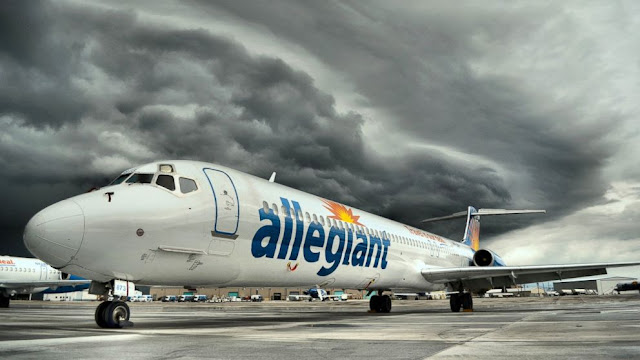
Another Allegiant Pilot about to be Fired!

That crash was NOT VLJ's fault.

Yes they had some mechanical issues, but the Everglades crash was NOT, I say again, WAS NOT the fault of VLJ.

Some of yous need to learn your accident history.
 
Another Allegiant emergency landing due to an engine failure on January 2nd.
http://www.ktvq.com/story/30893606/...ant-flight-adds-to-string-of-airlines-miscues
Good ol' Billings. When I was in college I was a ramp/gate agent for Allegiant in BIL. It really gave me perspective after spending 1 year there and 2 years at Delta.

I think my 11 months at G4 had double the amount of delays than my entire time with DL. That's really saying something when I worked 4 G4 flights a week compared to the 25-30 a week at DL. 95% of delays were maintenance that I worked. What's even worse than the airplanes at G4 was their operations. No hotels, no customer service, and very poor management that I had to deal with.

I give props to you guys that are there. You were always the most positive pilots I knew with your circumstances.
 
Former Allegiant Air mechanic says he quit over 'obscene' maintenance operations

OCALA — Veteran aircraft mechanic Greg Marino worked at Allegiant Air for just two weeks before he quit because of what he said are the airline's dangerous maintenance practices.
Marino said mechanics at the airline's facility in Sanford often lapsed into bad maintenance practices. He said they failed to follow proper procedure in diagnosing aircraft problems and routinely misused a Federal Aviation Administration program that allowed planes, under some conditions, to fly with inoperative components or systems.
Marino said the airline needlessly delayed repairs in the push to keep planes flying, eroding the margin of safety...
 
KathrynsReport.jpg

Sometimes a picture speaks volumes.

Why did Allegiant Air's second-in-command resign? Likely over safety issues, experts say

More than a week before Allegiant Air's chief operating officer abruptly resigned, John Goglia questioned the airline's response to five emergency landings during the last week of 2015.
All five were flights departing Florida.
Goglia, a widely respected aviation accident investigator, said an identical series of incidents would warrant quick discipline against those overseeing maintenance at other airlines. Allegiant had done nothing publicly.
"A vice president of maintenance would be looking for a new job, and probably a few people with him," said Goglia, who served a decade as a member of the National Transportation Safety Board. "Heads would roll."
The abrupt resignation of Allegiant chief operating officer Steve Harfst a week ago after just 13 months in the job left some industry watchers questioning whether his was the first head to roll as a consequence of the airline's highly publicized maintenance and operational difficulties during 2015.
That departure comes as the Federal Aviation Administration is conducting increased surveillance of Allegiant amid reports of multiple emergency landings and other problems, according to the Teamsters Aviation Mechanics Coalition, which is related to the Allegiant pilots' union.
One Allegiant aircraft made four separate emergency landings from Oct. 25 to Dec. 3 after reports of smoke in the cabin, an almost unheard-of occurrence for a lone aircraft over such a short period of time, aviation watchers say.
"The FAA is all over Allegiant right now," said Chris Moore, chairman of the coalition, which has documented maintenance issues at the airline on behalf of the Airline Professionals Association Teamsters Local 1224.
Moore speculated that the COO's sudden departure was more a message to the FAA than the public that Allegiant is trying to address safety issues. The FAA would not confirm whether Allegiant is under increased scrutiny, though it said it is investigating maintenance incidents.
Henry Harteveldt, a travel industry analyst, said he had little doubt that Harfst was essentially fired.
"I suspect what happened is, as they do in any kind of company, things came to a head and the CEO and perhaps the board told this guy his services were no longer needed," he said. "I'm not convinced the right person left the company. I believe part of problem stems from its CEO and the imperious way in which he runs the company."
Allegiant CEO Maurice Gallagher Jr. is the airline's biggest stockholder, with 21.7 percent of the company's outstanding shares as of April. He is firmly in control of the airline, analysts say.
Gallagher was one of the founders of ValuJet, an airline that lost an aircraft in a 1996 Everglades crash that killed 110 people.
Harteveldt noted, "As a low-cost airline, which certainly follows FAA procedure, I don't know that Gallagher pushed the airline (Allegiant) to be better in terms of aircraft maintenance. They certainly have the ability to do so."
Allegiant officials say the airline is one of the safest in the nation and have accused the pilots' union of using unfounded safety concerns as a ploy in contract negotiations. Company spokeswoman Kim Schaefer said her company would not comment on Harfst's departure.
Late Thursday, Allegiant announced the appointment of Jude Bricker as its new COO. Bricker is the company's senior vice president of planning and will retain those duties.
Allegiant carried about 95 percent of the record 1.6 million passengers at St. Pete-Clearwater International Airport last year and is viewed by tourism officials as a vital cog in Tampa Bay tourism. Allegiant serves 49 cities from the Pinellas airport, and will add the 50th in June when it begins flights to New Orleans.
The airline remains one of the most profitable in the world on a percentage basis. Last fall, its 24 percent profit margin was the highest among airlines globally.
But it was nonetheless a tumultuous 2015 for Allegiant's public relations as the airline suffered through a long list of emergency landings, including three in Pinellas during the summer. A flight to Fargo, N.D., had to land at a closed airport when the pilot, a member of Allegiant management, reported he was running low on fuel.
In August, a Las Vegas flight nearly ended in disaster when an aircraft's elevator — a control surface on the tail that helps a plane ascend or descend — was jammed in one position during a takeoff roll. Goglia and others in the industry said the flight may have ended in a crash had the pilot not aborted a takeoff at 138 mph.
Earlier this month, a former Allegiant mechanic told the Tampa Bay Times that he quit the airline's Sanford maintenance operation in October after just two weeks because he thought its mechanics operated a poor safety culture.
Allegiant may have invited speculation about Harfst's resignation by releasing a fuzzy statement that might have vaguely hinted at maintenance issues.
"The company will use this leadership change as an opportunity to refocus on operational needs and areas for improvement," the company said.
Harfst has declined to talk to reporters.
Brett Synder, founder of the aviation website CrankyFlier.com, said he thought operational problems at Allegiant were a reason for Harfst's resignation. But if Allegiant is trying to send a message to reassure the public, he questioned whether the public would even notice.
"People like a cheap deal," Synder said. "I think there is some amount of trust by the public that the FAA is doing its job in ensuring every carrier is safe. Whether that's misguided or not, that's embedded in people who don't follow the industry closely. I think people just look and see a good deal. They just don't notice" changes in airline leadership.
Dan Wells, president of Allegiant's pilots' union, said the resignation was odd and certainly unexpected, noting Harfst was seen working at headquarters just the day before.
But Allegiant's management has been slow to recognize or acknowledge maintenance problems, Wells said. And by not commenting about the COO's resignation, he was doubtful that Allegiant fired Harfst to telegraph anything.
"If they're saying, 'All right, we see a problem and we're fixing it,' I'd think they'd be very vocal about that," Wells said. "Sadly, given Allegiant's history, and (Gallagher's) personality, they still aren't recognizing they have a problem."
Story and photo gallery: http://home.tampabay.com

 
One Allegiant Air plane had four emergency landings within six weeks

According to Moore and FAA records on the aircraft (all flights landed at the city from which they departed), these are the incidents:
•On Oct. 25, Allegiant Flight 607 departed Youngstown for Sanford when the crew smelled smoke at rotation, the moment when an aircraft begins to lift off the runway. Flight attendants then reported smoke coming from a fan that delivered air into the cabin from the plane's air system. Air-conditioning was turned off and the aircraft safely landed.
• On Oct. 30, Flight 730 had just departed Concord Regional Airport in North Carolina bound for Fort Lauderdale when flight attendants reported smoke in the cabin. Mechanics replaced the oil filter and an O-ring on an auxiliary power unit, and found a leak in the hydraulic system.
•On Nov. 15, shortly after Flight 715 departed Owensboro-Daviess County Regional Airport in Kentucky for Sanford a bathroom smoke detector alarm began sounding. The FAA report said "there was a haze in the cabin with a smoke smell." The problem was diagnosed as occurring in an air-conditioning system.
• On the Dec. 3 flight to St. Pete-Clearwater, the problem was again tied to the air-conditioning.
• On Aug. 17, the plane suffered engine difficulties at 16,000 feet and made an emergency landing. No report of smoke occurred on that flight, and records do not show where the plane landed, its destination nor city of departure.
FAA records also show the aircraft's crew on Dec. 15 experienced the smell of evaporating oil in the cockpit, but FAA records indicate the crew did not make an emergency landing for that event.
 
I'm absolutely speechless. I don't know whether to feel sorry for those who have to continue facing this draconian management style or wish them the best in salvaging their career(s) after its too late.

A lot of, what appear to be, systemic threats exist in being employed by Allegiant in any direct aviation capacity (MX, DX, InFlight, FlightOps).


Sent from my iPhone using Tapatalk
 
The article is riddled with "according to the FAA" sentences. So clearly they are aware. Just like 135 on call BS isn't changing, Allegiant wont change.
 
The article is riddled with "according to the FAA" sentences. So clearly they are aware. Just like 135 on call BS isn't changing, Allegiant wont change.

They are good for a headline every other week with the local newspapers here... Matter of time before something happens, and it will obviously be noticed.
 
They are good for a headline every other week with the local newspapers here... Matter of time before something happens, and it will obviously be noticed.
And when it does, the FAA will be the one's to blame for shirking their oversight.
 
What exactly has to happen for an airline to be shut down?

Transport Canada shut down WestJet wayyyy back when they first started up due to maintenance discrepencies. But you're right, when, and how much, needs to happen before the FAA, or TC, can suspend the license to operate?

In the oil industry, we have this nice thing called a Incident Risk Triangle. At the bottom of the triangle is small events like scrapes, small cuts, light first aid. As you work your way up the triangle, you come across major first aids, injuries, loss time incidents, and eventually, fatalities. The higher you go, the severity of the incidents increases. The science behind it is that the more higher level incidents you have, the more likely a fatality is going to happen. Six loss time incidents means you are that much closer to a death, or deaths. So, in Allegiants case, are these bad enough incidents? Are these high level incidents going to pile up into a big one?

Numerous incidents, and the pilots who make the right decisions get fired. It makes the news, and now we use the most recent incident as a joke: "Another pilot to be fired." Its so bad, their poor safety culture has become a subject of dark humor. Normalization of deviance (there is a thread on JC about this.) Allegiant snuffs out the very people the hire to keep them safe and their PR department dormant. "If you don't play by our rules, you're out."

I think the writing is on the wall.
 
I've became a pilot in 1972, and ATC'er in 1976.

The FAA responds when 50 or more people are killed in a single 121 event or someone famous is killed.

Look back at the:
  • Buddy Holly accident
  • PSA midair in San Diego
  • The American DC-10 in Chicago
  • Wind sheer accidents in New Orleans and Dallas
  • The Cerritos midair
  • ValuJet in Florida
  • Colgan accident in Buffalo
And several others.

After each of these major changes were made by the FAA. Most were well know problems before the fatal accident but the FAA refused to correct the problem.
 
Back
Top