Aircraft MX cultures

BravoHotel

Well-Known Member
I have seen an glimpse of how other services perform aircraft MX. At Wake Island watching the Navy and Marine Corps work on their aircraft was awe inspiring.

My current existence is working on C-130s for the Air National Guard. It pays the bills, I have a job and most of the time I enjoy the work. The catch, it takes forever to get anything accomplished. We have QA and safey running around watching your every move. You must have the book out for every task. It takes time to find the tech data for some strange obscure task you're trying to accomplish. It is easy to get bogged down in the details. One of my co-workers is a A&P at Fed Ex and he stated it best. "If the Air Force was in the flying business to make money it would be bankrupt." I originally set down this track to earn my A&P, the CCAF does have a program that pairs with your work experience to make that happen. I am still highly considering that given where I am and the effort put in to get here.

How is MX culture on the civilian side? Airlines? G/A? Corporate? How does it differ from the military? How valuable is a pilot/a&p? I guess that would depend on what operation you're operating in.
 
Naturally, the operator I work for follows the FARs and manufacturer's manuals to a "T". However, my understanding is that in general, the big airlines are most similar to military in terms of the "git 'r' done" vs. "by the book" spectrum, and as the airplanes get smaller the balance tilts more and more in favor of "git 'r' done".
 
I'm a flight instructor with an A&P. During my A&P career, I have worked on everything from Cessna 172's to Cessna Citations. I spent four years at the airlines and two years on the space shuttle.

IMHO.... Nobody really cares. And you can get a fantastic flying job without an A&P.

It's on my resume but I don't talk about my maintenance background anymore. My last gig was a mess because of it. I was soldering push-to-talk switches while signing one kids logbook and sending the other out to pre-flight. I was working twice as hard... for only a little more in pay. My own fault I guess. Now I play "dumb pilot" like everybody else. If its broke, I write it up and call maintenance. When my work buddies find out I have an A&P, they don't believe me till I show them the card. Life is way better this way. Unless somebody wants to pay for it (they never do) my A&P experience will work for me.

Unlike some pilots... I don't spend years studying and paying for school, go out and get a bunch of actual experience, only to give it all away for free! BOOM!

Hahaha! I'm mostly kidding. The only reason I landed my first flying gig in the first place was because I had an A&P. So I guess you could say it's a blessing... and a curse.
 
I'm a flight instructor with an A&P. During my A&P career, I have worked on everything from Cessna 172's to Cessna Citations. I spent four years at the airlines and two years on the space shuttle.

IMHO.... Nobody really cares. And you can get a fantastic flying job without an A&P.

It's on my resume but I don't talk about my maintenance background anymore. My last gig was a mess because of it. I was soldering push-to-talk switches while signing one kids logbook and sending the other out to pre-flight. I was working twice as hard... for only a little more in pay. My own fault I guess. Now I play "dumb pilot" like everybody else. If its broke, I write it up and call maintenance. When my work buddies find out I have an A&P, they don't believe me till I show them the card. Life is way better this way. Unless somebody wants to pay for it (they never do) my A&P experience will work for me.

Unlike some pilots... I don't spend years studying and paying for school, go out and get a bunch of actual experience, only to give it all away for free! BOOM!

Hahaha! I'm mostly kidding. The only reason I landed my first flying gig in the first place was because I had an A&P. So I guess you could say it's a blessing... and a curse.

Double edged sword.
 
We're both on the same team as far as I'm concerned, although there's a fair amount of:

Pilots think mechanics don't do anything.

Mechanics think pilots don't know anything.

They're both wrong, although from the pilot's standpoint many mechanics do a whole lot of nothing—
"FO AHRS inop, ATT, HDG and FD flags on FO instruments."
"Reset AHRS computer, ops check good."

(well hell, I could have given it the 28-volt therapy myself...)

And from a mechanic's standpoint, the pilots seem to know a whole lot of nothing:
"Hey, there's like, this light, that is flashing, and it shouldn't be."

The level of mechanical aptitude required to be a pilot is unfortunately pretty low nowadays, but that's not an excuse for not knowing how the machine works...and there are quite a few who have no idea what happens between pushing button and receiving bacon. I don't expect everyone to geek out and work on their own airplanes on their days off (or even have an airplane for that matter), but a little more exposure to wrenching wouldn't hurt pilots. You won't find me relamping things at work, though: I'm not trained or checked for it, even though it's a silly and trivial task.

And then there's mechanics, who should be required to come along on every functional check flight they sign off...

Anyway, I digress. We're on the same team at the airlines, or at least I think we should be: the point is to get the people from A to B, safely and on schedule (and in that order!). I won't hover over a mechanic (ever) while they work on the airplane, but I do like to see the innards and know what they did. Given enough eyes, all problems are small.
 
We're both on the same team as far as I'm concerned, although there's a fair amount of:

Pilots think mechanics don't do anything.

Mechanics think pilots don't know anything.

They're both wrong, although from the pilot's standpoint many mechanics do a whole lot of nothing—
"FO AHRS inop, ATT, HDG and FD flags on FO instruments."
"Reset AHRS computer, ops check good."

(well hell, I could have given it the 28-volt therapy myself...)

And from a mechanic's standpoint, the pilots seem to know a whole lot of nothing:
"Hey, there's like, this light, that is flashing, and it shouldn't be."

The level of mechanical aptitude required to be a pilot is unfortunately pretty low nowadays, but that's not an excuse for not knowing how the machine works...and there are quite a few who have no idea what happens between pushing button and receiving bacon. I don't expect everyone to geek out and work on their own airplanes on their days off (or even have an airplane for that matter), but a little more exposure to wrenching wouldn't hurt pilots. You won't find me relamping things at work, though: I'm not trained or checked for it, even though it's a silly and trivial task.

And then there's mechanics, who should be required to come along on every functional check flight they sign off...

Anyway, I digress. We're on the same team at the airlines, or at least I think we should be: the point is to get the people from A to B, safely and on schedule (and in that order!). I won't hover over a mechanic (ever) while they work on the airplane, but I do like to see the innards and know what they did. Given enough eyes, all problems are small.


You know its funny maintenance is kinda different in that you can be a total slacker and stupid and the guy next to him could be gods gift to aviation and the recognition and pay is the same. In the pilot world you have check rides to maintain proficiency so that for the most part incompatent pilots get weeded out usually. Not so easy in the maintenance world. Also we are (southwest airlines notwithstanding) at my airline and my former airline often on the line I would go work problems on as much as 5 different a/c models sometimes even in the same day. Its impossible to have the knowledge to address complex issues on so many fleet types. You never see a pilot go fly one leg in a DC-9 then a DC-10 the next. We do it all the time. Thats why we use manuals. I often had pilots ask me when I worked the line they would have a nav problem lets say and I would say well I have to consult the manual and I get the "you dont know the answer?. Well depends on the question. Some are basic mechanic 101 that every mechanic should know then there are others. There are not enough years in a lifetime to know everything that can possibly go wrong with a complex aircraft much less different fleet types and manufactures. If I had known about the dispatch world 27 years ago when I got in this business I would have went there instead. I try my best to dissuade young people from getting into aviation but particularly maintenance. It is without a doubt a thankless job. Its also a job with consequences that can come back to bite you days, months or even years later if you did something incorrect. Theres my 2 pesos!
 
What's wrong with that write-up??? :sarcasm:
No kidding, I read in a maintenance can the other day:
"NOSE WHEEL STEERING FEELS TO ENGAGE."

I laughed, and then I sighed.
You know its funny maintenance is kinda different in that you can be a total slacker and stupid and the guy next to him could be gods gift to aviation and the recognition and pay is the same. In the pilot world you have check rides to maintain proficiency so that for the most part incompatent pilots get weeded out usually. Not so easy in the maintenance world. Also we are (southwest airlines notwithstanding) at my airline and my former airline often on the line I would go work problems on as much as 5 different a/c models sometimes even in the same day. Its impossible to have the knowledge to address complex issues on so many fleet types. You never see a pilot go fly one leg in a DC-9 then a DC-10 the next. We do it all the time. Thats why we use manuals. I often had pilots ask me when I worked the line they would have a nav problem lets say and I would say well I have to consult the manual and I get the "you dont know the answer?. Well depends on the question. Some are basic mechanic 101 that every mechanic should know then there are others. There are not enough years in a lifetime to know everything that can possibly go wrong with a complex aircraft much less different fleet types and manufactures. If I had known about the dispatch world 27 years ago when I got in this business I would have went there instead. I try my best to dissuade young people from getting into aviation but particularly maintenance. It is without a doubt a thankless job. Its also a job with consequences that can come back to bite you days, months or even years later if you did something incorrect. Theres my 2 pesos!
Uh, well, yeah. Our punishment for failure tends to be sudden, and immediate, since we're in the pointy end and the first to the scene of the accident. Our heirs and estates get to handle the consequences of BOTH our and your failures.

Any aviation business (but especially an airline) is a team sport, though. "Thanks for all you do" is really not enough thanks, and I try to express proper gratitude when our problem is solved, the can is handed back to me and we zip along our merry way towards the overnight.
 
No kidding, I read in a maintenance can the other day:
"NOSE WHEEL STEERING FEELS TO ENGAGE."

I laughed, and then I sighed.

Uh, well, yeah. Our punishment for failure tends to be sudden, and immediate, since we're in the pointy end and the first to the scene of the accident. Our heirs and estates get to handle the consequences of BOTH our and your failures.

Any aviation business (but especially an airline) is a team sport, though. "Thanks for all you do" is really not enough thanks, and I try to express proper gratitude when our problem is solved, the can is handed back to me and we zip along our merry way towards the overnight.

LOL thats true..It reminds me of a time many years ago when I started in this biz I was working with an old timer and this pilot just would not leave us alone on an engine change..The old guy said " You know captain if you f'k up you die and if I f'k up you still die"..He finally got the hint and left. But your right it is a team sport. I was drawn to aviation much like most of us as kids are looking up at the sky..But the airline industry being unstable as it is then 9/11 and loss of pensions and working most holidays and weekends and on my 3rd airline chasing this career all over the country makes me wish I had made a better career choice in my life. Its no surprise I am 49 and single. But could always be worse I do work for a great company would be nice to one day be able to retire but at this point it looks doubtful for me at least. Sorry rant over!
 
LOL thats true..It reminds me of a time many years ago when I started in this biz I was working with an old timer and this pilot just would not leave us alone on an engine change..The old guy said " You know captain if you f'k up you die and if I f'k up you still die"..He finally got the hint and left. But your right it is a team sport. I was drawn to aviation much like most of us as kids are looking up at the sky..But the airline industry being unstable as it is then 9/11 and loss of pensions and working most holidays and weekends and on my 3rd airline chasing this career all over the country makes me wish I had made a better career choice in my life. Its no surprise I am 49 and single. But could always be worse I do work for a great company would be nice to one day be able to retire but at this point it looks doubtful for me at least.
I know that feeling; I try to keep my personal and professional lives in separate buckets, as it were. Good luck to you.

(BTW, the old man lost his pension, a good chunk of his pay, and a bunch of his work rules post-9/11 too—so while I haven't individually gone through it I'm at least familiar with what transpires.)
 
The level of mechanical aptitude required to be a pilot is unfortunately pretty low nowadays, but that's not an excuse for not knowing how the machine works...and there are quite a few who have no idea what happens between pushing button and receiving bacon. I don't expect everyone to geek out and work on their own airplanes on their days off (or even have an airplane for that matter), but a little more exposure to wrenching wouldn't hurt pilots.

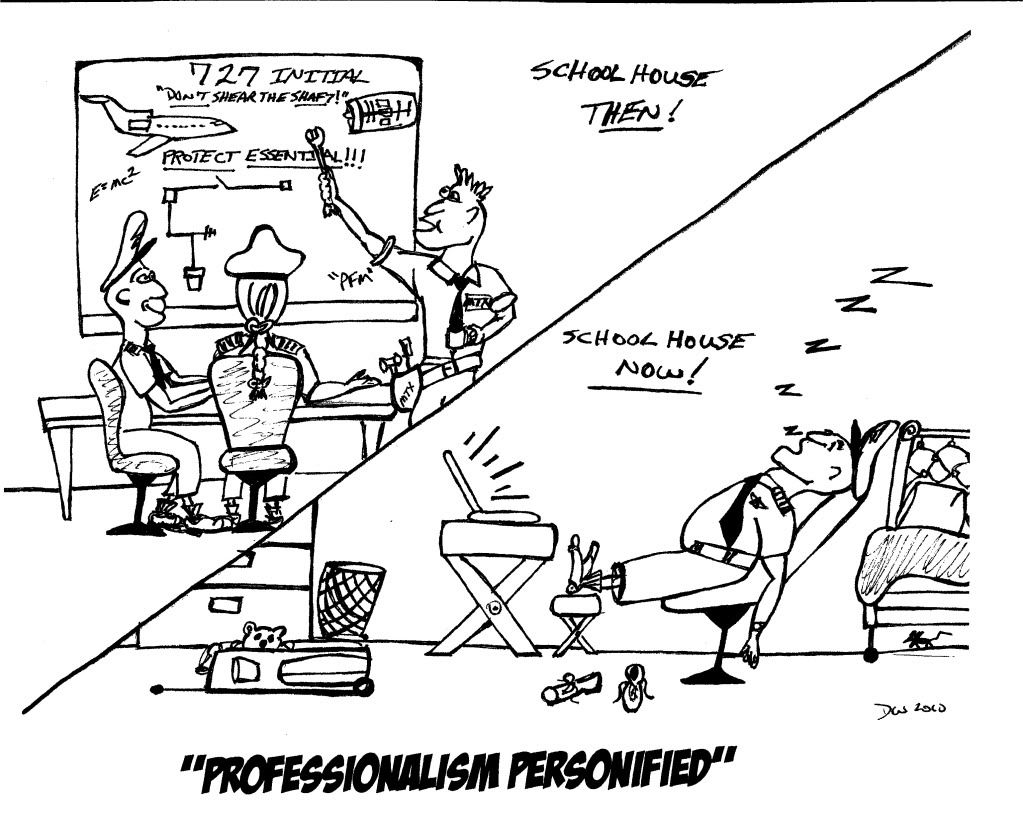
Although I haven't experienced 121 training first hand (and won't for a while, if at all), I've read a lot of first hand accounts about how it is now vs. how it was in the good ol' days... and the move over the last decade from the classroom to home study/online instruction and the general change in attitude towards the now prevalent idea that "you don't need to know how to build the airplane." (Always disturbing to a guy like me, who throughout flight training and now higher education actually does want to know how to build the airplane. :))

That being said, your quote above immediately conjured this image and I wanted to share it:

ProfessionalismPersonified.jpg

Credit goes to DogWhisperer over in this APC thread. I think he also has a facebook page called "Cockpit Creations."

Anyway, I like what you're saying... and it this case there was even a relevant political cartoon for it.
 
In GA, to be frank, the culture sucks. Almost universally. Ancient proverb says the mechanic is a poor soul who is expected to do more and more with less and less until eventually he or she must do everything with nothing. Those of us who try to raise the bar are ridiculed for trying to "rebuild the airplane at every annual". Airplane owners buy the must expensive airplane they can afford and then take it to a guy that pencil whips everything because they cant afford the maintenance costs. And if you think the race to the bottom is bad in the flying business you should see the airworthiness business. Nowhere have I seen hazardous attitudes more on display than on the shop floor at some times. Older guys, usually the ones that own the shops are completely change averse, and on top of that GA airplanes, engines, and accessories have little to zero manufacturer support, and if they do have support it costs a lot.

That isn't to say there aren't good people and shops out there, but it's a situation that is depressingly broken in a lot of places.


Sent from 1865 by telegraph....
 
This:
Those of us who try to raise the bar are ridiculed for trying to "rebuild the airplane at every annual".
This:
Airplane owners buy the must expensive airplane they can afford and then take it to a guy that pencil whips everything because they cant afford the maintenance costs.
And this:
GA airplanes, engines, and accessories have little to zero manufacturer support, and if they do have support it costs a lot.
Times a million.
 
Although I haven't experienced 121 training first hand (and won't for a while, if at all), I've read a lot of first hand accounts about how it is now vs. how it was in the good ol' days... and the move over the last decade from the classroom to home study/online instruction and the general change in attitude towards the now prevalent idea that "you don't need to know how to build the airplane." (Always disturbing to a guy like me, who throughout flight training and now higher education actually does want to know how to build the airplane. :))
Building the airplane is probably overkill, but knowing nothing beyond "I flip switch" is not confidence-inspiring. That's a great cartoon though. And it's true. I'm pretty sure my old man had to build the 727 from the ground up before they would let him be an engineer on it.

Homestudy/online is great as long as you're paying attention and as long as the material is sufficiently compelling and presented in a way that will keep your attention. Our quarterly CQ this last time through was actually pretty useful ("So this happened in the operation, and had the crew known X about the props, it wouldn't have.") That stuff has to be operationally pertinent, in my view.

My initial systems course (at least the computer based portion) on the -145 was garbage. It basically read the Volume II for the airplane to me. I don't want nor need the manual read to me—I can and will read the manual on my own, and if you read the book to me I'll tune it out. The computer based systems course provided a great opportunity to move, though. :D The Canadair jocks had an interactive system that let you flip switches and see valves and relays move. We EMB jocks got to sit through the manual being read to us, then we came in and talked to the M.S. and T.N.s of the world to figure out how the airplane ACTUALLY worked.

The training at my current employer was far superior. The chief instructor EMB at Brand Y has more Brasilia time than any other living human being as near as I can tell and insisted upon a deeper understanding of the airplane. Ironically, the FAA mandates a shorter training period for a more complicated airplane. Before jumping in the simulator to flip real switches, we flew the FTD, which had buttons and lights and in most respects was the same as the actual airplane (there were a few pre-mod B.S.*-120-whatever behaviors but those were clearly pointed out to us).

* Bulletin Servicio
 
I have seen an glimpse of how other services perform aircraft MX. At Wake Island watching the Navy and Marine Corps work on their aircraft was awe inspiring.

My current existence is working on C-130s for the Air National Guard. It pays the bills, I have a job and most of the time I enjoy the work. The catch, it takes forever to get anything accomplished. We have QA and safey running around watching your every move. You must have the book out for every task. It takes time to find the tech data for some strange obscure task you're trying to accomplish. It is easy to get bogged down in the details. One of my co-workers is a A&P at Fed Ex and he stated it best. "If the Air Force was in the flying business to make money it would be bankrupt." I originally set down this track to earn my A&P, the CCAF does have a program that pairs with your work experience to make that happen. I am still highly considering that given where I am and the effort put in to get here.

How is MX culture on the civilian side? Airlines? G/A? Corporate? How does it differ from the military? How valuable is a pilot/a&p? I guess that would depend on what operation you're operating in.

I would say that it all depends on how the airplane is used. Airlines, FBO's, and charter companies use their airplanes as profit centers. An airplane not flying doesn't do them any good, so they are going to want you to "git-r-done." Corporate operators use airplanes as business tools. The last thing they want is their CEO late to a meeting, or in the bottom of a smoking hole, so they are more likely to err on the side of safety.
 
I've worked with some kickass "gitr dun" civilian mechanics who knew the airplane inside and out. And I've seen a few ex-military mechanics who couldn't tell their ass from a hole in the ground. But the mechanic assigned to my aircraft now is ex-AF and totally awesome. If the company would buy him the stuff he needs, I think he could build another one from parts tomorrow. Plus, he gets ahead of problems and "goes the extra mile" to make sure we're ready to go when the phone rings. I'm just waiting for him to get fired because he tried to do his job too well. And I say this as someone who has heard every bad thing there is to hear about the AF. Outliers in every group, I guess.
 
I would say that it all depends on how the airplane is used. Airlines, FBO's, and charter companies use their airplanes as profit centers. An airplane not flying doesn't do them any good, so they are going to want you to "git-r-done." Corporate operators use airplanes as business tools. The last thing they want is their CEO late to a meeting, or in the bottom of a smoking hole, so they are more likely to err on the side of safety.
The taxpayer (me) additionally considers peacetime accidents to be unsatisfactory uses of our revenue...that's probably part of it.
 
Back
Top