Aerial Mapping - End of Season

Status
Not open for further replies.

Old Dominion Flyer

Well-Known Member
As the aerial mapping season draws to a close I'd be interested to know what people have to say about their experiences with the job. Back in October there were a few JCer's at places like DWAS and RAMS. If you guys are still around, perhaps you could share what you think of the job now that you have a season of experience under your belt.

Was the job different from what you thought the job wouuld be?

What were the best and worst aspects of the job?

How did you cope with being away from your family/sig other?

Was there anything you wish you had been told prior to taking the job?

Also, when do aerial mapping companies begin accepting applications/interviewing for the upcoming season? Is July too early to send my application to RAMS?
 
Having spoken to someone who'd done the job before (JonnyB's co-pilot, in fact...speaking of, where has Sean been lately?), it was pretty much exactly what I expected.

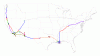
Being my first flying job, the best aspect was getting to fly nearly every day at someone else's expense, and get paid for it. Right alongside that was the opportunity to fly a coast-to-coast cross country. With work projects in Oregon, California, Arizona, Texas, Louisiana, Kentucky, Philadelphia and Utah, I got to see a lot of the country and at times got some great IFR experience. Some people drop serious coin at places like ATP or Ari Ben for that kind of experience, and I got paid to get it. And thanks to the magic of GPS and a program called GPSTrackmaker, I was able to map my travels throughout the season, which you can see in the attached graphic.

There were some negatives, of course; extended periods of down time due to weather resulted in my netting a lot fewer hours than I expected. I spent the entire month of December in a crappy Econolodge in Oregon, logging only 20 hrs that month. By season's end I will have logged about 500 hours since the season began, roughly 200-300 short of what I was told to expect. The down time can be a blessing as well, tho; we had quite a few down days while in New Orleans, affording ample opportunity to explore that town.

Other negatives included having to stay in crappy hotels in order to avoid having to share a room with another pilot. I don't know if all the Pictometry vendors are that way or just DWAS, but we had to keep it under $50/night if we wanted a private room. It's difficult to truly relax and get adequate rest when sharing a hotel room with a co-worker, and in places where we experienced lots of downtime due to weather, having to share a room sometimes felt like sharing a prison cell. (Younger guys fresh out of college and used to sharing a dorm room might have an easier time with this, but my dorm days were over looong ago.)

Which brings me to the separation aspect. Late last summer, just before I went to work for DWAS, my girlfriend's friends' boyfriend got sent to prison for his 3rd or 4th DUI conviction. In explaining my forthcoming lengthy absence, we joked with many friends that I was heading for the big house too. The funny thing is, Jenn has gotten to see her jailbird boyfriend far more regularly than my gf and I have gotten to see each other. Were it not for cell phones, email, text messages and webcams, this job would've done a serious number on my relationship. On the bright side, my gf jokes that after this experience, when I move on to an airline gig, my being gone for 4-5 days at a stretch will be no big deal.

Overall, it's been a great experience, especially for one that fell in my lap (via JC) literally 3 days after passing my commercial SE ride.
 

Attachments

  • map.gif
    map.gif
    12.6 KB · Views: 358
Respect for sticking it out full season Aloft, even with all the internal BS you dealt with. All in all DWAS was a good job and a great springboard, for all of us. It was cool to meet all the people (lol) as well. When exactly will you be returning the plane back to Phoenix?
 
Glad to hear the experience. I had the job at DWAS but turned it down to fly Otters and be home every night. I sometimes think if I made the right decision or not.. sounds like alot of fun though! Beats flying the Canyon everyday, anyways. Off topic: RPJ, how is Vision going? Heard all of the 328 props are grounded?? I've been seeing only the jets at the canyon lately..
 
328 props are down getting repaired, they will be back in service soon. As you know the 328JET's have taken their place until the props are back in service. 228's are fully operational with no problems.
 
Ryan: We've got about 35 hrs of rev left to shoot in Orange County to split between the three of us here, but with the marine layer you never know how many hours a day will be shootable. My guess is about a week.

Vheissu: thanks for turning the job down, I'm pretty sure I took your slot. :)
 
Sounds like a great experience Aloft! How does somebody get hooked up with a gig like that? And when/what is the "Season"?
 
Excellent question, sorry I forgot to answer it earlier.

The shooting season is mid-October thru mid-May, they generally want all the leaves off the trees so you can actually see what's on the ground in the photos.

There are 5 companies that provide a total of about 50 aircraft and pilots under contract to Pictometry, who owns the camera systems and markets the imagery. They are, in alphabetical order:

  • Air America, Inc.
  • Desert Wind Air Service LLC
  • Landcare Aviation Inc.
  • Northern States Aviation
  • Rochester Aerial Mapping Service
The job is identical regardless of which of these companies you work for. All 5 companies operate primarily C-172s; Landcare has 3 turbo Aztecs for high altitude shoots, making them the only vendor that offers any potential for multi time but in talking to their pilots, only those returning for a 2nd season have a shot at that. DWAS will be adding a turbo C-206 to its fleet this summer for the same purpose.

There are some very loose territories for the 5 vendors, though my experience shows that it doesn't really matter; they'll send you where they need you. Air America is based in Fla, but recently had 4 aircraft shooting in Bellingham, WA, DWAS is the "west coast operation", yet I found myself shooting in Philadelphia and New Jersey, and Landcare will have a couple crews headed for Alaska shortly.

All these companies will likely be staffing up beginning in September for a season start somewhere around the middle of October. I'd suggest submitting a resume at the end of August if interested. As for hiring mins, the requirements are generally Commercial ASEL/Instrument rated; DWAS requires 350 TT, a number of the others require only 250 TT. The hours mins are generally insurance requirements and thus inflexible.
 
Excellent question, sorry I forgot to answer it earlier.

The shooting season is mid-October thru mid-May, they generally want all the leaves off the trees so you can actually see what's on the ground in the photos.

There are 5 companies that provide a total of about 50 aircraft and pilots under contract to Pictometry, who owns the camera systems and markets the imagery. They are, in alphabetical order:

  • Air America, Inc.
  • Desert Wind Air Service LLC
  • Landcare Aviation Inc.
  • Northern States Aviation
  • Rochester Aerial Mapping Service
The job is identical regardless of which of these companies you work for. All 5 companies operate primarily C-172s; Landcare has 3 turbo Aztecs for high altitude shoots, making them the only vendor that offers any potential for multi time but in talking to their pilots, only those returning for a 2nd season have a shot at that. DWAS will be adding a turbo C-206 to its fleet this summer for the same purpose.

There are some very loose territories for the 5 vendors, though my experience shows that it doesn't really matter; they'll send you where they need you. Air America is based in Fla, but recently had 4 aircraft shooting in Bellingham, WA, DWAS is the "west coast operation", yet I found myself shooting in Philadelphia and New Jersey, and Landcare will have a couple crews headed for Alaska shortly.

All these companies will likely be staffing up beginning in September for a season start somewhere around the middle of October. I'd suggest submitting a resume at the end of August if interested. As for hiring mins, the requirements are generally Commercial ASEL/Instrument rated; DWAS requires 350 TT, a number of the others require only 250 TT. The hours mins are generally insurance requirements and thus inflexible.

Just to add my 2 cents as well... I previously worked for Landcare. My timeline was exactly like above, got hired in Sept, started in mid Oct. It is salary work, so when the weather is poor you still get paid to hang out in your hotel room. Landcare pays for rental car wherever you are, so you could go explore the surrounding town/city if you want. Their daily hotel limit was $74. Some of my coworkers were fresh commercial multis, some were ex-CFIs with a few hundred more hours under their belt. I have a significant other but it wasn't too bad. At Landcare, you could let the bossman know what your geographic preferences are and he will take it into consideration when sending you out for assignment. I believe this is possible especially at Landcare because they have quite a few planes (14 or 15?) so there are usually numerous locations available at any one time. The boss (B.S.) is a really nice guy and assigned me locations as close to my home at possible whenever they were available.
The work itself can be tedious, but also challenging esp if you're assigned work at class B airspace. I liked the cross country/single pilot IFR aspect of it as well.
I would do it again in a heartbeat.
 
I just wrapped up with RAMS and overall it was a terrific experience. The biggest thing I could tell anyone is that the people you're with make ALL the difference. Our group got along excellently and I consider every one of them friends. Living in hotels is tough but as with anything you get used to it. There is always something to do even in the middle of nowhere towns, you just have to get yourself out there.

The experience that you'll get, assuming you're coming in as a 250-300hr pilot, is invaluable. There's much more to it than just VFR timebuilding. Scheduling and keeping up on 50 and 100hr inspections for your plane, coordinating with ATC in busy airspaces for your operations, being "on your own" with an aircraft making those PIC decisions, etc.

You'll get a ton of great experiences out of it. I shot my first honest-to-goodness ILS to mins, dealt with my first comm failure, got exposure to mountain flying, saw all types of weather up close, and logged about 500 hours in the process. For me, this was the perfect "first step" aviation job. It gave me exposure to real-world scenarios and was a good transition away from the flight school environment...if that makes any sense.
 
What are some examples of jobs mapping pilots move onto after the shooting season is over? I'll have approx. 320TT and SE/ME COMM when/if I get an aerial mapping job this fall. Let's say I have 900TT at the end of the season. I'll be a little shy of Part 135 mins and I won't have a CFI. Do any aerial mappers have personal experience with this situation or would care to offer any suggestions for the next job after the season ends? My top two choices for this fall are aerial mapping and earning instructor certificates. However, at the moment it seems like I'll have to become an instructor after mapping unless I can find another job to help me meet 135 mins after the mapping season.
 
At this moment you can go straight to the regionals with 900TT and some multi. End of next season? Who knows how the pilot job market will be.
 
What are some examples of jobs mapping pilots move onto after the shooting season is over? I'll have approx. 320TT and SE/ME COMM when/if I get an aerial mapping job this fall. Let's say I have 900TT at the end of the season. I'll be a little shy of Part 135 mins and I won't have a CFI. Do any aerial mappers have personal experience with this situation or would care to offer any suggestions for the next job after the season ends? My top two choices for this fall are aerial mapping and earning instructor certificates. However, at the moment it seems like I'll have to become an instructor after mapping unless I can find another job to help me meet 135 mins after the mapping season.

There is always traffic watch, and here in San Diego I knew a couple guys that were "fish finders". They would fly out over the ocean and would look for schools of fish and radio the location to the deep sea pleasure fishing boats. Though that would be kinda cool.
 
just curious, why is the season over?

its something I would probably enjoy doing, but need to look more into it

edit: found out why, due to leaves.
 
Just finished up with RAMS also, thought I would put in my .02 for those looking to do it next year. I guess the first thing to say is how invaluable the experience was. It's all real life situations that you deal with, and not something you read about in a book. Not saying that you'll have these, but I dealt with many situations - Engine failure on short final, Icing conditions, mountain flying, running into trees (lol). But these are all things that help you learn, and especially right out of flight school where you aren't flying 500 hours in and out of the same airport every single day. I think JJ429PA said it best...

I guess the other thing is that you're going to have some period of downtime, especially in December or almost right away in some cases. I ended up getting stuck in some rundown travelodge in good ol' dayton ohio for a few weeks with nothing to do except wake up, eat, check the taf, drink, pass out, repeat. Like in any job though, there's pros & cons and that was the one con, at least we still got paid though.

Would I do all it again? Definitely. The good experience and all the great memories was worth it. Not to mention the 6 other guys I flew with were all real cool & good pilots. I would gladly pull up a bar stool with any one of them & swap rounds till closing time.
 
Thanks to AZ's low income tax, pay after taxes at DWAS was $2200/mo with about $685 of that being tax-exempt (per diem and partial cell phone reimbursement). Dunno what the other companies pay but I'm sure it's similar.

The season is runs from Oct to May principally for reasons of tree cover; no leaves on trees = more ground visible from the air.
 
What was the condition of the planes you guys were flying? How old were they? And how does it work... do you just follow a pre-planned GPS route and it takes all the pics automatically?
 
What was the condition of the planes you guys were flying? How old were they? And how does it work... do you just follow a pre-planned GPS route and it takes all the pics automatically?

Condition of my plane was a 1975 M model was minimally equipped. Ran fine though as far as instruments it was down to just two (one worked sometimes) VOR radios, no ADF, no DME, no GPS. For IFR flying it was pretty much VOR-A or an occasional ILS approach that was timed and didn't require something else. Some of the other planes were equipped a little better but nothing fancy.

One of the vendors I believe had some newer 90s 172R models with probably a King IFR panel so that would be much better than what my company had. It might have been Air America but I am not sure.

I would be willing and with the current situation of aviation probably do another season. My co-workers were very good people overall and we did have some good times. A great experience that I would not discount, flying across states, seeing totally new areas and meeting lots of people. You are totally on your own so be sure of what you can handle. With little oversight and being a single pilot crew all the time could get into trouble with a bad weather decision or just plain being tired one day.

All flight grids are gps produced and just make sure you can fly a localizer for 14 miles and you will be fine.
 
Status
Not open for further replies.
Back
Top