135.219

z987k

Well-Known Member
No person may take off an aircraft under IFR or begin an IFR or over-the-top operation unless the latest weather reports or forecasts, or any combination of them, indicate that weather conditions at the estimated time of arrival at the next airport of intended landing will be at or above authorized IFR landing minimums.
Emphasis mine.

So we were having a discussion today on whether we could launch for an airport whose forecast is below mins, but actually weather for the last many hours has been significantly above mins.

People don't actually go to their filed airport all the time with VFR airports. File to ABC 5nm from XYZ, cancel when you get close and go to the VFR airport, which may not ever have weather, so you really have no official way of knowing if the "airport of intended landing" is VFR.

An example under IFR - say I want to go from PDX to BFI, but BFI is down because the forecast says M1/4 for your ETA, while the METAR for the last two hours, which are included in the forecast time has been 1.5SM. PAE however has a good forecast and current conditions. So we launch for PAE, with the intention of changing our destination to BFI should it be above mins once we pick up the ATIS there. If it is not, we go to PAE.
Slight change, what if once we get the ATIS at BFI and it is no good, we just go back to PDX(had almost no intention of actually landing at PAE save an emergency)?
Legal?
 
Instead of delving into semantics and theoretical what-ifs (which I tend to do more often than not), let's do the thing where we imagine we're sitting at a table across from the FAA and NTSB.

The company asked you to go to BFI. You said yes. At the time you said yes, a "combination" of the available weather reports and forecasts indicated at BFI was to be below landing minimums.

I'd have trouble talking my way out of that - even if I was clever enough to eloquently explain that at first, I INTENDED to go to PAE, but during flight my intentions changed and I then intended to go to BFI. (When your company expected you to go to BFI all along because that's where their money was at or where their money wanted to go).

That's how I'd look at it. The safest thing is usually the right thing. If all goes fine, it'll probably never be an issue to launch for PAE and decide to go to BFI, and the company will be really happy they get their money at BFI. But as soon as you end up at that proverbial table, all eyes (including the company's) are going to be staring at you waiting for an explanation. Just my humble opinion.
 
"Ideally, my company wanted me to go to BFI, but they told me if that didn't work, we could go to PAE. instead."

And if you are sitting across the table having that discussion, you probably screwed something else up alot worse.
 
In no place does the FAA prohibit this. You launched for a legal airport. You diverted to another legal airport.
This is my stance.
"Ideally, my company wanted me to go to BFI, but they told me if that didn't work, we could go to PAE. instead."

And if you are sitting across the table having that discussion, you probably screwed something else up alot worse.
What if they said launch for PAE, try to go to BFI, if you don't make it into BFI, come back to PDX? Zero intention of PAE.
As far as the last statement is concerned, you don't know our POI.

Does anyone know of any legal interpretations or court proceedings that would shed light on this? I'm told there are some, but of course no one can show them to me and I can't seem to find them myself.
 
In no place does the FAA prohibit this. You launched for a legal airport. You diverted to another legal airport.

I agree, and again, if all goes fine, it's never an issue. At this point in my career with the experience level I'm at, I look at things as if it's a worst-case scenario. In this case, to me, worst-case would be something unrelated or unintentional caused the FAA to look at my flight a little closer, took issue with the decision making and wondered why I launched for PAE when the company wanted me to go to BFI. (I focused on the last part of z's post where he said there was no intention of ever going to PAE).

I have to assume the company wouldn't have your back on this. They might. But again, let's think worst-case.
 
I have to assume the company wouldn't have your back on this. They might. But again, let's think worst-case.
Ha! It's 135, I look forward to the day when anyone would have my back.
This scenario was actually built into the route structure at AMF, which I think is where eightball is coming from to.
 
After a little digging that resulted from an out-of-date reference in the "Everything Explained" book, here's some legal reference:

http://fsims.faa.gov/PICDetail.aspx?docId=8900.1,Vol.3,Ch26,Sec1
(from the FAA Flight Standards Information Management System)

Scroll about halfway down to

3-2050 REGULATORY INTENT.
(text below)

Paragraph A(1) starts to touch on what we're looking at. Granted, this is all assuming we're still on the ground trying to decide if we go or not (preflight planning), and once you're in the air on your way it's a different set of rules. If you decide to divert en-route, you just need to have a reason and the weather at your diversion airport needs to be above mins.


A. Requirement for Weather Reports, Forecasts, or a Combination Thereof. There are many regulations in 14 CFR that contain requirements for weather reports, forecasts, or a combination thereof to indicate that the weather at a destination or alternate airport will be at or above the authorized landing minima at the estimated time of arrival (ETA). The regulatory intent of these regulations is that each certificate holder, PIC, dispatcher, or person authorized to exercise operational control must consider all available weather information pertaining to a particular airport when making the decision on whether or not to dispatch, release, or operate (continue) a flight. There may be times when a combination of reports and forecasts indicate that weather will be at or above minimums, and there may be times when the opposite is true and a flight will have to be delayed or in some cases cancelled.

1) Combination of Weather Reports and Forecasts—The Worst Weather Conditions. When regulations regarding the selection of destination and alternate airports require “weather reports or forecasts, or any combination thereof” to indicate that weather conditions will be at or above the authorized minimums at the ETA, the worst weather conditions take precedence. The FAA Office of Chief Counsel has consistently interpreted regulatory text requiring “any combination” of weather reports or forecasts to mean that the worst weather conditions contained in any combination of weather reports or forecasts must be considered, and are therefore the controlling factor. These interpretations also make the remarks portion of a forecast as operationally significant as the main body of the forecast. Therefore, it is FAA policy that the worst weather condition in the main body or the remarks portion of a terminal forecast, as well as any weather report (see Volume 3, Chapter 26, Section 2 for more information regarding weather reports) used, is the controlling factor when selecting a destination or alternate airport. The burden of proof is on the certificate holder to show compliance with regulatory requirements and FAA legal interpretations. Therefore each certificate holder should be able to show at all times that any combination of available weather reports and forecasts indicate that the weather at the destination and any alternate airport will be at or above the authorized minimums at the ETA. (See also Volume 3, Chapter 26, Section 4, paragraph 3-2122 and subparagraph 3-2123B7)). This applies when determining compliance with the following regulations:
· Section 91.169 – Flight plan; information required: IFR alternate airport weather.

· Section 121.613 – Dispatch or flight release under IFR or over the top.

· Section 121.615 – Dispatch or flight release over water: Flag and supplemental air carriers and commercial operators.

· Section 121.619 – Alternate airport for destination: IFR or over the top: Domestic air carriers.

· Section 121.621 – Alternate airport for destination: Flag air carriers.

· Section 121.623 – Alternate airport for destination; IFR or over the top: Supplemental air carriers and commercial operators.

· Section 121.625 – Alternate airport weather minimums.

· Section 135.219 – IFR: Destination airport weather minimums.

· Section 135.223(b) – IFR: Alternate airport requirements.
 
Remember - it says "weather reports or forecasts." There may be times when the forecast is blown - have a good plan to get away and go someplace safe, but understand if it's been "well above mins" all day in contrast to the published forecast go ahead and go.
 
I don't see a problem with this scenario. For all you know, the company has plans to truck the freight from PAE if BFI never comes up.
 
Remember - it says "weather reports or forecasts." There may be times when the forecast is blown - have a good plan to get away and go someplace safe, but understand if it's been "well above mins" all day in contrast to the published forecast go ahead and go.
My understanding, and it's based upon the excerpt from the 8900.1 that MoMatt posted, the forcast(TAF/FA), if lower than the METAR is controlling.

After a little digging that resulted from an out-of-date reference in the "Everything Explained" book, here's some legal reference:

http://fsims.faa.gov/PICDetail.aspx?docId=8900.1,Vol.3,Ch26,Sec1
(from the FAA Flight Standards Information Management System)

I have read that portion, and as I just mentioned, that's how we know that the TAF is controlling and I can't launch off of the good METAR, but launching for a place with a good TAF and METAR with no intention of going there.
I am about 99% sure it is legal, we're not doing anything remotely unsafe and I can't find anything anywhere to say it's not.
 
So at AirNet, we were taught ametar alone could be used to satisfy .219 if it was within 1hr flying time. If it was over n hour flight, you had to use the forecast. Is this correct? Is there any basis for this?
 
So at AirNet, we were taught ametar alone could be used to satisfy .219 if it was within 1hr flying time. If it was over n hour flight, you had to use the forecast. Is this correct? Is there any basis for this?

Do you have any specific Ops Specs or company literature addressing this? That's where I would look. From what I understand and as stated above, you must use ALL available weather in your decision making and the WORST weather condition (current or forecast) is controlling.

I have read that portion, and as I just mentioned, that's how we know that the TAF is controlling and I can't launch off of the good METAR, but launching for a place with a good TAF and METAR with no intention of going there.
I am about 99% sure it is legal, we're not doing anything remotely unsafe and I can't find anything anywhere to say it's not.

I can't either. And reading back through this I would think as long as the you and the company (meaning whomever is responsible for "flight locating" your airplane) are on the same page, there's no problem with it. So I suppose my initial answer is a little too "tin foil hat."

The business I brought up about the company "throwing you under the bus" wouldn't be an issue if all parties involved knew the plan (launch for PAE, conveniently divert to BFI if weather is good, otherwise return to original spot).

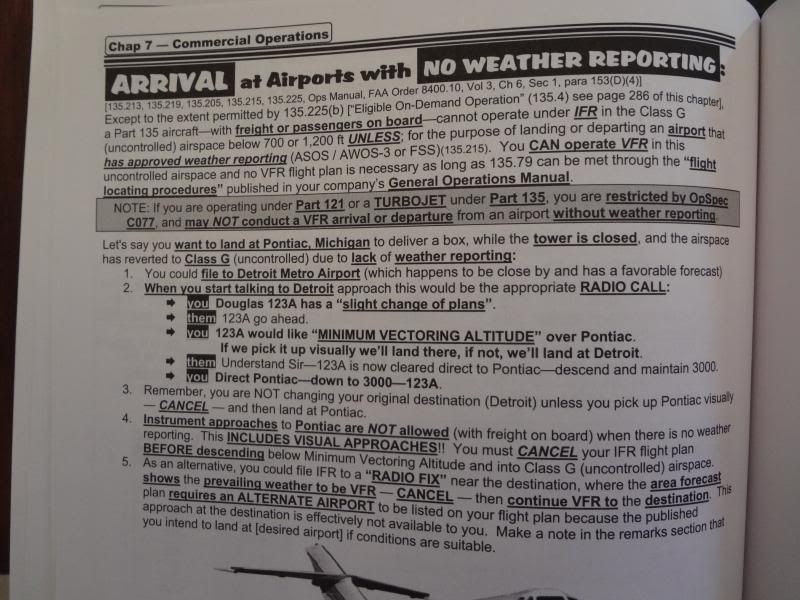
One suggestion made in "Everything Explained" is to remark in the flight plan your intentions to land at BFI if proper conditions exist at your eta.
 
airport of intended landing

It's probably legal, but cover your toosh. How? We intend to land at PAE unless we pick up good weather in BFI. Throw it in the "remarks" section. I would not mention returning to PDX, as your intention of landing at PAE is now void. HOWEVER, you could probably get around even that. How? If you do find bad weather in BFI, have your Company contact you on frequency. They can then tell you to return to PDX. Now it's probably legal as long as the new fuel planning (back to PDX) is legal. You, of course, are required to have a shocked face.

If the field is VFR, here's how Everything Explained does the dance (with a slightly different scenario of no weather reporting). Granted, it's another situation altogether, but it raises the point that legal may mean your second (real) intention may override your first (required) intention.

DSC07008.jpg


OR...you could just remember you fly in Alaska, and you can do whatever you want with not so much as a raised eyebrow.
 
Last edited:
Back
Top