0 or neg. G's and your engine

wzgrza

Well-Known Member
Hey guys.

On a normal GA aircraft engine, without inverted fuel tanks or oil system, what is exactly going on inside, at 0 or neg. G's?

When doing a zero G maneuver, and holding it a tad longer then normal, sometimes the engine seems to get a little rough... or not rough but RPM goes down and seems like the engine some what "chokes" as if I closed the throttle.

What is causing this? Is it just the fuel holes in the tanks being temporarily uncovered, and momentarily starving the engine of fuel? Or is it the oil in the sump, somehow interfering with cylinder movement slowing down your RPM? Thats all I can really come up with.

Is this a hazard, or dangerous?

Thanks for replies.
 
Normal piper cherokee and such.

And what I meant by that is something like making the pencil float type of thing for like 3-4 seconds. Nothing crazy like being upside down or anything. lol.
 
What is causing this?
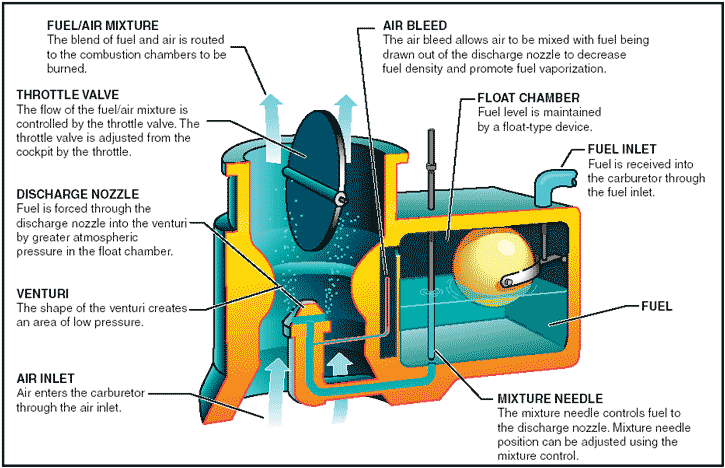
Carburetors rely on gravity to function. When you subject a carburetor to negative Gs, the float will rise up and close the needle valve in the fuel inlet, cutting off the flow of fuel. Also, the fuel already in the float bowl may drift away from the passage leading to the carb's main discharge nozzle, which will lean out the mixture. The lean mixture will cause the engine to run rough due to the uneven fuel/air distribution among the cylinders. Each cylinder will put out a slightly different amount of power, causing the roughness.

Figure 5-7 in FAA-H-8083 shows a carburetor cutaway. You can see how negative Gs can affect the float and the fuel in the float bowl.
Or is it the oil in the sump, somehow interfering with cylinder movement slowing down your RPM?
Eh, I doubt it.
Is this a hazard, or dangerous?
Well, if you do it long enough, the engine will quit. There also might be a chance of detonation if you are operating at a high power setting with an improper mixture. Reduce power below 70% or so and you can't cause detonation with the mixture. Running rough isn't good for it, though.
 
Most light GA aircraft have a float-type carb:

carburetor.gif


Now imagine what happens to the fuel in the float chamber under 0 Gs.
 
Very informative posts.

Thanks a lot for the replies guys.

I would have never thought of the carburetor. I was aware of the float chamber and the fuel in it, but that would have never came to mind.. or at least not for a while. :)
 
yep... the carb is the problem

the hurricane in WWII would cut out in 0 and neg G manuevers, which was a big disadvantage...

the germans were the ones to 'pioneer' the fuel injection system into gas engines during WWII.

during hurricane/109 battles the germans had a great advantage of being able to go 0Gs while the hurricanes would cut out :)
 
Carb is the problem as far as engine stutter.
Oil may not reach the pick up either, now your pump is not happy.
Oil pressure will drop.

-0.2 for 5 sec on the DA-42
 
Back
Top