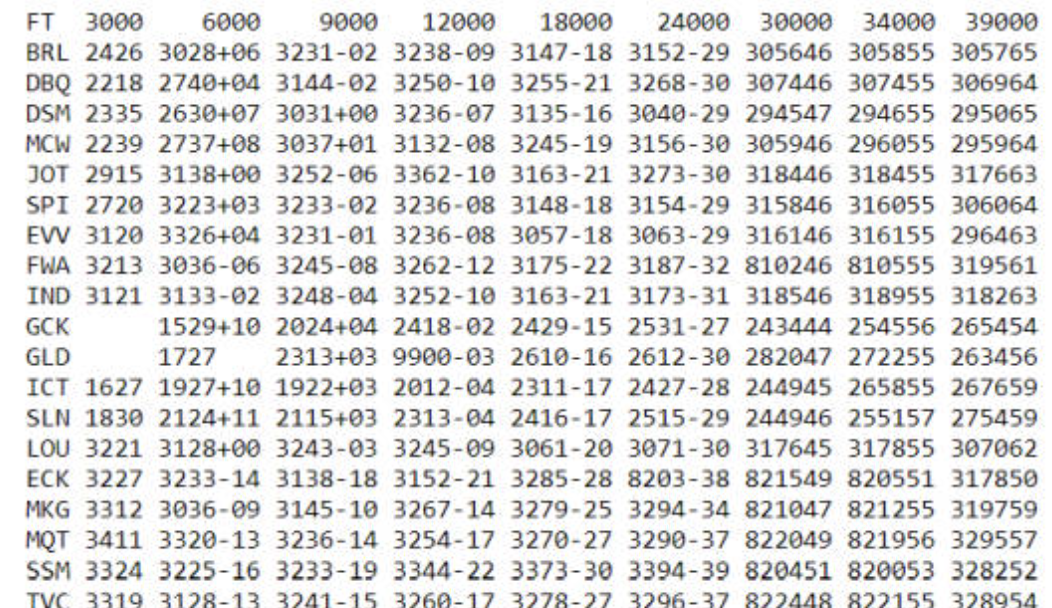
NWS discontinues winds aloft tables

Not directly related, but I was just wondering if the kids today know about Santorum and came across this:

“Santorum introduced the National Weather Service Duties Act of 2005, which aimed to prohibit the National Weather Service from releasing weather data to the public without charge where private-sector entities perform the same function commercially. The Aircraft Owners and Pilots Association was organizing a lobbying effort in opposition to the legislation, but it never passed committee. The motivations for the bill were controversial, as employees of AccuWeather, a commercial weather company based in Pennsylvania, donated $10,500 to Santorum and his PAC. The liberal advocacy group Citizens for Responsibility and Ethics in Washington cited the bill as one of several reasons for listing Santorum as one of its "most corrupt politicians". In support of the bill, Santorum criticized the National Weather Service in September 2005, saying its evacuation warnings for Hurricane Katrina were "insufficient".”
 
FWIW, I dislike a LOT of the "web 3.0" changes made to aviationweather.gov, but these winds-aloft tables are an artifact of data being distributed via teletype, and better accessible presentation modes are commonplace now.
Idk I find the tables useful for flight planning the old fashioned way and in my capacity as a controller. Not sure how to find the same info without the table.
 
Do you really use them in your capacity as a controller? I sure don’t.
Well you should. Maybe you have enough volume and you get pireps, but I like to know when the wind is drastically different on approach than it is on the field and it happens. Some places I've worked more than others, but it happens and it is good to know about.
 
like yeah, great, you can plug your VFR route into foreflight/garmin pilot and figure out how long your time en route with be because it will do the work for you, and thats why student pilots all suck these days. Now get off my lawn!
 
What? Those are important lol. I'll never forget the time I didn't check them on a beautiful San Francisco night with calm winds and unlimited visibility. Not even 1kt of wind at any of the local airports, METAR and TAF looked great eveywhere, no TFRs, but...I didn't look at winds aloft for this flight that wouldn't even exceed 2500ft.

I went for a 2AM random joyride to fly to HWD to get ramp shots of a Berry Aviation E120 still in the old "Coors Lite" silver colors from SkyWest. As soon as I got above about 1000ft, it was some of the worst and most gusty turb I've ever felt. Tried to fly a pattern at HWD with wings banking 30-40 degrees, then turning downwind ground speed of 95kts with the power idle and level flight and lining up with the runway both attempts it was like I was punched off course way to the side of the runway by gusts that kept locking up the yoke. Very violent and variable winds swinging the nose both ways a couple seconds at a time. Windsock was as limp as Epstein in a retirement home yet even at a few hundred feet those Diablo Range winds were making it the first, and so far only time, that I seriously couldn't keep it lined up at all even with no flaps. Decided to turn into the wind to climb out toward OAK and do landings there, similar result including a 50 degree "oh lawdz" wind punch to the wing at 150 feet, so I abandoned that, too. I was more amused than scared, but it was definitely prudent to just turn it into a Bay Tour and take the scenic route back to SQL. Where as soon as I got to pattern altitude, it was a beautiful night again and easy landing with no wind. Winds aloft at 3000 were VRB at 50+ knots when I checked! Never made that mistake again lol.

So, yep, that chart has since become rather important here where we sometimes have 50kt+ winds a few thousand feet up with calm below.

As a product of learning to fly in the 2000s, foreflight is just something I glance at (iPad stays in the side pocket until needed) and I prefer to go thru all the data myself to make decisions the way God intended. I also only have like 8 of 300 hours in glass cockpits, eff that noise until it's a job.
 
Last edited:
Well you should. Maybe you have enough volume and you get pireps, but I like to know when the wind is drastically different on approach than it is on the field and it happens. Some places I've worked more than others, but it happens and it is good to know about.
I just look at their groundspeed. You know someone is doing 250 indicated. Ground speed shows 300. 50kt tailwind.
 
Lol well maybe you know what his airspeed is, but usually by the time I am talking to them no one knows except the crew. I could ask but by then it's too late to do anything with that info.
 
I just look at their groundspeed. You know someone is doing 250 indicated. Ground speed shows 300. 50kt tailwind.
If they are at 20,000 feet on a standard day, and indicating 250 knots, their True Airspeed is 342 knots.

So if they are showing 300 knots over the ground, then they have a 42 knot headwind :)
 
Lessee Winds are 7229-02, uhh. Subtract the 5, carry the 1, take the standard deviation of the mean plus negative above 250, /0, NaN error beep booop.
 
If they are at 20,000 feet on a standard day, and indicating 250 knots, their True Airspeed is 342 knots.

So if they are showing 300 knots over the ground, then they have a 42 knot headwind :)

Well my airspace doesn’t go above 10k so 🤷‍♂️ Idk I’ve been working some of the busiest airspace in the world for 12 years now and seem to be doing alright without ever looking at a winds aloft chart. Honestly it’s literally never something I’ve even thought of doing or felt the need to.
 
Roughly the same winds aloft map that is available now is able to be overlaid on a center scope, but the terminal radar does not have that function. I still find the text tables to be more useful and comprehensive. I guess I was the only one 🤷‍♂️
 
Back
Top