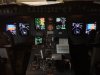
Candair CRJ200 from Heathrow Declares then Disappears

Having experienced an AHRS failure in that airframe, in IMC, that was a tough read. Regrettably the "confirm" part of recognize, confirm, recover doesn't seem to be taught outside of military and primary training.
That's crazy. I'm not used to the idea of an AHRS failing in that mode and not flagging out when something goes wrong with the guts.
 
That's crazy. I'm not used to the idea of an AHRS failing in that mode and not flagging out when something goes wrong with the guts.

To be fair, it did flag. But even with the flags, it takes a bit of time to adjust your scan and figure out what you can and can not use to keep the plane straight and level. Most partial panel primary training (say that three times fast) is done with a set up (ok... I'm going to cover these two gauges) so you now where to look and where not to look. Real world failures aren't always like that. Similar to a rapid decompression (in the sim) and a leak that can cause slow onset hypoxia.
 
To be fair, it did flag. But even with the flags, it takes a bit of time to adjust your scan and figure out what you can and can not use to keep the plane straight and level. Most partial panel primary training (say that three times fast) is done with a set up (ok... I'm going to cover these two gauges) so you now where to look and where not to look. Real world failures aren't always like that. Similar to a rapid decompression (in the sim) and a leak that can cause slow onset hypoxia.

Granted it was on the ground, I had one fail on the RJ. It definitely was a slow drift before it was sitting completely on it's side. Lemme see if I can find the picture I took. The first minute or so was us looking at it going "is that....I can't really tell...but I think...."
 
Granted it was on the ground, I had one fail on the RJ. It definitely was a slow drift before it was sitting completely on it's side. Lemme see if I can find the picture I took. The first minute or so was us looking at it going "is that....I can't really tell...but I think...."
See, I can see myself having trouble with that, that's a normal failure mode for a mechanical gyro but it's not something I've seen or trained on with an EFIS. Those the failure mode I'm used to to is ATTITUDE FAIL
 
Looking at the first picture I have where it's just a little off to when it is like this picture it was about 25 mins.
 

Attachments

  • IMG_6940.jpg
    IMG_6940.jpg
    1.1 MB · Views: 210
See, I can see myself having trouble with that, that's a normal failure mode for a mechanical gyro but it's not something I've seen or trained on with an EFIS. Those the failure mode I'm used to to is ATTITUDE FAIL

There is a EFIS COMP MON message and then flags pop up for things that it doesn't like. But it still requires a diagnosis of which one is screwed up.
 
I kinda wish there would be more training and emphasis on literally not doing anything in the first instant of a perceived emergency (except GPWS / imminent ground contact issues). Say, maybe wait 5-10 seconds. Analyze mean time.

A late (RIP) instructor from jet U who was ex-Eastern had a huge thing about this and he would almost yell to emphasize, "JUST SIT ON YOUR HANDS, SON" when one would be quick to reach/fix something. You have to admit, that advice would have helped most of the recent crashes. AF 447. Colgan 3407. AA 587. In all these cases, literally sitting there and not touching anything would have resulted in a far better outcome than the actuality. And in all of these, the pilot action to try and 'fix' the perceived problem was nearly instantaneous --- and as we obviously and tragically know now, the wrong action.
 
I kinda wish there would be more training and emphasis on literally not doing anything in the first instant of a perceived emergency (except GPWS / imminent ground contact issues). Say, maybe wait 5-10 seconds. Analyze mean time.

A late (RIP) instructor from jet U who was ex-Eastern had a huge thing about this and he would almost yell to emphasize, "JUST SIT ON YOUR HANDS, SON" when one would be quick to reach/fix something. You have to admit, that advice would have helped most of the recent crashes. AF 447. Colgan 3407. AA 587. In all these cases, literally sitting there and not touching anything would have resulted in a far better outcome than the actuality. And in all of these, the pilot action to try and 'fix' the perceived problem was nearly instantaneous --- and as we obviously and tragically know now, the wrong action.

When @Derg keeps saying WIND UP YO CLOCK SON! he's not talking about this guy...

Flavsignaturelook.jpg
 
The purpose of clearing the PFD units from unnecessary information, and thereby providing the pilots with a better display of the situation during unusual attitudes, is easy to understand. It is however more difficult to understand why indications related to instrument errors are removed.
This particular quote interested me so I tried it in the sim today; added a miscompare then induced an unusual attitude. In the Garmin family the miscompare flags/messages are one of the only things it does keep with the displays decluttered, though of course the pilot would still need to verify which of the sources was correct.

Unfortunately this could hit the newest AHRS or IRS just as well as the oldest ball gyro. Hopefully incidents or accidents like this one will lead to more people getting upset training.
 
This particular quote interested me so I tried it in the sim today; added a miscompare then induced an unusual attitude. In the Garmin family the miscompare flags/messages are one of the only things it does keep with the displays decluttered, though of course the pilot would still need to verify which of the sources was correct.

Unfortunately this could hit the newest AHRS or IRS just as well as the oldest ball gyro. Hopefully incidents or accidents like this one will lead to more people getting upset training.

That's pretty interesting to think about. I think I may drop a letter to the training department and have them check in the sim to see what happens.
 
Having experienced an AHRS failure in that airframe, in IMC, that was a tough read. Regrettably the "confirm" part of recognize, confirm, recover doesn't seem to be taught outside of military and primary training.

Sometimes, unfortunately, "confirm" may lead one to wonder which indication is actually the correct one. And in some aircraft, there can be insidious failures where both the primary attitude displays as well as the standby peanut gauge, can all be incorrect, due to where they're receiving their info from and what the failure mode is. I believe the most recent event like this was a Hornet crash, although a couple of Hog crashes are suspected to be from a similar failure mode.
 
Not sure it applies here but I agree with you generally...Ninja Hands have caused more problems than they've ever fixed.

Kinda think it does apply quite aptly here.

Seems the pilots were both heads down when the "event"/"anomaly"/"charlie foxtrot" commenced. So that right there is going to make this situation very tough. When the PF looked up he saw something that was completely unexpected and uninitiated by any pilot action. And, it seems, he took immediate action based solely on that something. But that "something" was incorrect data on one display unit. Other display units apparently were indicating correct data (i.e. information). Still other, independent indications remained unchanged from their state previous to the pilots taking their eyes away from the gauges (airspeed, altitude, engine settings, etc.) When airspeed, altitude, and engine haven't changed, chances are EXTREMELY good that nothing else materially has changed.

Easy to say from my calm, comfy desk, but before reacting, assess the situation and the quickly determinable consequences. Before any experiment, you need to establish your controls, lest you inject a hot dose of independent variables into the equation. In this particular case, it looks like the plane was flying along just fine - albeit with a FUBAR primary display; unfortunately, the PF reactively pushed the plane out of steady state based not on the state of the plane, but on the state of a faulty display. Had he waited just moments to separate the information from the data, things might have been very different. Once again, that's easy to say from a disinterested perspective, not so easy when one looks back up at a BIG, panel-dominating attitude indicating screen and it's telling you something is woefully amiss.

That is one thing I don't like about the new tech; certain data is amplified over other data and becomes virtually un-ignorable due only to the sheer size of the screen presenting it.

At the end of the day, I always remember the words of my dad years ago when he was teaching me to drive. "Son," he said, "Most accidents happen not because people don't react when they should, but rather because they overreact when they shouldn't."

 
My CRJ-200 knowledge has long been flushed from the mind, but if one PFD attitude is showing something entirely different than the other, shouldn't there be a warning/caution light associated with it? Eg, EFIS COMP MON or something?
 
My CRJ-200 knowledge has long been flushed from the mind, but if one PFD attitude is showing something entirely different than the other, shouldn't there be a warning/caution light associated with it? Eg, EFIS COMP MON or something?
EFIS COMP MON caution message and a flag on each PFD of the parameter that is flagged.

It is extremely important to look at the PFD flag every time you get the message and act accordingly.

You get nuisance HDG flags several times a day which numbs you to the other ones, and I've heard stories.

Sent from my XT1650 using Tapatalk
 
EFIS COMP MON caution message and a flag on each PFD of the parameter that is flagged.

It is extremely important to look at the PFD flag every time you get the message and act accordingly.

You get nuisance HDG flags several times a day which numbs you to the other ones, and I've heard stories.

Sent from my XT1650 using Tapatalk
Our AHRS get funny headings if you a) taxi out before they align or b) put large ferrometallic objects in the wrong baggage areas (on some aircraft). Never had or heard of an issue with attitude display though, a couple instances of the whole thing going red x due to a corroded wire or a magnetometer that was no good.

Very interesting topic though, I guess I sort of assumed a halfway modern EFIS was a lot more resistant to this type of issue.
 
Our AHRS get funny headings if you a) taxi out before they align or b) put large ferrometallic objects in the wrong baggage areas (on some aircraft). Never had or heard of an issue with attitude display though, a couple instances of the whole thing going red x due to a corroded wire or a magnetometer that was no good.

Very interesting topic though, I guess I sort of assumed a halfway modern EFIS was a lot more resistant to this type of issue.
Parts fail, complex parts fail with complexity!

And anyway the CRJ is the best of 1990's technology today. ;)

Even the G1000 X's out the attitude if the single AHRS craps the bed, I don't remember how it knows (maybe it only does if power is lost...) but it's beyond the capacity of what pro line 4 can do apparently.

As far as heading flags I had opportunity to speak with the engineer that designed the magnetometer system for the G-600 and he basically told me that the reason for so many nuisance heading flags is the the FAA required a ridiculously tight tolerance between the measured heading and the local variation based on a database.

A whiskey compass is "good enough" within 10 degrees but a hyper-accurate magnetometer must be within a degree.

Sent from my XT1650 using Tapatalk
 
Very interesting topic though, I guess I sort of assumed a halfway modern EFIS was a lot more resistant to this type of issue.

It's not halfway modern though. It's garbage.

As far as heading flags I had opportunity to speak with the engineer that designed the magnetometer system for the G-600 and he basically told me that the reason for so many nuisance heading flags is the the FAA required a ridiculously tight tolerance between the measured heading and the local variation based on a database.

The EFIS COMP MON goes off when the headings disagree by 6 degrees. Why do the heading indicators get off by 6 degrees multiple times per flight? Beats me, I've never seen it on any other glass cockpit aircraft, including ones with cheap non-certified avionics.
 
Back
Top