Saving up for first house. Invest or Savings Account?

gotWXdagain

Polished Member
I think the question speaks for itself. I'm saving up for a down payment and looking for the best way to get there. I'm about a year out from where I want to be, and wondering if it'd be smarter to put more money into a blue-chip dividend-yielding stock or ETF, or stick it all in a tried and true (but basically no interest) savings account?
 
If you're only going to be holding the money for a year, then putting it in equities isn't the way to go. Equities are only good investments long-term. In the short term, you could lose 30% of the value if the market has a big correction during the year. Put it in a short-term government treasury ETF. You'll yield somewhere around 1%, so you won't be making any money after inflation, but at least you'll be keeping up with it.
 
Also take into account the almost certain increase in rates before next year. Depending on the term of your loan and how long you plan on spending living in that house you may be better off buying now with less of a down payment. Obviously there are a lot of factors at play and no one has the perfect answer just something else for you to consider.
 
Also take into account the almost certain increase in rates before next year. Depending on the term of your loan and how long you plan on spending living in that house you may be better off buying now with less of a down payment. Obviously there are a lot of factors at play and no one has the perfect answer just something else for you to consider.

Unfortunately, even for an FHA loan I'm not in a position to buy, still working down the last of my credit debt. Being a CFI and spending over what I could afford at the time wasn't a great plan for long term success.
 
Rates shouldn't go up by more than a quarter point or so in the next year. You'll still be doing damned well compared to historical norms for mortgage rates.
Maybe the fed rate, I'm admittedly going into territory I know very little about but just from my own experience mortgage rates have fluctuated .75% over the past year.
 
Mortgage rates are driven only slightly by the fed funds rate. It's really more about demand for mortgage loans, creditworthiness of the average borrower, and risk aversion of the mortgage investors. With no indication of a coming surge in home buying, high creditworthiness of the average home buyer, and investors liking the low risk pool of borrowers, mortgage rates are unlikely to move significantly. The nearly three quarter points you saw this year was the peak shift, and the average rate throughout the year barely moved. The rates do float around a bit, but on average, you're unlikely to see much of a change in mortgage rates until either inflation picks up or the number of home buyers increases dramatically. No signs of either on the horizon yet.
 
Hold the money in the highest earning savings account you can find. The online banks usually have the highest rates without having to jump through hoops or having a huge balance to qualify.

Mortgage rates are predicted to be relatively flat for another year and China devaluing the Yuan has helped the very short term market.

Clean up the credit and save at least 5% for a down and try to avoid subsidized loans. I believe all subsidized programs now have PMI like payments baked into the loan for life. Once you go to refinance the rate may have jumped and you are stuck paying FHA or USDA rates for the life of the loan. Conventional will be required to drop PMI at 80% LTV when you request it and 78% automatically if you forget. The better credit you have will make a huge difference for rate and PMI amount.

I also highly recommend Costco to shop for a mortgage as well. I am an executive member and I only had to pay $300 for the entire loan. No points and a rate that was 0.25% lower than the others.
 
Luckily, my credit score never got that bad, as I was just about always able to pay more than minimum and on time. Earlier this year I balance-transferred to a zero interest for x months card, and calculated how much per paycheck I'd need to put on it and I'm able to comfortably do it.

Well, comfortably enough that i just put a Bose A20 on that zero interest card, yes, I know it sets me back slightly but it's all good, updated the per paycheck payment amount so I can still pay off on schedule and put money away, and my hearing is technically an investment unto itself.

And surprisingly my credit score has always been in the high 700s.
 
Luckily, my credit score never got that bad, as I was just about always able to pay more than minimum and on time. Earlier this year I balance-transferred to a zero interest for x months card, and calculated how much per paycheck I'd need to put on it and I'm able to comfortably do it.

Well, comfortably enough that i just put a Bose A20 on that zero interest card, yes, I know it sets me back slightly but it's all good, updated the per paycheck payment amount so I can still pay off on schedule and put money away, and my hearing is technically an investment unto itself.

And surprisingly my credit score has always been in the high 700s.
What's your debt to income ratio?
 
I also highly recommend Costco to shop for a mortgage as well. I am an executive member and I only had to pay $300 for the entire loan. No points and a rate that was 0.25% lower than the others.
I had no idea Costco was in the home loan business. Any idea how long they've been doing them?
 
I had no idea Costco was in the home loan business. Any idea how long they've been doing them?
It's not them that originates or services the loan. It's similar to Zillow or lendingtree where there are several originator's that try to get your business.
 
What's your debt to income ratio?

At the moment, on average monthly income with both me and the wife, it's about 49% and that includes everything (including rent/energy and the like, and averaged 1x/yr payments, as best as I could). When the credit card payment drops off, it will be about 32%. I've also picked up extra shifts to help pad the savings account but I'm not going to factor those into yearly income for the purposes of calculating monthly mortgage payments.
 
Sounds like you have a good handle on what needs to be done.

Make sure all is OK with your wife's credit past as well. I've had that fun personally so I took the mortgage on myself.
 
Speaking of market corrections, looking at my stock in GE (not alot ventured, not alot lost, had it before starting this thread) I think there's a reason the two ETFs I just bought are up today ;)

Holy correction batman!
 
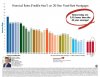
I received a chart recently showing mortgage rates in relation to historical averages. Now is still a good time to buy, and will be for the next year as well. I heard rates were going to jump 2 years ago when I purchased my most recent residence, but the graph shows that spike didn't happen as plan.

Even if rates increase, it's not very likely they'll increase above 1 % in the next six months. I don't foresee the economy getting that strong until the end of the next election cycle at the earliest.
 

Attachments

  • image.jpeg
    image.jpeg
    564.1 KB · Views: 279
Well, during the correction I have put a bit of money on stocks as well, I know it's riskier but since the correction they've been doing quite well. Buy cheap.
 
Back
Top