
Pilot Fighter
Well-Known Member
That's a dog-fighter.


While loiter is important, payload is essential. Ask any of the attack guys on here about situations where all the iron they had wasn't enough to deliver the win and they had to either hand off to another flight or leave to refuel/rearm. There aren't always other flights, and if your stations are empty but your fuel tanks are still full, you just became a spectator to the fight.As for the MQ-9, I don't know much about it, but you really don't need too large a payload to do CAS. Loiter time would seem to be a much more useful aspect. Come down, rain fire or drop relatively light antipersonnel munitions and return to loiter altitude. Done.
The thing that would really make a drone good at CAS would be that it could designed from the ground up to do that. None of the existing fixed-wing airframes- the A-10 included- were really designed with CAS in mind. A Predator with a Hellfire can do that now. Imagine what they could do with a little innovation.

That's a dog-fighter.

Infantry is cheaper than aircraft. We can accept the additional losses.Can't really do CAS, unless you have local air superiority. This would include superiority against robust IAD's. I'd say that there are a lot of really important missions that have to be successful prior to being able to do CAS, and support troops on the ground. Is it the big show in town in OEF? Sure. I'd say not so much in a future conflict where there is a lot of opposition (to aviation assets) initially.
This aircraft looks sort of appropriately mean, but it doesn't have the Big Gun.
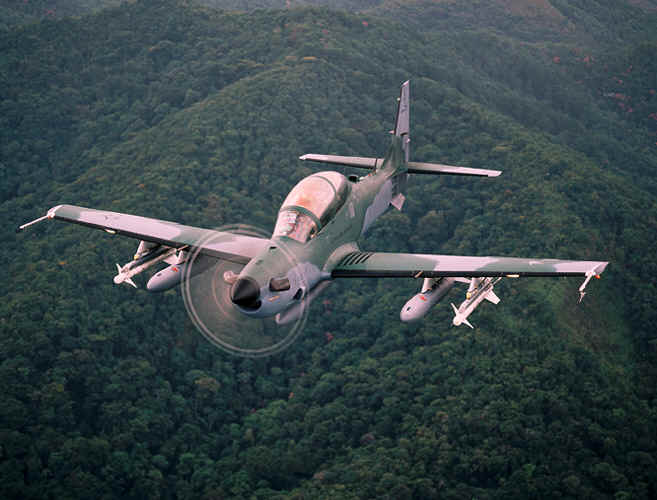
While loiter is important, payload is essential. Ask any of the attack guys on here about situations where all the iron they had wasn't enough to deliver the win and they had to either hand off to another flight or leave to refuel/rearm. There aren't always other flights, and if your stations are empty but your fuel tanks are still full, you just became a spectator to the fight.
I'd be all for the development of a CAS-specific UAV. If someone could develop a true virtual reality human interface, the Reaper already has the weapons capabilities, they'd just need a good number of them to avoid aforementioned spectatorship.

The big gun isn't really a necessity for CAS. The A-10's 'big gun' was a product of Vietnam-era thinking for tank-busting. With modern precision guided munitions designed for that, such a large gun is hardly still necessary.
In Desert Storm, one of the biggest tank-killing aircraft......was the F-111.
Was anything close?In Desert Storm, one of the biggest tank-killing aircraft......was the F-111.
... and I'm correct in assuming they weren't using a gun pod?
Correct. Gen. Horner's famout "tank plinking" campaign, using F-111s loaded out with GBU-12 500lb LGBs. The F-111s in DS didn't have their 20mm guns installed.
Ah- thank you. That validates my point. While the A-10's monster cannon is certain a 'shock and awe ' inducing thing and will be missed in that right, it's hardly reason to think that a true CAS aircraft is deficient without one.

An unorthodox strategy but entertaining nonetheless.I like watching people argue with a guy who has done CAS about CAS.

The thing that would really make a drone good at CAS would be that it could designed from the ground up to do that. None of the existing fixed-wing airframes- the A-10 included- were really designed with CAS in mind. Maybe the F-15E was intended- but that's a redesign from an interdiction jet. The mission almost always seemed to be an afterthought. True CAS is about putting something in firing position that can delivery heavy ordinance on demand. A Predator with a Hellfire can do that now. Imagine what they could do with a little innovation.
A lot of beliefs about CAS come from a time when munitions weren't GPS-precise and the only way to provide highly accurate fires was through slow-flying aircraft using forward-firing ordnance. That is certainly not the case today. GPS/Intertial munitions mean that any aircraft that can hold a bomb and get mensurated coordinates from the JTAC can deliver danger close fires. Laser designators on anything from a King Air to a Pred and on up to a B-1 or BUFF mean that anything that can hold a bomb with a laser kit on it can also deliver Danger Close kinetic effects. The reality is, the current technology means that a very wide range of aircraft with a very wide range of extremely useful tools can be used to provide accurate fires. JTACs can reach in to that toolbox sitting in the stack above them and use a hammer for nails and use a wrench for bolts, rather than having to use a mallet for everything. The diverse set of capabilities also means that it is just not possible to build one air vehicle -- regardless of how it is controlled (manned or unmanned) -- that is the "ultimate CAS machine" and can incorporate all that useful tools.
As an aside, the F-15E was never really designed with CAS in mind (again, as CAS was thought of pre-9/11). It was pretty specifically a replacement for the F-4 and F-111 as an interdiction bomber that could also provide its own air-to-air protection. When I went through the F-15E initial qual course, I remember asking my instructor on a surface attack sortie if we were going to strafe. He replied, "the F-15E will never strafe. That's not our mission." So...we see how well that prediction has borne out. On my first assignment in the F-15E, the only time we ever spoke about CAS was after 9/11 and when it was looking like we were going to Afghanistan. Before that we never even learned how to strafe, much less practiced it -- in fact, it was generally considered "too dangerous" for us to spend time on, given all of the other missions we needed to be good at. There was a mad thrash in my unit after 9/11 to have the former A-10 guys teach us academically how the Army worked, about CAS theory, and the mechanics of it all. It was a crash course. .

There was a mad thrash in my unit after 9/11 to have the former A-10 guys teach us academically how the Army worked, about CAS theory, and the mechanics of it all. It was a crash course.
When I went back to my 2nd F-15E tour in 2006, thanks to Iraq and Afghanistan, the community had fundamentally changed such that strafe and CAS were now basic, bread-and-butter items that were part of basic competency.
