Required Reading...

dasleben

That's just, like, your opinion, man
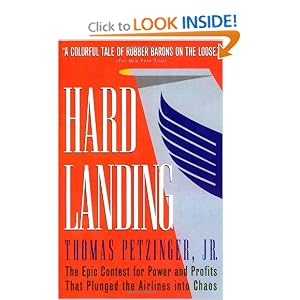
...particularly for airline pilots, but everyone in aviation should read it:

9780615611839_p0_v2_s260x420.JPG


Some very sobering lessons in this book about this industry, especially that bad luck combined with a few poor decisions can tear down an entire airline. I put this at the same level of "required reading" as Fate is the Hunter, by the way.

Buy it. It's cheap.
 
Great recommendation! Have had it in my library for many years and read it two or three times. Made my son read it and have lent it out to other pilots. It really is an excellent book. Gandt was a career Captain with Pan Am. It was so sad to see such a marvelous airline be destroyed so quickly after Trippe left. He also has some other good books like China Clipper, Intrepid and Twilight Warriors.

"The image would remain fixed in Rob Martinside's memory for the next twenty-seven years: burnished aluminum fuselages, sleek tails slanting skyward, blue-on-white paint schemes gleaming in the morning sun. New Boeing 707s, the cutting edge of commercial jet technology, covered the ramp at the San Francisco International Airport. Each bore on its tail the round blue logo of Pan American World Airways.

As Martinside made his way across the ramp to the Pan Am complex at the south end of the airport, he paused to gaze at the polished beauty of the jets. He was twenty-six years old, the youngest in his class of newly hired pilots. It was his first day at Pan American.

Martinside met his fellow new hires. Despite the differences in height and shape, they seemed cast from the same mold. Freshly released from military service, each still wore the ubiquitous crew cut, a PX-bought polyester business suit, an enormous wrist chronometer.

But there was something besides haircuts and clothes that distinguished them from their contemporaries of the mid-1960s. In their walk, in the way they bantered among themselves, in the appreciative look they cast on the nearby jet airplanes, there was a. . . cockiness. To a man, they walked with a discernible swagger. It was an acquired trait–the body language of the fighter jock, the astronaut, the test pilot.

Each knew he could have gone to another airline. There was Delta, for example, if you wanted to live in the South. There was Braniff, Texas-based and expanding very fast. American was also Texas-based, with a large domestic system. TWA was a leaner version of Pan Am. With TWA you could live in middle America–Kansas City was its headquarters. If you flew for Eastern Airlines you were based, not surprisingly, near the Atlantic shore.
But those were domestics, like Greyhound Bus. This was Pan American. No bus driving for them. No miserable lunches in places like Des Moines or Cincinnati or Boise. For them it would be sushi in Tokyo, petite dejeuner in Paris, tea in London.

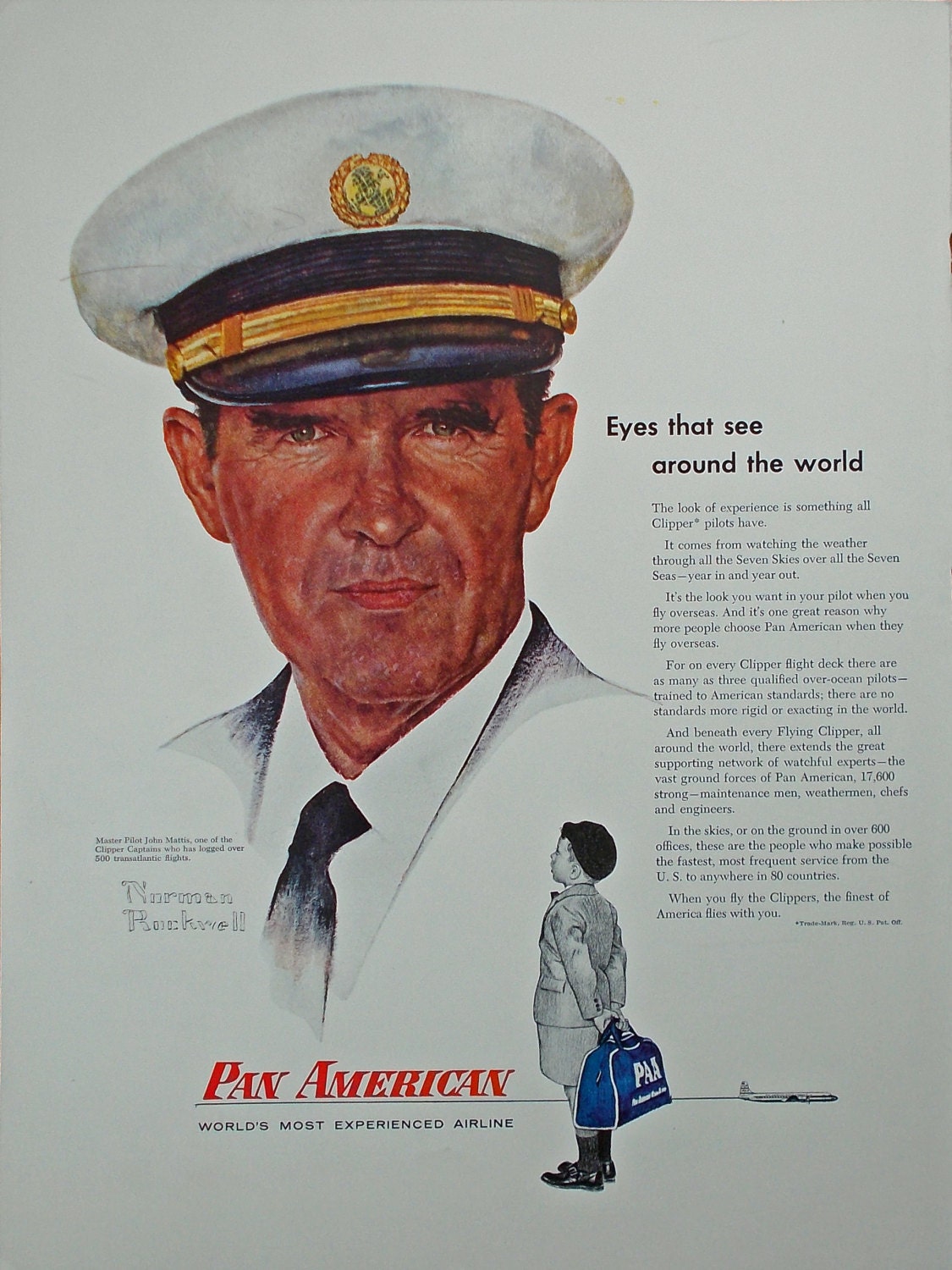
Pan Am advertised itself as "the world's most experienced airline." Well, sure, thought the new hires. That was the kind of airline they ought to be working for.

Pan American was the world's most glamorous airline. It was also the most snobbish. Pan Am's response to pilot applicants went something like ". . . if you truly believe that you possess the credentials to fly for the world's most experienced airline, then present yourself to our offices at. . . "

It was a time like no other in the history of the airlines. Traffic growth had doubled in the early sixties and was forecast to double again before the end of the decade. Expansion was so rapid that airline recruiters were predicting that the supply of new pilots–military and civilian–would be used up and the airlines would have to hire college kids and train them from scratch. Promotion would come so fast they would barely get settled into a new seat before the next became available. Boeing and Douglas could not build jetliners fast enough to fill the orders of the airlines.

Navy, Air Force, and Marine Corps pilots had an edge in the hiring order. To the airlines, military aviators were a known quantity. They were trainable, it was assumed, and they could probably even take orders.

Between 1964 and 1968 a steady stream of hopeful airmen flowed through the front door of Pan Am's operations complex at Kennedy Airport. Each of the crew-cut young men (no women pilots were being hired by the major airlines in the sixties) carried a briefcase containing his most precious documents–his military flight logs and pilot licenses."
 
+1. Great recommendation. I read that a couple years ago and loved it.

I didn't really think it was "sobering"....I suppose to the doe-eyed newbies who don't know anything about the profession or its history, it might come as a shock. For me, I've been around airline pilots for a decade and have probably a better than average understanding of the industry (for a military guy). Greater than the shock of seeing a great company felled by terrible business, I found the book informed and entertained a great personal nostalgia for a period of aviation I never participated it (but heard lots about!).

The part of the book that A Life Aloft quoted is one thing that has stuck with me the most since reading it; the fact that Pan Am prided itself on its experience so much that it marketed on it. I was too young and ignorant when Pan Am was around to notice a nuance like this.

It disappoints me that, since the attack of the Ivy League MBAs post-deregulation, the airline industry no longer cares about what I consider to be this extremely valuable and important metric. I wish desperately that today there was an airline that felt that this was important again. As was stated in the quote, that is a place that I'd want to be working for.

As an added reading recommendation, I'll add North Star Over My Shoulder by Bob Buck, which has a similar discussion about the "good old days" at TWA. For me, these three books (the other two being Fate Is The Hunter and Skygods) were all excellent reads about the foundational basis of the airline industry as it stands today. Since we're talking "required reading" in this thread, I also can't forget Flying The Line and Flying The Line II (which I have thanks to some generosity from Seggy several years ago here on JC).
 
+1. Great recommendation. I read that a couple years ago and loved it.

I didn't really think it was "sobering"....I suppose to the doe-eyed newbies who don't know anything about the profession or its history, it might come as a shock. For me, I've been around airline pilots for a decade and have probably a better than average understanding of the industry (for a military guy). Greater than the shock of seeing a great company felled by terrible business, I found the book informed and entertained a great personal nostalgia for a period of aviation I never participated it (but heard lots about!).

The part of the book that A Life Aloft quoted is one thing that has stuck with me the most since reading it; the fact that Pan Am prided itself on its experience so much that it marketed on it. I was too young and ignorant when Pan Am was around to notice a nuance like this.

It disappoints me that, since the attack of the Ivy League MBAs post-deregulation, the airline industry no longer cares about what I consider to be this extremely valuable and important metric. I wish desperately that today there was an airline that felt that this was important again. As was stated in the quote, that is a place that I'd want to be working for.
And this is what the newer generation of pilots will never understand and don't seem to care about. In fact, I see many what I would consider to be disrespectful, ignorant comments about this subject. Just yesterday someone stated that their Dad thought that pilots should be from the military and have a donkey load of hours. I had to laugh and shake my head. They have no idea what the industry was like, except from what they may have read and apparently they have not read much. They don't understand that the great carriers were mostly started and run by pilots, or by those who built the aircraft like Bill Boeing and not by business majors. They don't care that many, and I mean many of the pilots were indeed former military and that military pilots were given preference at places like Pan Am, United, Eastern and TWA. Flying Tigers to them, was simply some carrier eventually bought by Fed Ex. UAL used to have ads (as did all the carriers) which featured Captains with thousands of hours of flying experience/time and where their military accomplishments were highlighted in those ads. They never worked in an industry were there were no Regional carriers and where work was farmed out to them. There were only a few, very small and localized commuter carriers. They whine about not being able to get to the right seat of a Major and feel entitled with their couple of hundred hours of flying. They don't realize that the old civilian dogs had a few thousand hours under their belts flying freight, flying charter, flew checks and mail, usually had some MX experience and FBO experience, had done all sorts of flying in all sorts of planes and conditions and then began at a Major as an FE before they ever saw the right seat. And yes, there were always exceptions to this, but it was more the norm. The training was also different. They were not even alive during deregulation. They may see some old ads of what the interior of the planes looked liked and what the service was like for the pax and think, gee, that must have been great. It was great. There were no pilot puppy mills. They don't really get the big picture and see what the business has become and why.

And thus the decline of what I would consider to be aviators and not just pilots, which is probably a whole other discussion for another thread. There was a time that it was never about what bare minimums do I need to be hired and what types of limited flying in two or three types of planes will get me there. There were no short cuts. I see little joy shared about the actual path and the enjoyment of the process, the love of flying and why, the finesse, techniques and knowing your aircraft beyond again the minimums required to fly it, the experience and variables in all types of wx, and what is truly learned along the way and why this is valuable. Interesting enough, I see more of that from the pilots who fly in Alaska, on here.

There are those on here who do understand and who do get it and know who came before them and how important the process is. That always warms my heart. But then there are others, who simply just see the process as a fast means to an end, a large PITA and who have no interest in the history and who came before them or what skills they should be honing along the way and why. There are those who will never care or understand the process because it's all about me and I want mine now mentality and it sucks that I can't have it asap and what can I by pass and do the minimum of.

Your other book recommendations are also top notch.

il_570xN.448971804_qnn8.jpg


american-airlines.jpg


united.jpg
 
Eh, that's true for some of the period of time that you're talking about, but not for some other parts of it. My newhire sim instructor at AirTran was an Eastern Air Lines newhire at the age of 24 in the '60s (can't remember the exact year). He had 700 hours total time. He started in the right seat of the Connie, and upgraded just three years later into the Electra. An Eastern Air Lines captain, at the age of 27, with just about 3,000 hours. All civilian. Never one hour sitting sideways.

So while it's true that there have certainly been times when it was a much harder road to travel to get to that coveted major airline seat, it is also true that there were times in the "golden years of aviation" when it a lot easier than it is today.
 
I will be looking to pick this one up as well. Any other recommendations? I was trying to find an e-book version of "Stick and Rudder" just to say I have read it.
 
Ignorant comment? My father and his two brothers retired from the military and all three flew for majors. They believe the best airline pilots are ex-military. Disagree, but categorize as ignorant?

I'm 50 and a third generation pilot. Did you think my post was the ramblings of youth?
 
I will be looking to pick this one up as well. Any other recommendations? I was trying to find an e-book version of "Stick and Rudder" just to say I have read it.


I enjoyed The Outer Whorl by Neal Schier.
 
Ignorant comment? My father and his two brothers retired from the military and all three flew for majors. They believe the best airline pilots are ex-military. Disagree, but categorize as ignorant?
Short-sighted, not ignorant. Believing that the military is The Only Way means that you discount valuable experience of others. (And yes, there's plenty of worthwhile, and improving, civilian flying out there.)

I don't think you can safely say that "X is the only way to produce the best airline pilot," and I don't think you can quantitatively assess "best" either. You can be "sierra hotel" at flying, and still a really bad airline pilot, since there's much, much more required than just your ability to make many thousands of pounds of airplane move.
 
...particularly for airline pilots, but everyone in aviation should read it:

9780615611839_p0_v2_s260x420.JPG


Some very sobering lessons in this book about this industry, especially that bad luck combined with a few poor decisions can tear down an entire airline. I put this at the same level of "required reading" as Fate is the Hunter, by the way.

Buy it. It's cheap.

I've read this...VERY GOOD BOOK.

Also read "Splash of Color" a comprehensive history of Braniff by John Nance. Also cheap used on Amazon
 
And this is what the newer generation of pilots will never understand and don't seem to care about. In fact, I see many what I would consider to be disrespectful, ignorant comments about this subject. Just yesterday someone stated that their Dad thought that pilots should be from the military and have a donkey load of hours. I had to laugh and shake my head. They have no idea what the industry was like, except from what they may have read and apparently they have not read much. They don't understand that the great carriers were mostly started and run by pilots, or by those who built the aircraft like Bill Boeing and not by business majors.

I'll try again with less profanity. I would be interested what was especially disrespectful or ignorant about my post.

I had posted that my 80 year old father believed, based on his own experiences, that the best airline pilots were former military pilots. Many of his generation feel the same way. I suspect, if we looked at the post-war period through the late sixties, his opinion might have some merit.

However, our insightful friend failed to recognize that I did not share my father's opinion, as should have been clear by my vocal opposition to the new ATP rule. I offered my father's opinion as the old, out-dated paradigm that might still be embraced by some, including Sully.

Sully, a former F-4 pilot, appears to share some of my father's opinions - I don't agree, as multiple posts suggested.

Where was the ignorance and disrespect? My father and his two brothers, all over the age of 80, saw some growth in the industry during their careers. Can we let old men embrace the lessons of their own experiences? Or, was I the target of your disdain? Let's see, was I a former military pilot with a donkey-load of hours? No, I only had 300 hours PIC when I got my 135 jet gig.

How could I have possibly been offended? Newer generation? Who are you talking about? I'm a 50 year old ATP. Critical of the views of an 80 year old industry vet?

You aren't as perceptive or attentive as you might believe.
 
I've flown with lots of former military guys. Some are really good, some are not. Some can operate properly in a multicrew 121 cockpit, some shouldn't have left their single-seat jet. The same is true for the rest of us who came from the civilian ranks. Nothing stands out as spectacular or awful about any particular group; we're all just trying to get through the day without breaking something or getting violated.
 
I've flown with lots of former military guys. Some are really good, some are not. Some can operate properly in a multicrew 121 cockpit, some shouldn't have left their single-seat jet. The same is true for the rest of us who came from the civilian ranks. Nothing stands out as spectacular or awful about any particular group; we're all just trying to get through the day without breaking something or getting violated.

I don't think I've given any of my own opinions about military guys. As I wasn't a Naval Aviator, I have more in common with non-military guys.
 
I've flown with lots of former military guys. Some are really good, some are not. Some can operate properly in a multicrew 121 cockpit, some shouldn't have left their single-seat jet. The same is true for the rest of us who came from the civilian ranks. Nothing stands out as spectacular or awful about any particular group; we're all just trying to get through the day without breaking something or getting violated.

This.

Exactly my experience at Southernjets.

I would love to be a fly on the wall when MikeD finally breaks down and gets a job in the airline business! :)

"You can't backslap the other FO, Mike! I know he's an idiot, but we have to follow the protocol! Oh hell, kick his ass, but keep it on the down-low"
 
Thing is, we are all idiots at times and that's being human. I try not to hold the weird stuff against anyone knowing that brain farts are me. Or maybe it's just Alzheimers at 52. But the best pilot, military or civilian, in one who is humble and has a ton of patience.

Just this morning I did a favor for an F/O and flew her leg on a flight I was going to jumpseat on. I'm not used to the right seat. I was slightly wondering about the Capt when he had a little trouble digging the PDC out of the ACARS. I mean, how many times have we pushed those buttons. But then, we get to the end of the runway, and Capt says switch over to tower, so I flip the switch. Start hearing departure talking on tower freq and can't figure out why they would be doing that. Then, realize flipping the switch just put me on departure, and I forgot to put tower freq in after leaving ground. I mean, I never work the radios on the ground as that's an F/O thing, but how stupid can you be....
 
Back
Top