
Airspace

K902

The New Guy
Alright folks, first I'm not sure if this is the place for this question or not, but here goes. I'm well behind all of you as I'm just now working on my private. I seem to be struggling with the airspace chapter. There is alot of infotmation thrown out at once. Any ideas or tricks on how to make this stuff less confusing since its something I HAVE to learn?! I'm using the Jeppesen book and would appreciate any help. Thanks!
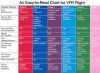
 
Hopefully this helps.

Just break it down into chunks. Look for areas that have the same information. Flash cards help, too.
 

Attachments

  • image.jpg
    image.jpg
    96.6 KB · Views: 1,511
What specifically is giving you trouble? Weather mins can be pretty daunting, especially with class E and G and all the different ones. The way I break it down is its always a certain minimums above 10,000, always a certain minimums at night, etc, until the other minimums (above 1200 AGL and below 10,000 MSL in class G) become easier to remember by filling in the gaps. Having a sectional helps because you can visualize where the airspace is more easily.
 
Alright folks, first I'm not sure if this is the place for this question or not, but here goes. I'm well behind all of you as I'm just now working on my private. I seem to be struggling with the airspace chapter. There is alot of infotmation thrown out at once.


What in particular are you having trouble with?

You can essentially break this into three areas:

Airspace type (A/B/C/D/E/G) and requirements (xpdr, 2-way radio, clearance, etc)
Weather minimums by type
Special Use Airspace (MOA/ADIZ/Prohibited/Restricted/etc)

Once you have a grasp of it conceptually, it is just a lot of detail to memorize. For weather, remember basic VFR mins are 500/1000/2000, and then memorize the exceptions to that.
 
The hardest part is taking what you learned from rote memorization (vis, cloud clearances, entry requirements, controlled vs uncontrolled) and applying that to real world situations on the VFR chart.

To organize it in your head, just separate controlled (A,B,C,D,E) and uncontrolled (G). Pick a point on the chart, start on the ground and work your way up to 18K (you'll always end at class A). Be able to identify when (altitude) the class of airspace changes, what class it is, the VFR WX mins required to enter, communications required and equipment required. After you get that, then start plotting courses on the chart and do the same exercise only at a specific altitudes along the route. MOAs, Restricted Areas and such don't really matter for this, since WX mins don't directly dictate if you can enter those areas or not. Just remember that "controlled" airspace has nothing to do with communication... "Controlled" only refers to a controlling agency's authority to provide separation between IFR & VFR traffic.

Why isn't your CFI helping you with this???
 
Rod Machado's Private Pilot book has a couple of particularly excellent chapters on this which breaks it down into easy-to-understand chunks with some good mnemonic devices.
 
A few good ones, I think they were from Rods book, are the C152 and F-111.

A - No VFR (unless NORDO)

B - 3 and clear

C,D,E(below 10k)- C152 3 Miles visibility(c=3) 1000 above, 500 below, 2000 side

E (above 10k) - F111 Five miles vis 1000 above, 1000 below, 1mile to the side

G - below 1200 day - 1 and clear, below 1200 night - C152
G - Above 1200 below 10k day A152, Night C152, Above 10k F111
 
Correct on the NORDO, you can continue flight under VFR and remain in Class A. You do not need to descend, but should pick up a VFR altitude and land as soon as practical (not as soon as possible).

AIM 6-4-1 (c):

2. VFR conditions. If the failure occurs in​
VFR conditions, or if VFR conditions are encoun-​
tered after the failure, each pilot shall continue the
flight under VFR and land as soon as practicable.​
NOTE−​
This procedure also applies when two-way radio failure
occurs while operating in Class A airspace. The primary​
objective of this provision in 14 CFR Section 91.185 is to​
preclude extended IFR operation by these aircraft within​
the ATC system.​
 
It's really hard to teach unless you have a sectional out. That combined with diagrams (such as the classic AOPA reference card) make it easy to visualize and als helps dial in the why behind some airspace rules. I usually teach it as an XC describing all of the airspace encountered enroute.
 
Airspace is quite simple after a while, at least for us... but for the students it might be challenging to understand at first. I would say start out with the least used airspace that a PPL would use, A and then most likely B, and then C and so on but then teach them the 3/ 152 rule. When an examiner asks "what weather do you need to fly into a class D airport?" the DPE doesn't necessarily need the whole '3 miles, 1,000 foot ceiling, 500 below, 2,000 horizontal' BS, as long as the student understands the basic minimums then the student will understand airspace.
 
When an examiner asks "what weather do you need to fly into a class D airport?" the DPE doesn't necessarily need the whole '3 miles, 1,000 foot ceiling, 500 below, 2,000 horizontal' BS, as long as the student understands the basic minimums then the student will understand airspace.

You're confusing VFR conditions with what it takes to maintain VFR. 3sm 1000ft vs. 3sm 1000 above/ 500 below/ 2000 horizontal, respectively.

Also, if an examiner asked what the cloud clearance and visibility requirements are required to fly VFR into D, how else are they supposed to answer?
 
You're confusing VFR conditions with what it takes to maintain VFR. 3sm 1000ft vs. 3sm 1000 above/ 500 below/ 2000 horizontal, respectively.

Also, if an examiner asked what the cloud clearance and visibility requirements are required to fly VFR into D, how else are they supposed to answer?

1 statute mile, clear of clouds would be my answer to that anyway, as that is technically more correct.
 
It's also possible that controlled airspace is above VFR weather minimums, but you cannot fly in it...can you describe that scenario???
 
Correct on the NORDO, you can continue flight under VFR and remain in Class A. You do not need to descend, but should pick up a VFR altitude and land as soon as practical (not as soon as possible).

AIM 6-4-1 (c):

2. VFR conditions. If the failure occurs in​
VFR conditions, or if VFR conditions are encoun-​
tered after the failure, each pilot shall continue the
flight under VFR and land as soon as practicable.​
NOTE−​
This procedure also applies when two-way radio failure
occurs while operating in Class A airspace. The primary​
objective of this provision in 14 CFR Section 91.185 is to​
preclude extended IFR operation by these aircraft within​
the ATC system.​
A little abstract for a private student :P
 
1 statute mile, clear of clouds would be my answer to that anyway, as that is technically more correct.

91.157 (SVFR) is more of an exception to 91.155. It's not a "normal" operation and not available in all cases. Clearance is required from ATC and IFR separation is provided. You can't even use it at night unless you meet the pt 61 requirements for the instrument rating and the aircraft meets night/IFR certification per 91.205.

If a student answered "SVFR, 1sm clear of clouds" for class D VFR weather mins on a check ride, I don't know a single DPE who wouldn't tear into them about 91.157. This is one of those times where it's better to just ATFQ.
 
When I learned all this stuff, I had a "side view" of the airspace, and would fill in the various blanks for A-G (equipment required, weather, clearance/radio contact, etc.).

A little abstract for a private student :p
Unless he's sitting on his wallet and balls, of course. ;)

1 statute mile, clear of clouds would be my answer to that anyway, as that is technically more correct.
"Your answer is technically correct, but useless."
 
Back
Top