How...improve...pilot: ACM breakaway convo :-)

Re: How can you improve yourself as a pilot?

Probably one of the biggest mistakes made by young guys in their first fighter is to underestimate the capability of opponents.

Again, I've been able to get kills on F-15Cs, F-15Es, F-16s, A-10s, and even a classic Bug in the AT-38.

No radar...no radar missile...just heat, guns, and visual lookout. None of it had to do with any particular prowess I had, but most of it had to do with mistakes in radar coverage, comm, tactic execution, visual lookout, energy management, etc by the guys in the big gray fighters.

If you think it can't happen to you, then you're probably going to be a victim of it at some point. I know I have been on the receiving end of such a thing, and it is an important learning experience.

Doesn't the F-15E have the biggest motors in the 15 series? I hear it's quite a performer, especially when clean.
 
Re: How can you improve yourself as a pilot?

Probably one of the biggest mistakes made by young guys in their first fighter is to underestimate the capability of opponents.

Again, I've been able to get kills on F-15Cs, F-15Es, F-16s, A-10s, and even a classic Bug in the AT-38.

No radar...no radar missile...just heat, guns, and visual lookout. None of it had to do with any particular prowess I had, but most of it had to do with mistakes in radar coverage, comm, tactic execution, visual lookout, energy management, etc by the guys in the big gray fighters.

If you think it can't happen to you, then you're probably going to be a victim of it at some point. I know I have been on the receiving end of such a thing, and it is an important learning experience.

I certainly would put trust in your perspective.....I guess my point was that the Hornet dude would have needed to REALLY goon away the basics to find himself in an envelope where a T-45 could pick him off. Not sure how the T-38/AT-38 fights, but I'd be confident in guessing that it is not really comparable to the -45 in the BFM arena. The Goshawk was not known for having any real pitch authority, and certainly had no advantage in the vertical either. Fought well, it could stay in a very wide radius 2 circle fight with another -45, but it still had almost no nose authority to pull for a shot. If it did happen as described, I'd guess he made himself really small (that was about the only thing it had going for it), came raging out of higher altitude with a whole load of smack, and probably got a lucky snapshot before either overshooting like a big dog, or bleeding down until he had no energy for any kind of follow on opportunities. Would love to see a HUD tape though.....could be a decent learning point.
 
Re: How can you improve yourself as a pilot?

Not saying it isn't possible, but I'd love to see this one. Before I left Meridian, there were a couple impromptu DACT hops organized....one with a Rhino, and another with a VFC-111 F-5E. They let studs trunk in them, with T-45 IP's flying. From what I heard, it was absolute murder. I have no idea how a Hornet pilot could put himself into a spot where he could get shot by a T-45 (can't imagine the flight regime they would need to be in), but my hat is off to the -45 IP if this is true.

Rhino? As in the USN/USMC F-4? Blasphemy to use Rhino for anything else......:D
 
Re: How can you improve yourself as a pilot?

Probably one of the biggest mistakes made by young guys in their first fighter is to underestimate the capability of opponents.

Exactly what happened to my C-model I killed. I'll have to dig up that tape.

No radar...no radar missile...just heat, guns, and visual lookout. None of it had to do with any particular prowess I had, but most of it had to do with mistakes in radar coverage, comm, tactic execution, visual lookout, energy management, etc by the guys in the big gray fighters.

A pointy-nose guy with a radar took it to the merge? :D

The bolded part includes your dark grey family-model Rodan too......:D

On a serious note, did the CFTs on the Strike give any performance loss in ACM? Or were they aerodynamic enough to not be an issue?

If you think it can't happen to you, then you're probably going to be a victim of it at some point. I know I have been on the receiving end of such a thing, and it is an important learning experience.

Very much so. The Hog especially so since energy management was so important, being so energy limited. The C-model guy I was able to kill, had his smarter cohorts who simply hawked the fight looking for an opportunity to pounce, yet were also content staying above us, forcing us to remain in our defensive wheel below. If we attempted to disengage/extend, thus losing our mutual support the wheel provided, we were food on the platter to them......and the good guys knew that........and made it a waiting game: "who needs to bingo first?" :)
 
Re: How can you improve yourself as a pilot?

Rhino? As in the USN/USMC F-4? Blasphemy to use Rhino for anything else......:D

Sadly no.......talking about my trusty steed's bloated younger brother. This way when they call "rhino ball" the dudes on the boat don't use baby Hornet weight settings for the CDP's. Potentially big GW difference between a 5.0 in a Hornet versus Rhino for example.
 
Re: How can you improve yourself as a pilot?

Sadly no.......talking about my trusty steed's bloated younger brother. This way when they call "rhino ball" the dudes on the boat don't use baby Hornet weight settings for the CDP's. Potentially big GW difference between a 5.0 in a Hornet versus Rhino for example.

Interesting. Kind of like when A-6 Intruders were still around, EA-6Bs often had an Iron Cross on the nose to instantly tell a Prowler from an Intruder visually when recovering on the boat.

Yes, when I think of a Rhino, I generally picture the USMC RF-4B....
 

Attachments

  • RF.jpg
    RF.jpg
    325.3 KB · Views: 70
Re: How can you improve yourself as a pilot?

Interesting. Kind of like when A-6 Intruders were still around, EA-6Bs often had an Iron Cross on the nose to instantly tell a Prowler from an Intruder visually when recovering on the boat.

Along those lines, the newer 8-blade E-2C's have the cross on the nose to differentiate them from the older 4 blade ones. Apparently it involves different LSO technique depending on which one, but I am not an expert in E-2's nor am I one in the work of Paddles :)
 
Re: How can you improve yourself as a pilot?

Not sure how the T-38/AT-38 fights, but I'd be confident in guessing that it is not really comparable to the -45 in the BFM arena. The Goshawk was not known for having any real pitch authority, and certainly had no advantage in the vertical either.

Have you seen what the wing on a T-38 looks like? It's smaller than the stab on a F-15! It was made to go in a straight line in a hell of a hurry, and has one of the worst E-M diagrams I've ever seen. It's powered by two cruise missile engines.

Your statement about no pitch authority and no ability to use the vertical could have easily been written about the Talon.

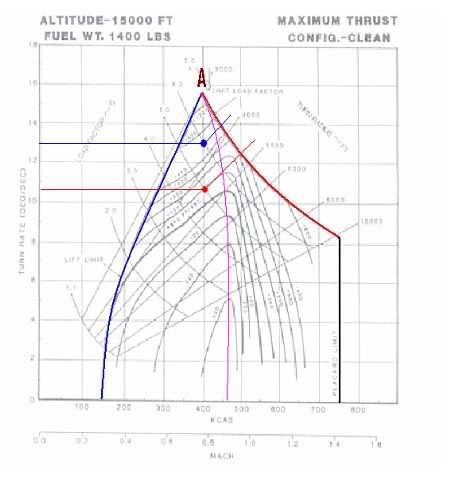
Not sure if you guys use the same type of E-M diagram in the boat service, but here's one for the T-38:

em.jpg


That sharply-pitched shape says it all. Cliffs notes: there are only a couple specific G and airspeed combinations that can produce turn rates and radii that are even in the same neighborhood as front line fighters (and minor deviations off airspeed can kill that performance quickly). The energy needed to make those turn rates/radii happen requires a bunch of vertical, too, meaning the turns can't be sustained long at all.

Bottom line: any kills scored by an AT-38 against a big gray fighter are because the operator of the big gray porked it away. Again, it happens a lot more than you'd expect. Why do you think they have F-5s as Aggressors? The F-5 is a much better aircraft than a T-38, but the difference in size and RCS means that they're able to present the big fighters a different 'look'. This is what often leads to guys getting out of their habit patterns forged against similar opponents and to making mistakes.
 
Re: How can you improve yourself as a pilot?

Interesting. Kind of like when A-6 Intruders were still around, EA-6Bs often had an Iron Cross on the nose to instantly tell a Prowler from an Intruder visually when recovering on the boat.

I've only seen the "radiation" symbol on the nose.

ea-6b_1.jpg
 
Re: How can you improve yourself as a pilot?

Have you seen what the wing on a T-38 looks like? It's smaller than the stab on a F-15! It was made to go in a straight line in a hell of a hurry, and has one of the worst E-M diagrams I've ever seen. It's powered by two cruise missile engines.

.

I think only the F-104 was worse, in terms of E-M.
 
Re: How can you improve yourself as a pilot?

On a serious note, did the CFTs on the Strike give any performance loss in ACM? Or were they aerodynamic enough to not be an issue?

It was more the drag of the bomb racks than the physical shape of the CFT. My understanding is that the CFTs used by the F-15s up in Iceland back in the day (which didn't have the bomb racks) were pretty neutral aerodynamically.

Nonetheless, the F-15E never met a knot it couldn't bleed.
 
Amazes me that some nations use the Hawk as a point defense fighter and light strike. Light strike makes more sense I think. Even the fighter version has limited thrust and fuel. As I understand it, the Hawk turns pretty good in a circle but I can't see much more (of course I'm very limited on my knowledge of such things :cool:). The Hawk 200 is the fighter version. I'm sure it has to do with an economic factor vice what is best. I think Oman and maybe Malaysia used the 200 for the fighter role as a back-up role I'm sure.
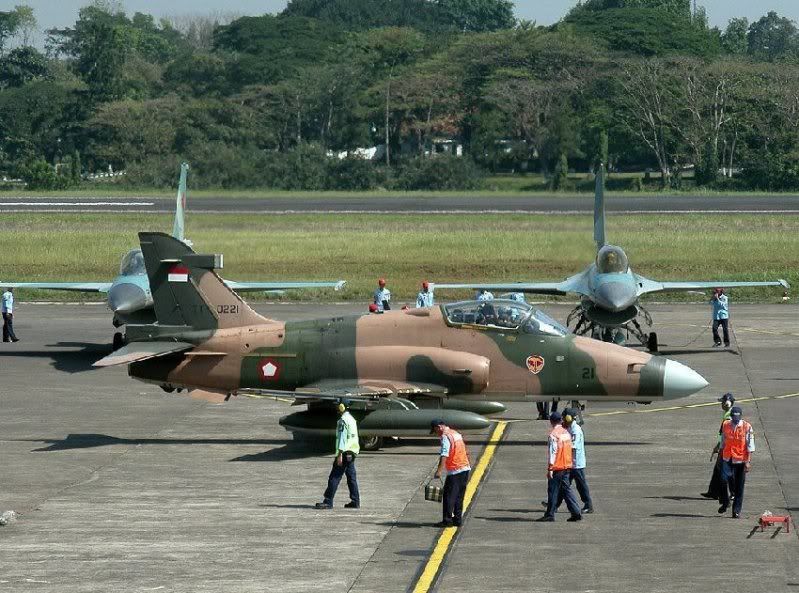
200692-Hawk200-Lanud2-1.jpg
 
That flats in the -45 is definitely an exercise in stick and rudder skills....if nothing else, it is a very good lesson in basic aerodynamics....ie you try to reverse too aggressively at 110 kts, and you will either depart or accel to about 170 kts and go from offense to heavily defensive in the blink of an eye. One thing I didn't think about was that the IP in question could very well have broken the ACM training rules and dropped the flaps/slats 1 cirlce or something.....would be a pretty good way to get VERY slow and throw the Hornet for a sudden surprise.
 
All this information makes me tingly in my nether regions.

Hacker: I'm sitting in Midland, Texas tonight after watching the Midland Airshow this morning. The Strike Eagle Demo easily stole the show. Wow.

Crappy pic:
39570_166372743378777_100000181561716_618348_4362582_n.jpg
 
Always interesting to read the details of a very different segment of aviation. Good reading guys!
 
Well, with the boilerplate that I am the equivalent of an FS2000 junkie in the "airline pilots" section on this one...

From my extensive reading and not much else, it seems that the temptation to throw the energy advantage away and turn with less powerful, less highly wingloaded aircraft has been eternal. There are countless stories of F4U pilots taking the silk elevator because they decided to turnfight a Zero. On the other side, plenty of Squareheads found themselves swimming in the channel trying to turn with spitfires in either a 109, which could climb away like it was burning solid fuel, or a 190, which could go like stink and easily boom and zoom all day if employed correctly (but which bled energy like a stuck pig in the turn).

All of which is a preface for the question: How do they teach y'all the proper balance between aggression (which, if you read all these dusty tomes in my library, seems to be the x-factor that differentiates guys who become aces and guys who "just get through it") and using the advantages of the airframe? I mean, obviously, it's a complex learning process, but I'd have thought by the time you're behind the stick of an F-15 (from Mike's example), you'd have better sense than to get down in the dirt and try to Red Baron with a Hog.
 
How do they teach y'all the proper balance between aggression...and using the advantages of the airframe?

It's one and the same.

Right from the beginning in the USAF's introduction to fighter fundamentals program (where students are flying the T-38), the basic axioms of dogfighting include knowing that controlled aggression means you fight the gameplan instead of just going for it and pulling on the stick for all it's worth. We don't really give them the option of going wild and just "making it happen".
 
To add to Hacker's points, on the Navy side towards the end of your ACM training (talking about basic BFM flight school level stuff here), you do several solo neutral 1 v 1 hops....ie you break the section up, come back towards each other beak to beak, pass at about 500' and the fight is on, with presumably nobody having the advantage (if this can be said about stud vs IP :) ). If you didn't "get it" up until then, you quickly learn exactly what he is talking about. Coming into the merge without a plan, and simply reacting to the bandit, is a recipe for failure. They will try to exploit you into a type of fight that you will not win, and if you don't counter it, you will find yourself quickly out of options with the inevitable "pippers on....tracking.....tracking....tracking" until the IP decides to give you another shot. Lesson is learned quickly. You absolutely cannot check your brain out at the merge.
 
Back
Top