UA232 remembered 20 years later

Snoopy2

New Member
Wow!! It's been 20 years since the Sioux city crash of United 232.

Number 2 engine destroyed
Severe damage to tail from fan blades
All hydraulics gone
Surface controls froze putting plane in a perpetual right turn
Number 2's throttle jammed in upright position making it extremely difficult to maneuver other throttles by single hand
No onboard computer guidance to Sioux city - airport had shut down system for repair - ATC had to verbally guide craft - crew had to visually find the airport through July afternoon haze
Severe phugoid effect - losing 100's/1000 feet of altitude with every wave descent
Sink rate of 1600 ft/min as plane approached runway
Forward speed of 220 knots
Right wing struck the ground followed by the right landing gear
Plane slammed so hard the tail section broke off, skidded, main body flipped causing the cockpit and 1st class section to snap off like the head of a pencil, broke apart and caught on fire

184 of 296 people lived to tell about it with many walking away from the wreck

20 years later and it's still an unbelievable story

A miracle in many ways
 
Is today the 20th anniversary of that?

Wow... what is sad, is that I would have been 14 at the time. But I was apparently so wrapped up in my small-town high school existence that I don't remember hearing much about it. :( I'm actually embarrassed to admit that....
 
Yep, it's been 20 years. Man time sure does fly. (no pun intended)
There's a good interview with Capt. Haynes in the Seattle Times if you're interested. The Sioux city media (both tv and print) also has many stories.
Interesting that KTIV has some raw footage they shot before/during and after the crash. They're the ones who shot that world famous video. So eery because you hear the plane coming in with engines blaring, they you hear the actual crash......they it gets so so quiet once the wreckage comes to a stop.
Btw KTIV must kick themselves when they realize the opportunity lost. They've got a jumbo jet coming in without hydraulics and the best they can do is an obstructed view with builldings and a fence in their way??? Ouch!!!
Lesson 101 on how not to capture a news story on video.
 
One of the most heroic acts in the history of aviation. It just goes to show that no matter how bad things that, you should never give up. The fact that they got the jet down and lined up with a runway just blows my mind. And then saved like 2/3 of the passengers.
 
And then saved like 2/3 of the passengers.
Given the circumstances the fact anyone survived is amazing, but if you watch the interview with Fitch in the MAYDAY series about it, its pretty obvious the crew didn't look at that number as an accomplishment. Must be horrible to lose people sitting behind you, even though what they did was really an accomplishment.
 
Yeah I agree, it's still remarkable that they were able to get it down like they did though. They've probably saved a lot more lives considering a few pilots found themselves in similar situations and were able to land safely because they had heard of how the crew of 232 controlled the plane. The DHL A300 in Iraq is the only one I can name, but if I remember right there was another similar incident.
 
For those who didn't get to attend last years NJC, you missed a good presentation. It was really quite an honor to meet Captain Haynes and one of the survivors and listen to his story. Doug was the man for pulling thay off last year! I wish I could find my notes.:banghead:
 
You know what one of the things that Haynes said that really caught my attention was?

He said they were lucky.

Lucky that it took place during the day. Lucky that it took place when there were no thunderstorms. Lucky that the Iowa national guard was doing an exercise at the airport. Lucky that the crash took place during a shift change at the hospital, which allowed them to have double the medical staff available to help.
 
While hearing from Al Haynes and Denny Fitch speak on their experiences on UA232 is very interesting; hearing some of the other sides of that tragedy it exceptionally interesting too. During firefighter training, I got to hear retired SMSgt Jim Hathaway, who was the fire chief of the (then) 185th Tactical Fighter Wing fire department/crash rescue speak about the CFR response and challenges faced during the crash of 232.

Lots of lessons learned from that accident from that angle. Even from VERY important things such as the specific CFR response itself, as well as completely failed equipment during the firefighting effort, which the 232 accident highlighted.

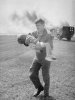
One of many riveting images of the accident, then-LtCol Dennis Nielsen...an A-7 fighter pilot from the ANG wing....carries 3 yr old Spencer Bailey to a waiting USAF ambulance. Bailey and his brother survived the accident, while their mother was killed. This snapshot, taken among many, became the centerpiece of a memorial dedicated to the accident.
 

Attachments

  • spencer_bailey.jpg
    spencer_bailey.jpg
    8.6 KB · Views: 80
  • Flightmemorial-231x358.jpg
    Flightmemorial-231x358.jpg
    18.7 KB · Views: 84
While hearing from Al Haynes and Denny Fitch speak on their experiences on UA232 is very interesting; hearing some of the other sides of that tragedy it exceptionally interesting too. During firefighter training, I got to hear retired SMSgt Jim Hathaway, who was the fire chief of the (then) 185th Tactical Fighter Wing fire department/crash rescue speak about the CFR response and challenges faced during the crash of 232.

Lots of lessons learned from that accident from that angle. Even from VERY important things such as the specific CFR response itself, as well as completely failed equipment during the firefighting effort, which the 232 accident highlighted.

One of many riveting images of the accident, then-LtCol Dennis Nielsen...an A-7 fighter pilot from the ANG wing....carries 3 yr old Spencer Bailey to a waiting USAF ambulance. Bailey and his brother survived the accident, while their mother was killed. This snapshot, taken among many, became the centerpiece of a memorial dedicated to the accident.

To expand on that a little... from a municipal tactical response standpoint, there were some amazing advances made from that incident. Inter-departmental communications weren't very well managed among separate government departments and counties' emergency crews back then. Many agencies had more money than others and were able to afford better equipment than others. While the response to 232 was actually phenomenal across various emergency response agencies in the area, it highlighted some clear gaps in how agencies communicate with one-another, leading to better incident management. Aside from the amazing CRM and aircraft piloting lessons-learned, there was a whole different angle from the ground based operations that make that incident monumental.
 
Aside from the amazing CRM and aircraft piloting lessons-learned, there was a whole different angle from the ground based operations that make that incident monumental.

Yes. The support aspect, as well as the tactical on-scene aspect garnered many lessons. It was interesting hearing Chief Hathaway outline the myriad numbers of challenges his crews had to face and work around.
 
You know what one of the things that Haynes said that really caught my attention was?

He said they were lucky.

Lucky that it took place during the day. Lucky that it took place when there were no thunderstorms. Lucky that the Iowa national guard was doing an exercise at the airport. Lucky that the crash took place during a shift change at the hospital, which allowed them to have double the medical staff available to help.

Of course luck played a huge role with UA232 as is does with all incidents like these. What's so refreshing is that it's Al Haynes who speaks about it. It's pretty typical of Haynes to pass out the credit to everyone and everything else involved besides himself. His humility and modesty is what people remember most when meeting him.
(Think Sully ever used the world "lucky" during his victory tour? :D Sorry couldn't resist ;))

There is a great interview with Al, Bill and Dudley from KCAU.
When you get the written summary of the story go to the bottom of the page and click on the video icon. Awesome to see these guys together again after 20 years. http://www.kcautv.com/Global/story.asp?S=10752107
 
To expand on that a little... from a municipal tactical response standpoint, there were some amazing advances made from that incident. Inter-departmental communications weren't very well managed among separate government departments and counties' emergency crews back then. Many agencies had more money than others and were able to afford better equipment than others. While the response to 232 was actually phenomenal across various emergency response agencies in the area, it highlighted some clear gaps in how agencies communicate with one-another, leading to better incident management. Aside from the amazing CRM and aircraft piloting lessons-learned, there was a whole different angle from the ground based operations that make that incident monumental.

Very true. In the Sioux city area they now have a center set up with state of the art communications to facilitate disaster management among various agencies and counties. Communications or a lack thereof between departments was a huge problem during 232. Gary Brown, who was a 1st responder with 232 and now runs this center speaks all over the country about disaster planning and response coordination.
 
Very true. In the Sioux city area they now have a center set up with state of the art communications to facilitate disaster management among various agencies and counties. Communications or a lack thereof between departments was a huge problem during 232. Gary Brown, who was a 1st responder with 232 and now runs this center speaks all over the country about disaster planning and response coordination.

Comms is always one of the first things to go to hell in a handbasket in an emergency
 
Back
Top