Why Does TAS Decrease with Altitude?

Vflyer

Well-Known Member
So I'm staring at the auto-generated nav-log from fltplan.com and I'm seeing the TAS value decrease with altitude. 3500 = 115kts, 5500 = 112kts, 7500 = 110kts, etc. This is my first time using it to assist with flight planning, but I'm sitting here scratching my head as this goes against my understanding of true airspeed. Assuming my indicated is the same (which may not be an accurate assumption), wouldn't it be increasing with altitude? Based off this, in a no wind situation, the fastest flight times occur flying the plane basically on the ground.

I'm sure this question is painfully dumb, but I just can't put my finger on what I'm not understanding.
 
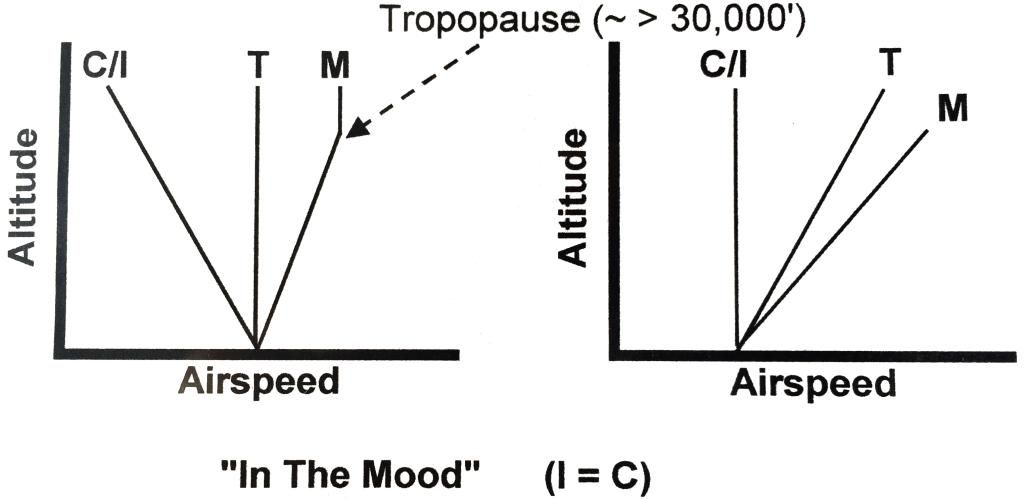
As you climb;

Constant IAS = increasing TAS

Constant Mach = decreasing TAS

The speed of sound is dependent on temperature. Colder = slower. 39 times the square root of the absolute temp (Degrees kelvin)


Same MACH number at warmer temps = faster TAS. Engine output is the limiting factor as it gets warmer. Colder makes for better engine output but lower speed of sound thus the same MACH is a slower TAS.


Sent from my iPhone using Tapatalk
 
What type of airplane? With a constant IAS the TAS will increase with altitude, but if it's in a small piston single, it's probably limited by power so the IAS is decreasing with altitude.
 
Last edited:
990D7108-83CD-4D4D-924D-9E13952507E3_zpsuhvp9hsf.jpg
 
The airplane in question in the OP is a small piston single (i.e 172). Does this mean the TAS figures aren't relevant? I would imagine this will skew the ETE times since the GS would be determined off that.

Edit: I just reread your post and didn't realize the IAS was decreasing in such a way between 0 and say 7500 feet. Seems like best times then would be achieved at near sea level then?
 
What type of airplane? With a constant IAS the TAS will increase with altitude, but if it's in a small piston single, it's probably limited by power so the IAS is decreasing with altitude.

Don't think of it terms of aircraft type. The physics doesn't care. Jets are normally aspirated engines too.

All things being equal, go up to go faster, go up high enough you stop going faster.

In a jet you can get a round about idea of why flying higher is more efficient. Look at your fuel flow at 450, set that same fuel flow at 10000 feet. You will get roughly the same IAS but your TAS is much slower down low.


Sent from my iPad using Tapatalk
 
Don't think of it terms of aircraft type. The physics doesn't care. Jets are normally aspirated engines too.

All things being equal, go up to go faster, go up high enough you stop going faster.

In a jet you can get a round about idea of why flying higher is more efficient. Look at your fuel flow at 450, set that same fuel flow at 10000 feet. You will get roughly the same IAS but your TAS is much slower down low.


Sent from my iPad using Tapatalk

I didn't mean to quote you, I understand all that, I'm telling him in this specific situation he's probably seeing a reduction in TAS because his airplane is power limited and he's seeing a reduction in IAS.
 
I didn't mean to quote you, I understand all that, I'm telling him in this specific situation he's probably seeing a reduction in TAS because his airplane is power limited and he's seeing a reduction in IAS.

I gotcha. I thought new was running numbers and was getting erroneous data. Disregard.


Sent from my iPad using Tapatalk
 
Above about 6k you won't be able to get max cruise power out of the engine.

Looking at the POH it seems that 65% power can be maintained up to 12000 feet. The performance chart seems to show with a 1kt increase in TAS with each 2000 increase in altitude assuming standard conditions. Are you saying fltplan.com is assuming max power?
 
Above about 6k you won't be able to get max cruise power out of the engine.
Bingo. The "understanding " that TAS increases with altitude is subject to a common misunderstanding. It's not that TAS increases with altitude, it is that TAS increases in altitude for the same IAS. that assumes you have enough power to maintain that IAS. Above a certain sweet spot altitude, a normally aspirated piston simply can't.
 
Edit: I just reread your post and didn't realize the IAS was decreasing in such a way between 0 and say 7500 feet. Seems like best times then would be achieved at near sea level then?

Check out the cruise performance numbers for your plane. Most single engine pistons have their sweet spot (fastest TAS at cruise power) in the 6000' -7000' range at standard temp.
 
Are you saying fltplan.com is assuming max power?
FYI fltplan.com is an awesome site, but it is user input, so it is garbage in, garbage out.

Go to:
Settings
A/C Performance
Then select your aircraft and verify its performance matches the book numbers (or your particular aircraft if you have speed mods, etc).

This will take the default profile and both make it more accurate as well as match your airplane. Then adjust it based on actual flights (maybe it's for 75% power and you use 65%, etc). A lot of jets will have multiple profiles for high speed cruise, long range cruise, etc.
 
Kind of one of the reasons I went back to ForeFlight.
That's interesting...ForeFlight's flight planning is weak compared to FltPlan.com. Given correct numbers FltPlan is incredibly accurate...I've done a 4:45 flight and been within 50 lbs of my planned fuel burn in a light jet. ForeFlight uses a dumbed down planning system...fine if you're trolling around your state in a Skyhawk, a little lacking beyond that.

ForeFlight makes a pretty good app, no doubt (though I have FltPlan Go as well since they have Canadian charts...and are free).
 
That's interesting...ForeFlight's flight planning is weak compared to FltPlan.com. Given correct numbers FltPlan is incredibly accurate...I've done a 4:45 flight and been within 50 lbs of my planned fuel burn in a light jet. ForeFlight uses a dumbed down planning system...fine if you're trolling around your state in a Skyhawk, a little lacking beyond that.

ForeFlight makes a pretty good app, no doubt (though I have FltPlan Go as well since they have Canadian charts...and are free).

It's just the app portion fltplan was lacking for me, and the occasional crashes, although I do agree when performance data is on point, it's amazing. Just renewed FF for another year as I'm working on my CFI ratings and it's a bit more widely used around me.


Sent from my iPhone using Tapatalk
 
I currently have and run ForeFlight, FltPlan Go, Jeppview, iPreFlight, and AeroWeather, plus digital copies of all the airplane manuals...just wanna cover my bases haha.
 
You must be rich [emoji23] more than likely I'll go back to FltplanGo at the end of the year. When it first came out, I was promoting it heavily among fellow students but then it would just crash in the middle of an instrument XC and I'd look like an ass. When people try something new based on recommendation, it's like the recommending person coded the app. One other thing that's great about Fltplan Go is that it's approach charts. They are all high quality and high definition, you can zoom to the tiniest details of it.


Sent from my iPhone using Tapatalk
 
Back
Top